The Panamanian golden frog may already be gone from the wild. No confirmed sighting has been made since 2006–2007, even though the IUCN still lists the species as Critically Endangered rather than Extinct.
It is not actually a frog but a true toad, a member of the family Bufonidae, and it once lived along fast-moving streams in the Cordilleran cloud forests of west-central Panama. Between its lethal skin toxins, its silent hand-waving "conversations," and the scale of the rescue effort now keeping it alive only in captivity, it is a species whose story runs far deeper than its brilliant color.
Identification and Appearance
The single best field mark is the skin itself: a smooth, glossy coat ranging from light yellow-green to bright gold, sometimes overlaid with irregular black spots on the back and legs. This coloring is not just decorative — it signals toxicity to anything that might try to eat the frog.
Size differs between the sexes. Females run larger, measuring 45 to 63 mm (1.8–2.5 in) long and weighing 4 to 15 g (0.14–0.53 oz), while males are smaller and lighter, at 35 to 48 mm (1.4–1.9 in) and 3 to 12 g (0.11–0.42 oz).
The body plan is typical of Atelopus: a compact, slightly flattened frame with slender limbs adapted for clinging to wet rock rather than swimming or leaping far. Black spotting is variable — some individuals show heavy markings, others are almost uniformly gold.
The species was originally described as a subspecies of Atelopus varius before being split out as its own species, so historical records and museum specimens sometimes group the two together.
Distribution and Habitat
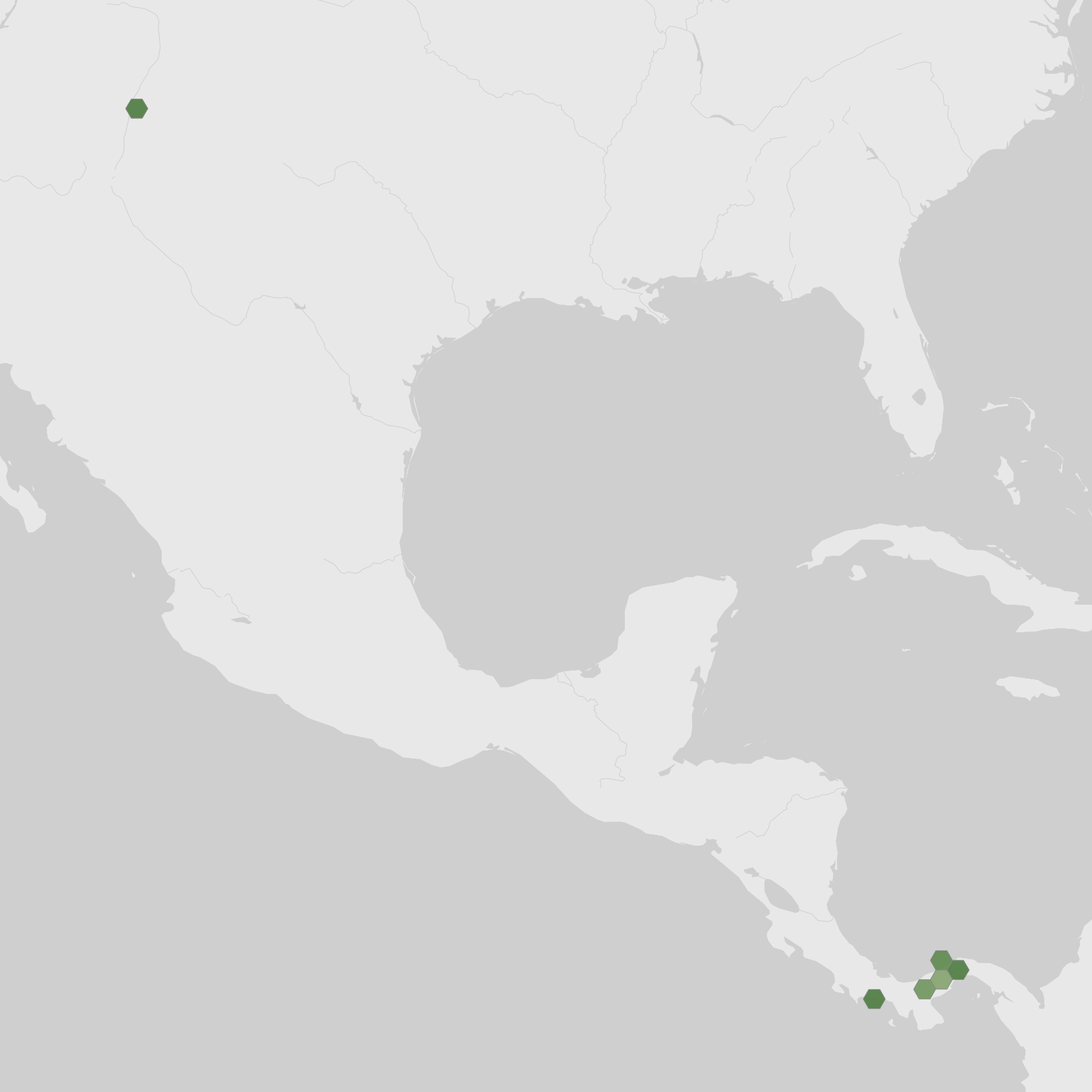
Atelopus zeteki is endemic to a narrow strip of Panama, historically found along mountain streams on the eastern slopes of the Tabasará range in Coclé and Panamá provinces. Its range once reached as far east as El Copé in western Coclé before that population collapsed abruptly in 2004.
The frogs depended on cool, fast-flowing streams within Panama's cloud forest belt, a habitat defined by near-constant moisture and moderate elevation. Much of this terrain has been lost to small farms, commercial agriculture, livestock grazing, and residential and industrial expansion, squeezing the remaining habitat year by year.
GBIF-style monthly observation counts show a sharp spike of 188 records in one month and a smaller rise of 40 in another, with very few sightings in between. These figures reflect presence records, not abundance or population size, and given the species' likely disappearance from the wild, they probably trace captive populations and survey effort as much as any wild seasonal pattern.
Today the species survives mainly in more than 50 captive-breeding institutions across North America and Panama rather than in its former streamside range.
Behavior and Lifestyle
Male Atelopus zeteki are strongly territorial, holding the same streamside site for most of their lives and defending it through a mix of vocal and visual signaling. Lacking a normal ear membrane, males still respond to pulsed calls from rival males, turning toward the sound and calling back — a striking case of directional hearing without a tympanum.
When a rival male encroaches, the resident often escalates from calling to physically confronting the intruder, waving its forefeet in what functions as a semaphore signal of aggression. The same hand-waving gesture, along with soft calls, is used toward potential mates in a gentler context.
Activity patterns shift between day and night. Adult males patrol the ground near streams during the day but climb into trees to perch after dark, likely because they can feel an approaching predator's weight on a branch or hear it move, compensating for poor night vision.
When threatened, the frog waves and lifts a foot toward the predator, drawing attention to its warning coloration rather than fleeing immediately. If the threat persists, the waving and calling intensify. This defense is not foolproof — the colubrid snake Erythrolamprus epinephalus is able to metabolize the frog's toxin and preys on it regardless.
Population and Ecological Role
An individual Atelopus zeteki can live around 12 years, developing through four distinct life stages: larva, juvenile, subadult, and adult. Breeding centers on the stream itself — males stay close to the water and use soft calls to attract mates, then grab a passing female in amplexus, which can last from a few days to several months before she lays eggs in the shallows.
Tadpoles hatch within 2 to 10 days and live entirely in water, clinging to rocks with a suction-cup belly in pools below cascades rather than venturing into the main current. They graze on algae for 6 to 7 months while growing, making them small but steady algae consumers within the stream's food web. Their dark, golden-flecked skin during this stage helps protect them from sun exposure.
Outside the breeding season, males remain near the streams while females retreat into the surrounding forest, a division that spreads the species' presence across both aquatic and terrestrial parts of the cloud forest habitat it once occupied.
Conservation and Threats
The Panamanian golden frog is listed as Critically Endangered, though it may in practice already be extinct in the wild — the last individuals were filmed for the BBC series Life in Cold Blood in 2006, and none have been confirmed in nature since. The decline began in the late 1990s and accelerated sharply once the fungal disease chytridiomycosis reached El Valle around 2006, collapsing populations within a short span.
Beyond the fungus, habitat loss from agriculture, livestock range expansion, and development has steadily eaten into the species' limited stream habitat, compounded by pollution, pet-trade collection, and aquaculture pressure. No treatment currently controls chytridiomycosis in the wild; one attempt to protect frogs using the bacterium Janthinobacterium lividum failed because the species' skin proved unsuitable for it.
Conservation now runs almost entirely through captivity. The Amphibian Recovery Conservation Coalition exported frogs to the United States starting in 2004, the Houston Zoo established the El Valle Amphibian Conservation Center (EVACC) in Panama in 2005, and the San Diego Zoo has bred roughly 500 individuals since receiving its first frogs in 2003, holding them until the disease threat eases enough for release. Project Golden Frog coordinates education, research, and fundraising across institutions in Panama and the United States.
Conservation status
- LC
- NT
- VU
- EN
- CR
Critically Endangered
Cultural Significance
The Panamanian golden frog functions as a national symbol, its image appearing on lottery tickets and throughout Panamanian art and craft. Local belief holds that the frog turns to gold upon death and brings good luck to anyone who witnesses it, a tradition traced back to golden and clay talismans called huacas carved by Pre-Columbian peoples in the frog's likeness.
Since 2010, Panama has formally marked August 14 as National Golden Frog Day, celebrated with a parade through the streets of El Valle de Antón and a public display of the frogs at the El Nispero Zoo's EVACC facility.
The frog's toxic skin has practical history as well as symbolic weight: native peoples of the Panamanian forests used it for centuries to prepare arrow poison. More broadly, harlequin frogs of the genus Atelopus appear in indigenous folklore across parts of Central and South America, sometimes linked to rain and fertility.
Fun Facts
- Despite the name "frog," Atelopus zeteki is classified as a true toad in the family Bufonidae.
- It has no eardrum at all, yet males can still tell which direction a rival's call is coming from — a form of hearing scientists find hard to explain without a tympanum.
- Its skin toxins include zetekitoxin AB, a compound that blocks sodium channels far more potently than saxitoxin and can be lethal to mice within 20 to 30 minutes at high doses.
- The species communicates partly through semaphore-like hand-waving, a trait thought to have evolved because the roar of fast mountain streams drowns out vocal calls.
- It was filmed in the wild for the final time in 2006 for David Attenborough's Life in Cold Blood, and the filming location was kept secret to protect the last individuals from poachers.
Ecology
Habitat
- Forest
- Mountain
- Freshwater
Behavior
- Solitary
- Territorial
- Diurnal
- Semi-aquatic