A common frog can live for as long as 27 years in the wild, an unusual lifespan for an amphibian small enough to sit in a human palm.
The common frog, or grass frog (Rana temporaria), is a semi-aquatic amphibian in the family Ranidae. It ranges across most of Europe, from Ireland in the west to the Urals and beyond into Asia and Japan, and reaches as far north as Scandinavia inside the Arctic Circle. The IUCN lists it as Least Concern, reflecting how common and widely distributed it remains.
Despite its familiarity in garden ponds and woodland edges, the species shows striking regional quirks: black and red color morphs turn up in Scotland, and albino individuals with yellow skin and red eyes have been documented. That variability, paired with a life history built around sudden spring breeding frenzies and long winter dormancy, makes it a far more interesting animal than its everyday presence suggests.
Identification and Appearance
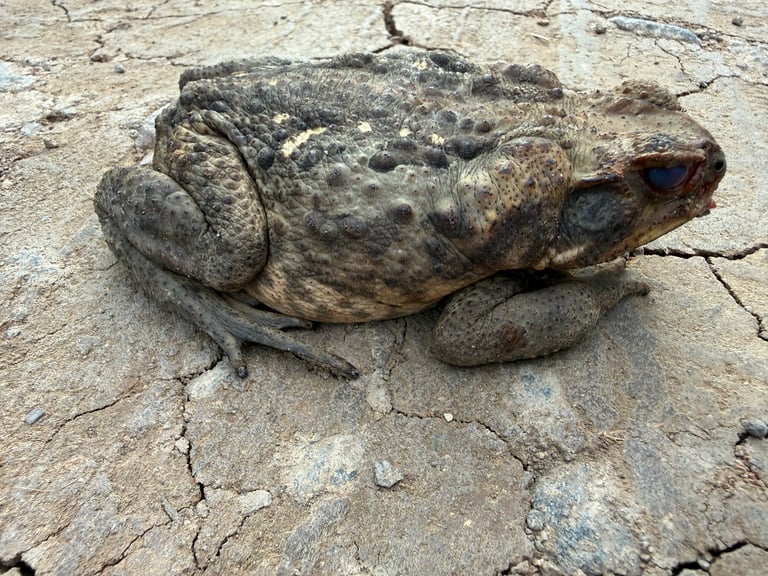
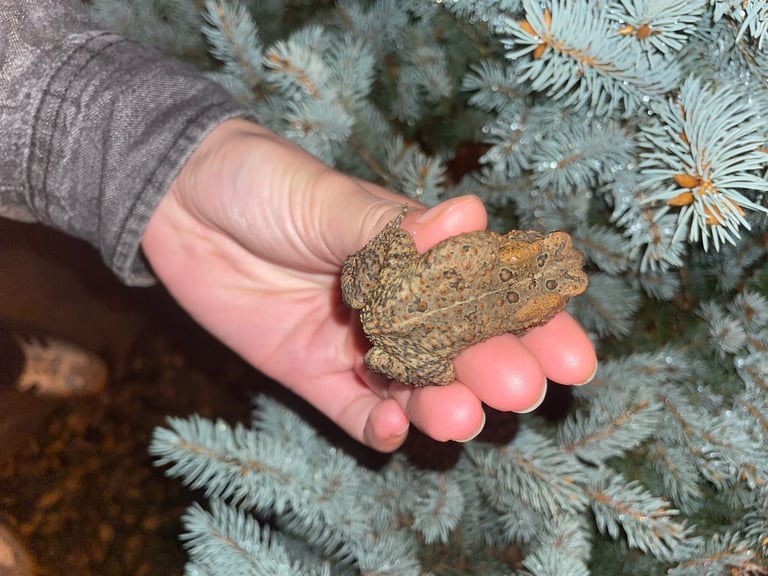
The clearest field mark is the dark chevron-shaped spot on the back of the neck, combined with a dark mask running from the snout through the eye to the eardrum. Adults measure roughly 6 to 10 centimeters in body length and weigh around 22.7 grams on average, with females usually slightly larger than males.
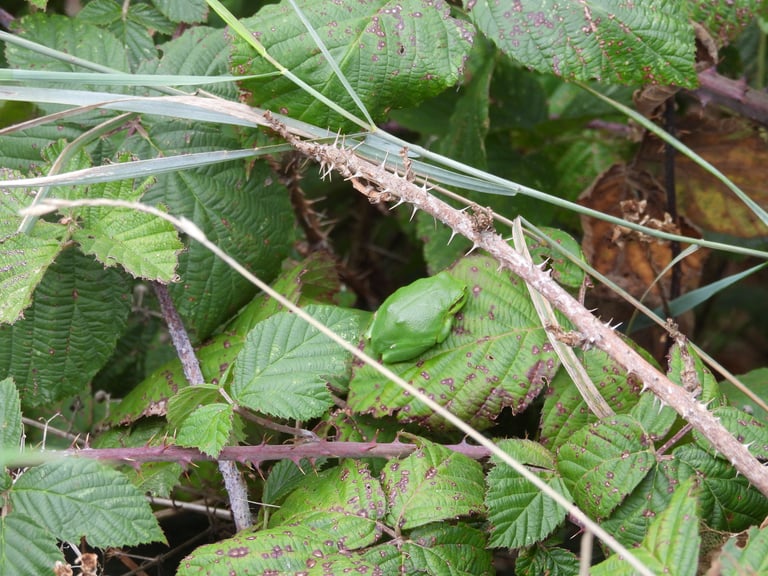
Back and flank color is highly variable, ranging from olive green, grey-brown and brown to olive brown, grey, yellowish or rufous, and the frog can lighten or darken its skin to match its surroundings. Irregular dark blotches cover the flanks, limbs and back, and the underside is white or yellow, sometimes speckled with brown or orange, with females occasionally showing more orange tones. Unlike some relatives, common frogs generally lack a strong mid-dorsal stripe; when present, it is faint. The eyes are brown with horizontal pupils and are protected by transparent inner eyelids for use underwater.
Sex and season change the picture. During the breeding season males turn greyish-blue with a whitening throat, and their forelimbs develop hardened nuptial pads on the first digits, used to grip females during mating. Females tend to stay browner, sometimes with reddish tones.
The common frog's longer hind legs (relative to the common toad) can cause confusion with the agile frog, which shares part of its range. The agile frog is distinguished by even longer hind legs and paler, less blotched coloration. Where present, the moor frog's light dorsal band offers another easy way to separate that species from the common frog, which normally lacks such a band.
Distribution and Habitat
The species occurs across most of Europe, from Ireland in the west to the Ural Mountains in the east, and eastward through Asia to Japan, reaching as far north as Scandinavia inside the Arctic Circle. It is largely absent from most of the Iberian Peninsula, southern Italy and the southern Balkans, though it has been introduced to island groups such as Shetland, Orkney, the Faroe Islands and the Isle of Lewis. In Ireland, genetic evidence suggests some southwestern populations are native survivors from ice-free refugia rather than purely later introductions.
It uses a wide range of damp habitats, breeding in puddles, ditches, ponds, large lakes, running water, and both rural and urban garden ponds. Outside the breeding season it lives a solitary life in wet meadows, riparian grass and cool upland forest, and it is often the most common frog found around mountain lakes.
Monthly observation counts show a sharp rise from a low of around 4,300–7,000 sightings in November and December to a peak of roughly 168,600 in March, tapering through the summer to about 23,000 in October. Read cautiously, since these are presence records rather than population counts, this pattern lines up with the species' known habit of emerging from hibernation and migrating to breeding ponds in late winter and early spring across much of its range.
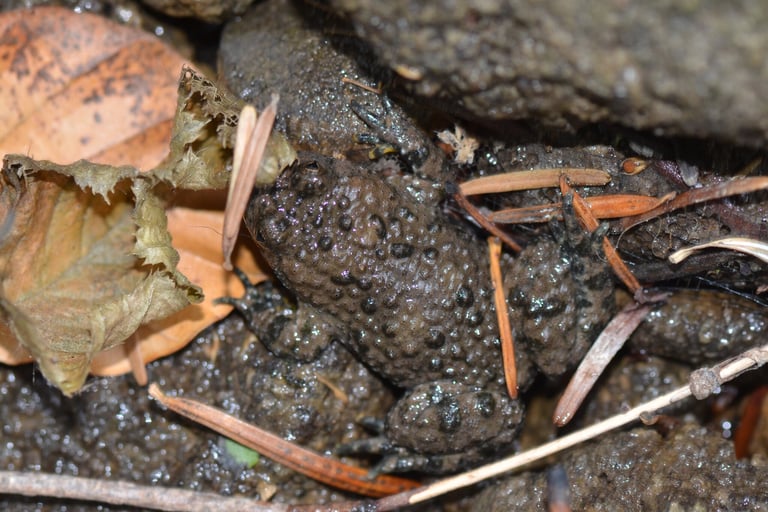
Hibernation timing itself varies with climate: British frogs typically hibernate from late October to January and re-emerge as early as February, while populations in harsher settings such as the Alps may not emerge until early June. Hibernation sites include running water, muddy burrows, and layers of decaying leaves and mud at the bottom of ponds or lakes, where oxygen absorbed through the skin sustains the motionless frog.

Behavior and Lifestyle
Common frogs spend most of the year active, hiding in damp places by day and searching for food at night or during rain, only retreating into hibernation during the coldest months. Outside the breeding season they are solitary, sheltering in wetland niches near ponds and marshes or among long riparian grass, sometimes wandering well away from open water.
They are not territorial in the way some animals are, and males show no physical fighting over space; instead, competition plays out through speed and positioning during the brief breeding window. Frogs can recognize other individuals of their own kind, and tadpoles develop a strong innate tendency to associate with conspecifics once they reach a certain age, without needing prior social contact to learn it.
Aggregation is largely a response to environmental pressure rather than sociability for its own sake: frogs cluster together when temperature or predation risk pushes them toward the same sheltered spots. About three years after metamorphosis, individuals return to the pond where they themselves developed, a homing behavior tied closely to their reproductive cycle.
Hunting and Diet
Common frogs locate much of their prey by smell, most notably detecting earthworms this way before seizing them. Beyond worms, they take insects and their larvae, wood lice, spiders and snails, hunting mainly after dark or during wet weather when prey is more active on damp ground.
What ends up on the menu shifts strongly with the time of year, tracking which invertebrates are available as conditions change through spring, summer and autumn. This flexible, season-driven foraging lets the species exploit a broad range of damp habitats rather than relying on any single prey type.
Reproduction and Life Cycle
Breeding begins when a relatively cold spring triggers hormonal changes: the pituitary gland responds to rainfall, day length and temperature by prompting egg and sperm production, while males develop swollen, pigmented nuptial pads. Spawning generally runs from late February to late June depending on latitude and altitude, most commonly in April, in shallow, still, fresh water such as ponds.
Males arrive at the breeding pond first and wait for females, creating a short period of intense male-dominated competition; larger males tend to hold the shallow water most suitable for egg-laying, while smaller males often search for mates on land or in less favorable parts of the pond. Once a male finds a female he clasps her in amplexus and will not release her until she has finished laying; males with longer thumbs tend to have higher mating success because of the better grip this gives them. The whole breeding period is short, with hundreds of eggs laid within about three nights.
A female produces roughly 400 eggs at a time, laid in thick clumps within gelatinous envelopes, and fertilization happens externally as the male releases sperm over the eggs. The eggs hatch after about 30 to 40 days. Tadpoles then go through metamorphosis, growing hind legs first, followed by front legs, absorbing the tail, losing their gills, developing lungs, and reorganizing the digestive system, heart and skeleton.
No parental care follows spawning; adults abandon the eggs entirely. Individuals reach sexual maturity at around three years of age (roughly 1,095 days for both sexes) and then return to their birth pond to breed themselves.
Population and Ecological Role
Common frogs sit in the middle of a long food chain: their tadpoles are eaten by fish, diving beetles, dragonfly larvae and birds, while adults face predation from storks, birds of prey, crows, gulls, ducks, terns, herons, pine martens, stoats, weasels, polecats, badgers, otters and snakes. Domestic cats kill some adults but rarely eat them, and road traffic accounts for large numbers of deaths.
By feeding heavily on insects, the species plays a practical role in controlling mosquito populations and other crop-damaging insects, which gives it direct value in both natural and human-altered landscapes. Its abundance and wide distribution have also made it a standard laboratory subject for studying vertebrate anatomy and embryonic development.
Genetic studies show that populations become less numerous and less variable toward the edges of the species' range, with genetic differentiation declining as latitude increases, a pattern linked to strong selective pressure for behavioral thermoregulation in colder climates.
Conservation and Threats
The IUCN lists the common frog as Least Concern, reflecting its wide distribution across Europe and northwest Asia and its continued abundance overall, even though local populations can be unstable.
The most serious threat is Ranavirus, which causes skin ulceration and hemorrhaging and can kill more than 90 percent of an affected population; deaths occur at every life stage but cluster in summer. Disturbance of breeding ponds, unusually hard freezes, and pollution from herbicides can also wipe out regional populations. Urbanization compounds these pressures: roads and buildings act as absolute barriers to migration, cutting gene flow between urban populations and leaving them with lower genetic diversity, higher mortality and more developmental abnormalities than rural frogs, a sign of forced inbreeding.
No special protections apply under the US Federal List or CITES, and no dedicated recovery program is described.
Conservation status
- LC
- NT
- VU
- EN
- CR
Least Concern
Cultural Significance
In European folk tradition the common frog has long stood as a symbol of rebirth, appearing in medieval bestiaries alongside alchemical imagery that linked frogs to transformation. Its association with renewal likely echoes the amphibian's own life cycle, from egg to tadpole to terrestrial adult.
The species' cultural presence stretches back far earlier: an engraved shale image from Gönnersdorf, dated to around 12,000 BC, shows a frog identified as either Rana arvalis or Rana temporaria jumping to catch prey, among the earliest known depictions of a frog.
Beyond folklore, the common frog has practical value to people. Its appetite for mosquitoes and crop-damaging insects benefits agriculture, it is a standard teaching subject for vertebrate anatomy and embryology, and its populations are monitored by ecologists as an indicator of ecosystem health. In parts of Europe, frog legs are also eaten as a delicacy.
Fun Facts
- Both black and red color morphs of the common frog have been recorded in Scotland, alongside albino individuals with yellow skin and red eyes.
- Males turn greyish-blue with whitening throats during the breeding season, a temporary color change tied entirely to mating.
- Transparent inner eyelids let the frog protect its eyes while swimming underwater.
- A shale engraving from Gönnersdorf, roughly 12,000 BC, may be the oldest known depiction of a frog, showing it jumping to catch prey.
- Genetic diversity in common frog populations declines steadily toward the edges of the species' range, a pattern linked to the demands of surviving colder climates.
Ecology
Habitat
- Wetland
- Forest
- Mountain
- Freshwater
Behavior
- Nocturnal
- Predator
- Solitary
- Semi-aquatic
Diet
- Insectivore
Photos
SourcesGBIFiNaturalistWikidataWikipediaEncyclopedia of LifeAnimal Diversity WebAnAge