Genetic studies have redrawn the map of this frog: populations once lumped together across Europe, Asia, and North Africa turn out to be separate species, narrowing the true Hyla arborea to a range stretching from France to Poland and Greece.
This amphibian belongs to the order Anura and the family Hylidae, within the class Amphibia. The IUCN lists it as Least Concern, reflecting its still-wide distribution across much of Europe.
Its taxonomic story, still being revised as genetic tools improve, makes it a useful case study in how species boundaries are drawn in modern herpetology.
Identification and Appearance
A dark brown stripe running from each eye to the groin, sharply dividing the dorsal skin from the whitish underparts, is the clearest field mark for a European tree frog.
Males measure 32–43 mm (1.3–1.7 in) in length, while females are somewhat larger at 40–50 mm (1.6–2.0 in). The body is slender with notably long legs, and the head is rounded with a lip that drops sharply, a horizontal elliptical pupil, and a clearly visible tympanum.
Dorsal skin is smooth and can shift between green, gray, or tan depending on temperature, humidity, or the frog's mood, while the ventral skin is granular and whitish.
The sexes differ in throat color and voice structure: females have plain white throats, while males show golden-brown throats with large, folded vocal sacs used for calling. Adhesive discs on the toes let the frog grip trees and hedges, and its hind legs, much larger and stronger than the forelimbs, power the rapid jumps it uses to move and hunt.
Distribution and Habitat
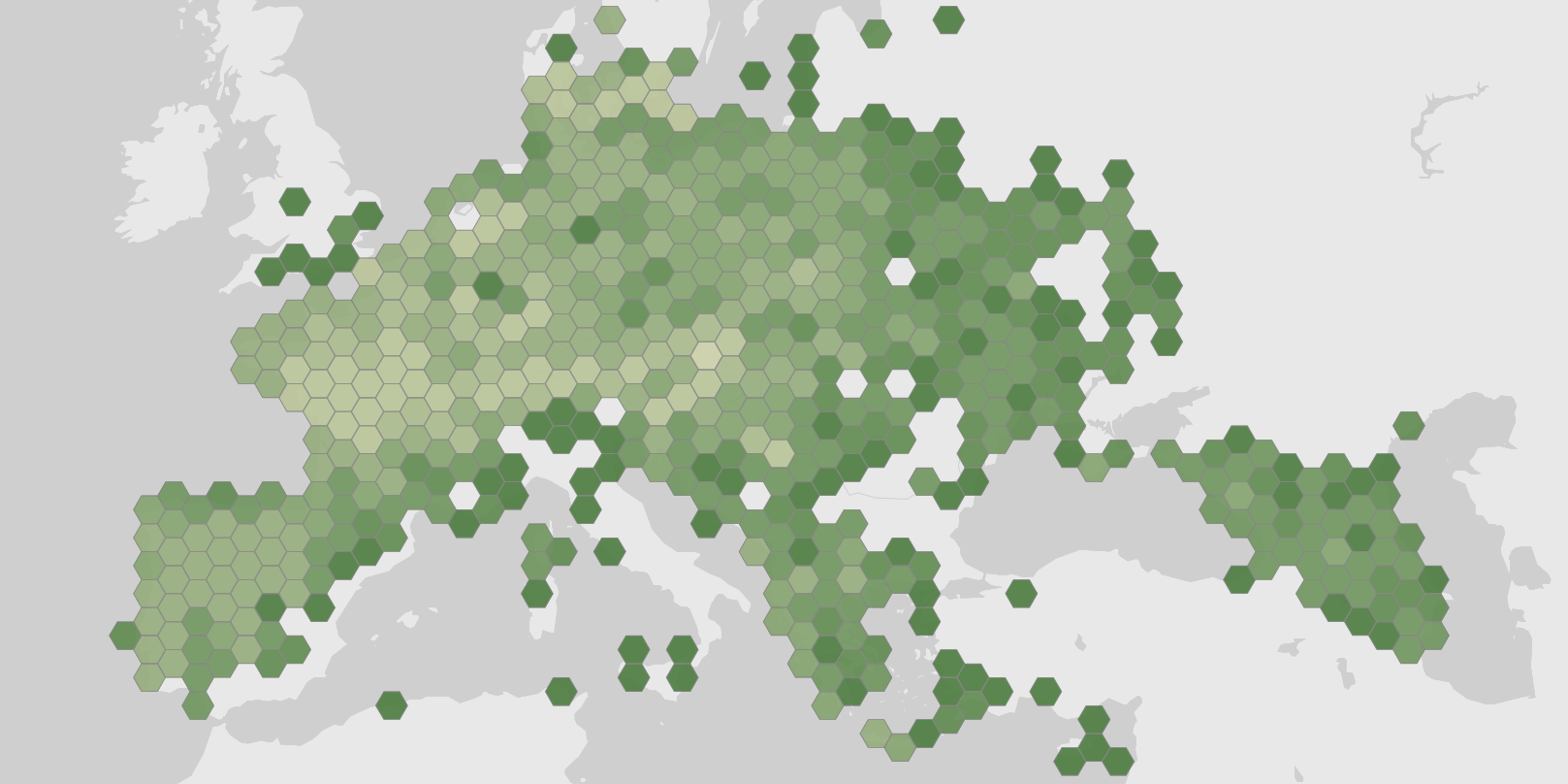
The European tree frog occurs across most of mainland Europe, from France east through Germany, Poland, the Balkans, and Greece, with records extending into countries such as Austria, Belgium, Bulgaria, Croatia, the Czech Republic, Hungary, Italy, Portugal, Romania, and Ukraine, among others. It was introduced to the United Kingdom, where it is legally classed as non-native and is now thought to be extinct.
It uses a broad mix of habitats, including marshlands, damp meadows, reed beds, stream banks, and lake shores, alongside human-influenced sites such as parks, gardens, vineyards, and orchards. It also occupies humid or dry forests but tends to avoid dark, dense woodland, and it can tolerate periods of dryness better than many other amphibians.
Monthly observation counts rise sharply in spring, peaking in May at nearly 48,000 records after a climb from just over 26,000 in April, before falling off through summer and dropping to a low of around 100–500 records in November and December. This pattern most likely tracks the breeding season, when calling males become far easier to detect, rather than reflecting true seasonal abundance or the species' complete range.
Behavior and Lifestyle
Historically, people used this frog as a living barometer, since it tends to croak more when rain is approaching, a habit tied to its sensitivity to changing humidity and pressure.
Skin color shifts between bright and olive green, gray, brown, and yellow depending on the subspecies, temperature, humidity, and the frog's mood, a flexible response that likely aids both thermoregulation and camouflage.
Most of its diet comes from fast-flying insects such as flies and butterflies, along with spiders, beetles, and smooth caterpillars; its long, powerful leaps let it intercept prey in midair rather than relying on ambush from a fixed position.
To survive colder months, individuals hibernate in sheltered spots such as walls, cellars, under rocks, beneath clumps of vegetation, or buried within leaf piles or manure piles.
Reproduction and Life Cycle
Breeding runs from late March to June, when frogs move to stagnant or slow-moving waters such as lakes, ponds, swamps, reservoirs, and sometimes puddles. Males often croak even while migrating toward these sites, then call females from low vegetation or shallow water after spring rain; a single male may shift between different breeding ponds within one season.
Females lay 800 to 1,000 eggs in clumps roughly the size of a walnut, with each individual egg about 1.5 mm across.
Eggs hatch after 10 to 14 days, and the resulting tadpoles take about three months to metamorphose into frogs, with most transformations peaking from late July into early August.
European tree frogs can live up to 15 years in the wild, and some records show individuals reaching 22 years.
Conservation and Threats
The IUCN classifies Hyla arborea as Least Concern, based on its wide distribution and presumed large population, though the IUCN also records its overall population trend as decreasing.
The most significant threats are habitat fragmentation and destruction, wetland pollution, and predation by introduced fish; trout introduced into breeding ponds have been linked to sharp population declines. Capture for the pet trade and climate change add further pressure, alongside secondary factors such as increased UVB radiation, pesticides, fertilizers, and other pollutants.
Since the 1980s, habitat restoration has helped rebuild populations, supported by the construction of new breeding ponds, the creation of habitat corridors linking breeding sites, and reintroduction programs. These measures have succeeded in Sweden, Latvia, and Denmark, and habitat protection is regarded as the single most important tool for conserving the species.
Conservation status
- LC
- NT
- VU
- EN
- CR
Least Concern
Cultural Significance
The genus name Hyla comes from the Greek word hyle, meaning "wood" or "forest," tying the frog's name to imagery of nature and woodland.
The name also honors Hylas, the young companion of Hercules in Greek mythology, remembered for his beauty and his tragic disappearance while fetching water; the genus name Hyla is grammatically feminine.
Fun Facts
- Hyla arborea sits in a small clade with two other Eurasian tree frogs, Hyla annectans and Hyla savignyi, which together form the sister group to a much larger clade of 11 North American Hyla species plus the Asian Hyla japonica.
- In the myth behind its genus name, Hylas vanished after water nymphs, drawn in by his beauty, pulled him into a spring while he was fetching water for Hercules.
- Male-male competition, not only female choice, appears to shape mate quality in this species, a pattern studied far less often than female mate selection in frogs.
Ecology
Habitat
- Wetland
- Forest
- Freshwater
- Grassland
Behavior
- Predator
- Hibernating
- Arboreal
Diet
- Insectivore