When a predator gets too close, the European fire-bellied toad doesn't flee — it flips onto its back and flashes a belly of blazing red and black, daring the attacker to try its luck. This bluff, backed by real toxins in the skin, is one of the clearest examples of aposematism among European amphibians.
A member of the family Bombinatoridae within the order Anura, Bombina bombina is native to Central and Eastern Europe, where it lives around ponds, marshes and other still waters. The IUCN lists it as Least Concern, but that broad label hides a species that has vanished from parts of its former range even as it survives, sometimes thrives, elsewhere. Between its aposematic display and its distinctive nighttime "whoop" calls, this toad offers a small but vivid case study in how amphibians defend themselves and adapt to changing landscapes.
Identification and Appearance
The most reliable way to identify this species is its belly: a vivid red background heavily mottled with thick black blotches, visible mainly when the animal is disturbed and performs its defensive display. This posture, known as the Unkenreflex, involves the toad arching its back, lifting its limbs, or even flipping fully onto its back to expose the colored underside to a predator.
Bombina bombina is a medium-sized frog, reaching up to about 5.6 centimeters in length. Its back is rough with warts and its dorsal color ranges from gray to brown to green, giving it effective camouflage against mud, leaf litter and vegetation near water. The contrast between the drab, textured upper body and the alarming red-and-black underside is the species' defining feature.
No details on sex, age or seasonal color variation are documented for this species beyond the general body plan described above.
Distribution and Habitat
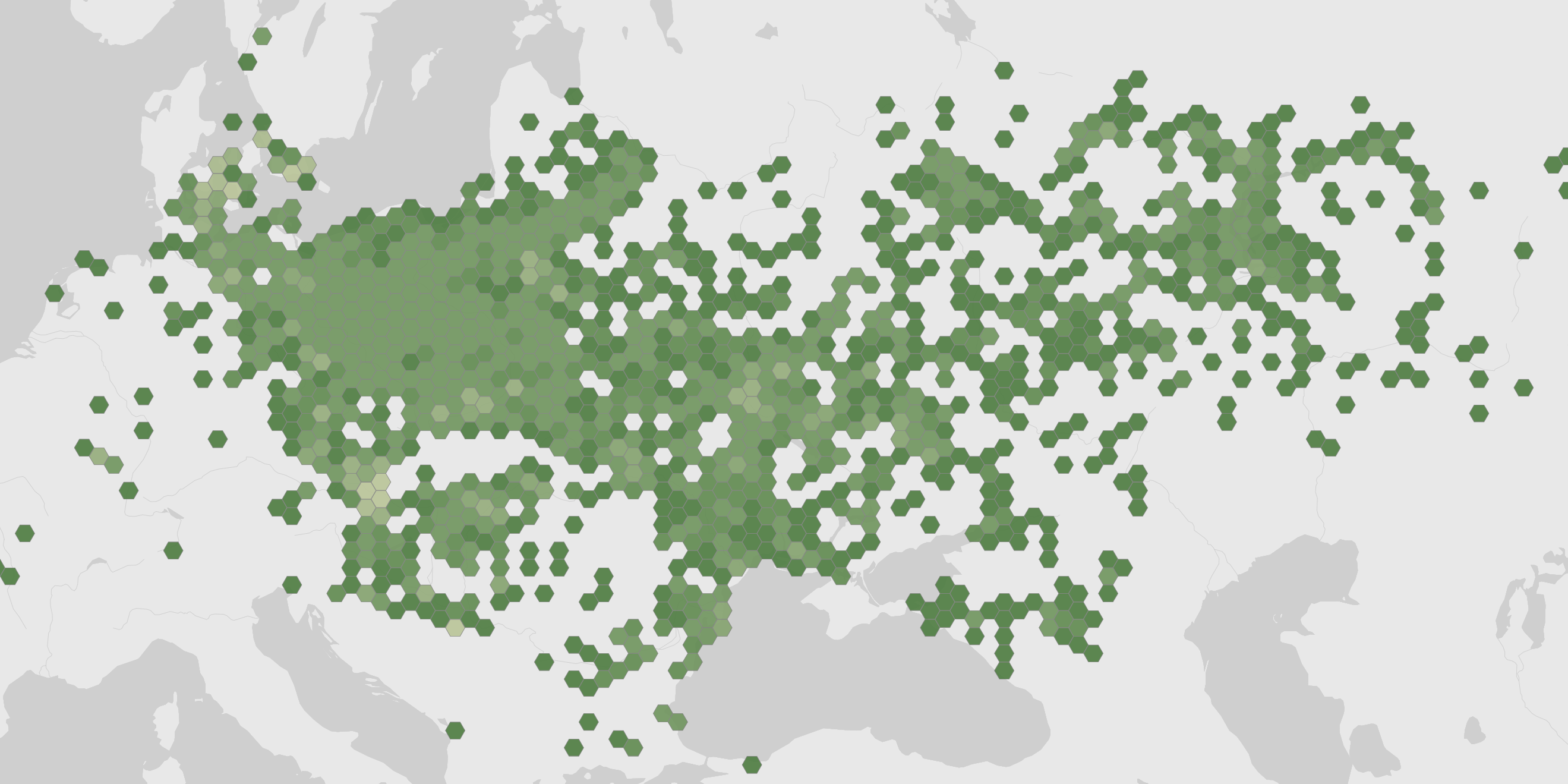
The European fire-bellied toad ranges across Central and Eastern Europe, from eastern Germany — including eastern Denmark and parts of southern Sweden — eastward to Russia's Volga District, where the Ural Mountains mark the edge of its range. Its southernmost populations reach Bulgaria and the Marmara region of Turkey. Within this range it favors lowland ponds and marshes with little woody vegetation, and in larger lakes it stays along shallow edges, roughly 50 to 70 centimeters deep, among reed beds and floodplains.
An introduced population exists far outside this native range, in Lorraine, France, more than 500 kilometers from the nearest native populations in eastern Germany. First discovered in 2009 in Moselle, this population has since been found up to 30 kilometers away, a pattern suggesting the toads were deliberately transported by people. Where this introduced population overlaps with native yellow-bellied toads, hybridization is a potential concern.
Monthly observation data show activity concentrated from spring through midsummer, rising sharply from a low of about 21 sightings in February to a peak of nearly 7,000 in May, then tapering through the fall to near zero by December. This pattern likely reflects seasonal surfacing and breeding activity rather than year-round abundance, since these are presence observations rather than a measure of population size.
Despite its wide range, local declines have been documented: Denmark had 15 known breeding populations in 1974, but only 8 remained by 1988. Surveys elsewhere describe the species as uncommon in Poland's Puszcza Romincka Landscape Park, rare in the Coastal Landscape Park, and making up just 9% of amphibians recorded in a Warsaw survey.
Population and Ecological Role
Rather than a single population figure, the available record points to a species whose numbers vary sharply by region and habitat quality. In Funen County, Denmark, conservationists dug dozens of new ponds for the toads over a decade, and the local population grew roughly five-fold in response — a clear sign of how strongly breeding-site availability limits numbers.
Ecologically, the species sits in the middle of its food web. It feeds on a wide range of small invertebrates, especially springtails, beetles, flies and ants, foraging in and around the shallow, vegetated edges of ponds and marshes it prefers. In turn, adults are hunted by snakes and birds, while its tadpoles are consumed by leeches and fish, making the species both a consumer of insect prey and a food source for larger predators.
Its life cycle is tightly tied to temperature. The toads hibernate once conditions drop to about 4°C, burrowing into soil or rotting logs and entering torpor until spring. Breeding begins once temperatures climb back to around 16°C, usually at night or in the early morning, when females lay 15 to 40 eggs depending on their size; tadpoles hatch within about a week and take roughly a month to metamorphose at a size of about 3.8 centimeters.
Cultural Significance
No documented folklore, symbolism or traditional use specific to the European fire-bellied toad is recorded in the available material. Its name and appearance — a drab-backed frog concealing a fiery red belly — remain its most distinctive calling card, and the species is more often discussed in scientific contexts, such as studies of its hybridization with the yellow-bellied toad, than in cultural ones.
Fun Facts
- The scientific name Bombina bombina is a tautonym, meaning the genus and species names are identical.
- It hybridizes with the closely related yellow-bellied toad, Bombina variegata, in areas where their ranges overlap — the two species trace back to an ancient divergence but have never fully separated.
- Its call is a soft, repeated "whoop," delivered mainly at night or in the early morning during the breeding season.
Conservation status
- LC
- NT
- VU
- EN
- CR
Least Concern
Ecology
Habitat
- Wetland
- Freshwater
Behavior
- Predator
- Hibernating
- Semi-aquatic
Diet
- Insectivore