The mottled rustic (Caradrina morpheus) carries the name of the Greek god of dreams, yet its own story spans continents rather than sleep. First described by Johann Siegfried Hufnagel in 1766, this noctuid moth belongs to the superfamily Noctuoidea within the order Lepidoptera.
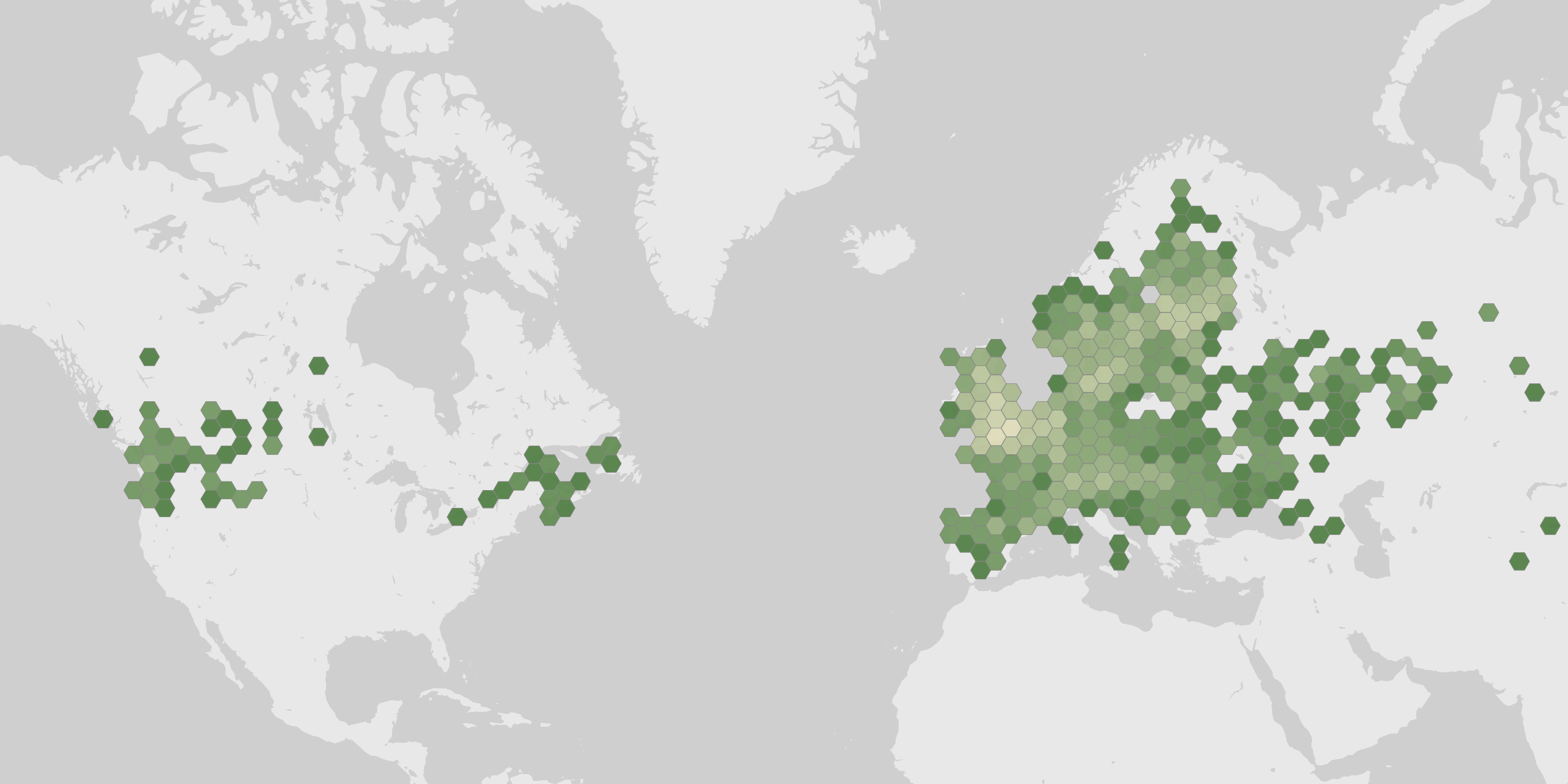
It occurs naturally across the Palearctic, from northern Europe through Siberia to the Amur region and Korea, with additional populations in Armenia and Turkestan. The species has also been accidentally introduced to North America, where it now turns up on both coasts of Canada.
Its wide natural range paired with this unplanned overseas expansion makes it a useful example of how a modest-looking moth can quietly cross oceans.
Identification and Appearance
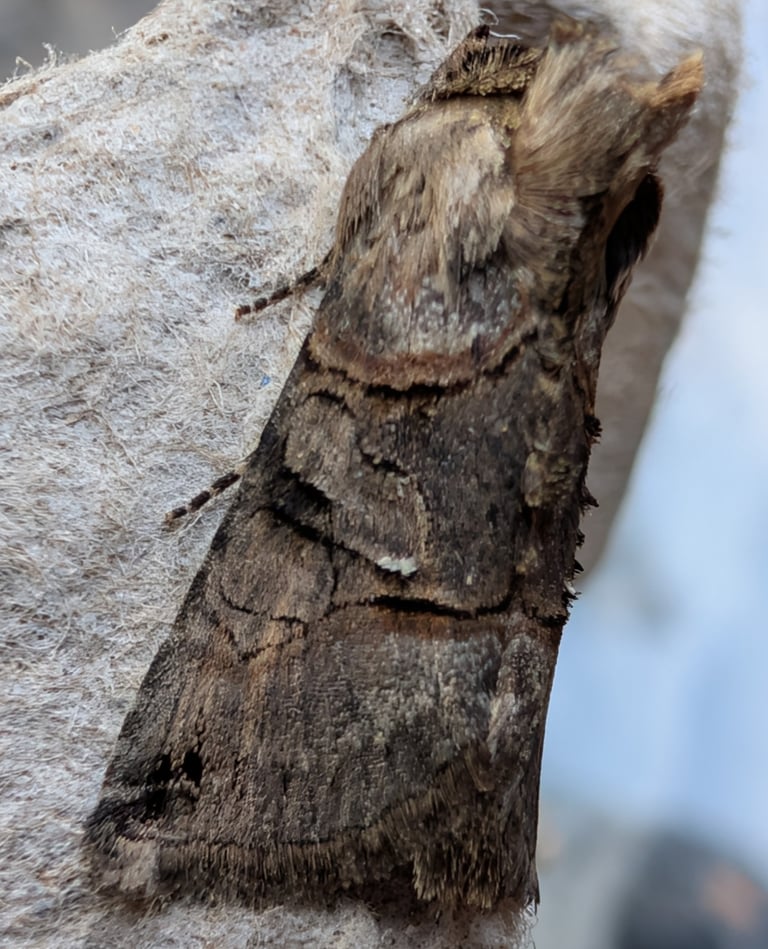
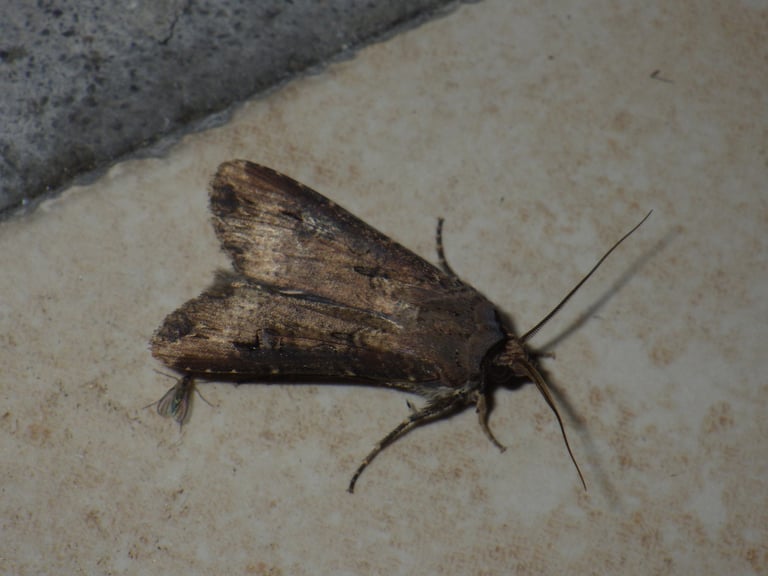
The most useful field mark is the combination of dull dark fuscous forewings with a greyish tinge and pale, glossy white hindwings. This contrast between a muted, mottled forewing and a much paler hindwing helps separate the mottled rustic from many similarly drab noctuids at rest.
The wingspan measures 32 to 38 mm, with forewings 13 to 16 mm long. The forewing pattern includes obscure, double inner and outer lines whose arms sit far apart, along with a grey subterminal line edged by dark suffusion on its inner side.
The orbicular and reniform stigmata appear cloudy fuscous, and the reniform stigma shows a slight fulvous stain along its outer edge at the middle. The hindwing is dull whitish, marked only by a grey cell spot, grey veins toward the outer margin, and a faint subterminal line.
Some individuals show variation, with forewings ranging from pale brown to darker brown and sometimes appearing glossy. In these forms the antemedian line is dentate, the postmedian line poorly defined, and the termen shows dark lunules between the veins, while the darker stigmata remain clearly defined against the ground color.
Distribution and Habitat
Caradrina morpheus occurs across a broad stretch of the Palearctic, from northern Europe eastward through Siberia to the Amur region and Korea, with further populations recorded in Armenia and Turkestan. Beyond this native range, the species has been accidentally introduced to Canada, appearing in the east from New Brunswick to Ontario and in the west in British Columbia.
Presence observations gathered through the year show activity concentrated across a distinct window, with counts rising sharply and peaking during the warmer months before tapering off toward autumn and winter. This pattern points to a seasonal flight period rather than year-round adult activity, consistent with a moth that overwinters in an earlier life stage and emerges as adults for a limited stretch of the year.
Diet and Nutrition
As a larval feeder, the mottled rustic relies on a range of low-growing herbaceous plants rather than any single host. Recorded diet associations point most consistently to nettles, with Urtica, Urtica dioica, and Urtica urens all appearing among the plants used.
Beyond nettles, the larvae are also linked to Chenopodium album and Cichorium intybus, as well as Clematis vitalba. Additional recorded associations include Artemisia vulgaris, Aster linosyris, Chenopodium vulvaria, and Dipsacus pilosus.
This spread across several unrelated plant families suggests a caterpillar that is not narrowly tied to one host group, instead taking advantage of common weedy and wayside vegetation such as nettle patches and chenopods.
Cultural Significance
The mottled rustic's scientific name draws directly on Morpheus, the figure from Greek mythology tied to dreams. In myth, Morpheus was not counted among the twelve Olympian gods, yet his influence on ancient Greek culture was considerable, and his role was to reveal truth to sleepers whether that truth was comforting or painful.
Morpheus was known for his skill at transforming himself into lifelike apparitions convincing enough to deceive even discerning observers, and the Greek gods often chose him as their messenger to appear in the dreams of mortals. This same figure has echoed forward into later culture, appearing as a personification of dreams among the Oneiroi and lending his name to characters such as Dream in DC Comics, sometimes referred to directly as Morpheus.
The moth's binomial name, chosen by Hufnagel in 1766, ties this small, muted-winged insect to that long mythological lineage of shape-shifting and dream-revealing, even though the connection is one of naming rather than documented folklore about the insect itself.
Fun Facts
- The species name honors Morpheus, the Greek god of dreams known for shape-shifting into lifelike forms convincing enough to fool even careful observers.
- In parts of its range, such as localities noted in Kazakhstan, the mottled rustic is described as a meso-xerophilous species associated with steppe habitat.
- Morpheus was often chosen by the Greek gods as their messenger, appearing in mortals' dreams to deliver messages while they slept.
Photos
Photographs from via iNaturalist, licensed under CC0 1.0., by Винер Фаритович Хабибуллин via iNaturalist, licensed under CC BY 4.0., by David Price-Goodfellow via iNaturalist, licensed under CC BY 4.0., by CaracalShan via iNaturalist, licensed under CC BY 4.0., by Thorsten Hackbarth via iNaturalist, licensed under CC BY 4.0., by Viktor Strenada via iNaturalist, licensed under CC BY 4.0., by Timon B via iNaturalist, licensed under CC BY 4.0., by Bóna Katalin via iNaturalist, licensed under CC BY 4.0., by Brodie Cass Talbott via iNaturalist, licensed under CC BY 4.0., by Евгений Рыбальченко via iNaturalist, licensed under CC BY 4.0., by Julia Palmer via iNaturalist, licensed under CC BY 4.0., by Will Taylor via iNaturalist, licensed under CC BY 4.0., and by Adrien Cozannet via iNaturalist, licensed under CC BY 4.0., credited on each photo.
Ecology and classification
Diet
- Herbivore
Classification
- Phylum
- Arthropoda
- Class
- Insecta
- Order
- Lepidoptera
- Family
- Noctuidae
- Genus
- Caradrina
- Species
- Caradrina morpheus