The bull shark can survive for years in pure fresh water, a trait shared by almost no other shark on Earth. Known regionally as the Zambezi shark in Africa and the Lake Nicaragua shark in Central America, Carcharhinus leucas is a requiem shark found worldwide in warm coastal waters, estuaries, and the lower reaches of rivers.
The species carries a reputation for aggression, and that reputation has driven shark-culling programs near beaches meant to protect swimmers—programs that are, ironically, one of the pressures pushing the species toward decline. The IUCN lists the bull shark as Vulnerable, a status shaped as much by fishing pressure and habitat loss as by human fear. Few sharks move as freely between salt and fresh water, and fewer still turn up in city canals, golf-course lakes, and rivers thousands of kilometers from any coastline.
Identification and Appearance
The single most useful field mark is the bull shark's stocky, heavy build: it is noticeably wider and heavier than other requiem sharks of the same length, with a small, blunt, rounded snout and no ridge between the two dorsal fins. The body is grey above and white below, the first dorsal fin is much larger than the second, and the caudal fin is longer and lower than that of the largest sharks.
Adult females average 2.4 m (8 ft) and about 130 kg (290 lb), while males average a slightly smaller 2.25 m (7 ft) and 95 kg (209 lb). Pups are born at up to 81 cm (2 ft 8 in). A maximum length of 3.5 m (11 ft) is commonly reported, though one female specimen measured exactly 4.0 m (13 ft) and pregnant individuals of 3–3.25 m have weighed between 347 and 450 kg (766–990 lb); the largest confirmed pregnant female may have exceeded 600 kg (1,300 lb), and unconfirmed reports suggest exceptional individuals could reach 900 kg (2,000 lb).
Pound for pound, the bull shark has the strongest bite of any cartilaginous fish studied, generating up to 5,914 newtons (1,330 lbf). Combined with its bulk, this bite force is part of why the species ranks among the largest and most physically formidable of the requiem sharks despite its relatively modest length.
Distribution and Habitat
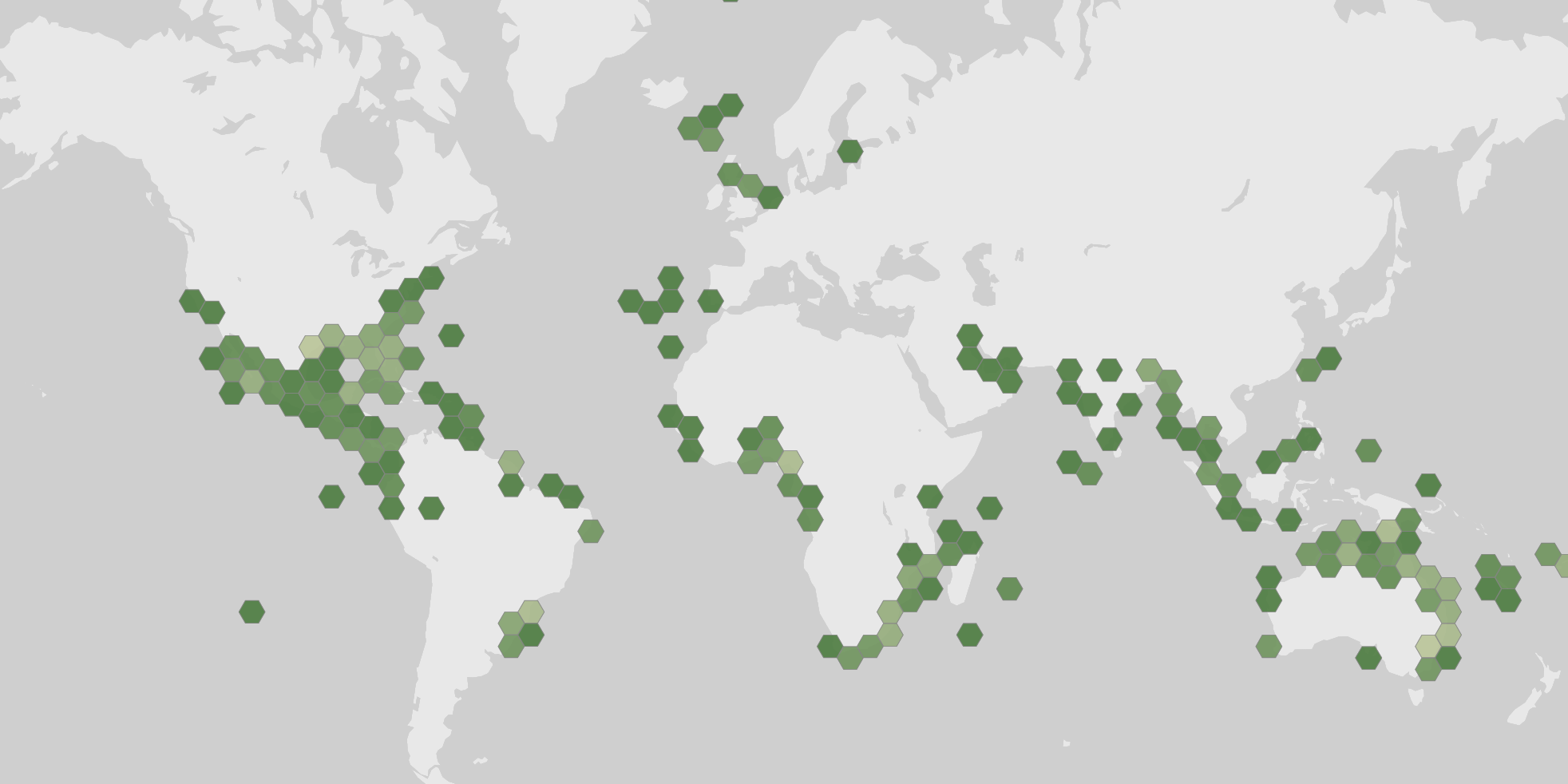
The bull shark occurs in tropical and subtropical waters worldwide, typically at depths around 30 m but ranging down to 150 m near the coast. In the Atlantic it is found from Massachusetts to southern Brazil and from Morocco to Angola; in the Pacific, from Baja California to Ecuador. Uniquely among sharks, it also pushes deep into fresh water: individuals have traveled 4,000 km (2,500 mi) up the Amazon to Iquitos in Peru, and the species lives permanently in the freshwater Lake Nicaragua, in the Ganges and Brahmaputra rivers of eastern India and Bangladesh, and in the Tigris River as far upstream as Baghdad, where records date to at least 1924.
Coastal lagoons, river mouths, and low-salinity estuaries serve as nurseries, and juveniles typically stay in these shallow waters until seasonal cooling pushes them back into the sea. Established urban populations exist too: more than 500 bull sharks are thought to live in Australia's Brisbane River, and sharks have been sighted swimming city streets during the 2010–11 Queensland floods and in the canals of the Gold Coast. In the United States, bull sharks have been recorded as far inland as Alton, Illinois on the Mississippi River and in Louisiana's Lake Pontchartrain after Hurricane Katrina.
Global observation records peak from January to March, with counts above 20,000 per month, and taper through the year to roughly 8,000–9,000 by October and November. These figures come from presence records rather than population counts, so they show when and where the species is most often recorded, not how many individuals exist. The pattern is consistent with the bull shark's known seasonal shifts between warmer and cooler waters rather than any true measure of abundance.
Behavior and Lifestyle
Bull sharks are diadromous, moving between salt and fresh water with an efficiency almost no other cartilaginous fish can match. Their rectal gland, kidneys, liver, and gills work together to manage the massive osmotic strain of living in fresh water, reducing blood urea concentration and reabsorbing sodium and chloride that would otherwise be lost. Despite this adaptation, a shark cannot survive on fresh water alone indefinitely; laboratory subjects kept purely in fresh water died within four years, apparently from starvation, since most of their prey lives in salt water.
In rivers, activity follows a strict daily rhythm: sharks move upstream near the bottom during the day and drift back downstream near the surface at night, within linear home ranges of roughly 0.9 to 5.6 km. Along the U.S. East Coast the species is also seasonally migratory, moving into northern waters for summer and retreating south as temperatures drop. Habitat choice throughout its range tracks water temperature closely, and sharks abandon cooling temperate waters once conditions turn unfavorable.
The species' temperament extends even to captivity: many aquariums avoid displaying bull sharks because they tend to kill other tank occupants, a trait that ironically adds to their popularity as an exhibit.
Communication
Hearing is a key sense for the bull shark, tuned most sharply to frequencies between 400 and 600 Hz, though it can detect sound from 100 to 1,500 Hz. This sensitivity lets it pick up potential prey from more than 6 m (20 ft) away, well before it comes into visual range.
Chemical signaling also plays a role, particularly in reproduction. Researchers presume the species' sense of smell is as strong as that of related Carcharhinus sharks, which use their olfactory systems to detect pheromones released by the opposite sex, helping locate mates in murky estuarine water where vision is limited.
Beyond smell and hearing, the bull shark relies on visual and electrical senses to read its surroundings, and it can also detect water vibrations, giving it several overlapping ways to track prey, mates, and obstacles in the low-visibility rivers and estuaries it frequents.
Hunting and Diet
Bull sharks hunt largely near the bottom of coastal waters and rivers, using their sharp hearing and presumed strong sense of smell to locate prey in the murky, low-visibility water they favor. Their diet shifts with age: younger sharks feed mainly on ray-finned fish, while older individuals increasingly take other elasmobranchs, particularly stingrays such as Dasyatis sabina and D. sayi.
Catfish are a staple, especially Arius felis and Bagre marinus, alongside blue crabs (Callinectes), menhaden (Brevoortia), and mullet (Mugil). Sheepshead (Archosargus probatocephalus), jacks (Carangidae), and seatrout (Cynoscion) appear only rarely in their stomachs. Minor prey includes small mammals, birds, mollusks, crustaceans, and even turtles.
Cannibalism has been documented, typically in groups of six or more sharks where one individual is already injured, suggesting opportunistic feeding rather than routine predation on their own kind.
Reproduction and Life Cycle
Bull sharks are polygynandrous, mating without lasting pair bonds, and males often leave bite marks on the pectoral and pelvic fins of females during copulation. Mating occurs mainly in bays and estuaries in late summer and early autumn.
The species is viviparous, with embryos nourished through a yolk-sac placenta rather than laid eggs. A female's single functional ovary enlarges 15 to 22 eggs, but typically only 10 or fewer are ovulated; the rest are reabsorbed. Gestation lasts 9 to 12 months, averaging around 11, and in most of the range birth occurs between April and June, though tropical populations may breed year-round. Litters range from 7 to 13 pups, averaging about 10, each born tail-first at 50–81 cm (20–32 in) long.
Because gestation is so long, females typically reproduce only every other year. Males mature at around 14–15 years old and 160–165 cm long, while females mature later, around 18 years and 160–235 cm. Newborns receive no parental care; instead, they are born into shallow estuarine nurseries such as coastal lagoons and river mouths, where protection from predators and abundant food support faster growth and survival.
Population and Ecological Role
Long-term data on accidental catches in gillnets and beach seines from 1953 to 2003 point to a decline in bull sharks using estuary habitats, likely tied to coastal development that has degraded the shallow nursery grounds the species depends on. Tagging studies in Florida's Caloosahatchee River estuary found that young sharks move downriver together as conditions change, a synchronized response driven by energy conservation—sharks ride tidal flow and reduce osmoregulatory effort rather than reacting to predators or other external threats.
As a large, wide-ranging predator, the bull shark helps structure coastal and estuarine food webs, feeding heavily on catfish, stingrays, and other fish while occasionally falling prey itself to larger tiger sharks and great white sharks, which mostly target juveniles. In rivers and estuaries, crocodiles are a documented threat: saltwater crocodiles have been observed killing bull sharks in northern Australia, and a Nile crocodile was reportedly seen consuming one in South Africa.
The species also takes part in a cleaning mutualism with remoras, slowing down and raising its head to signal readiness while the fish removes parasites from its skin, gills, and mouth. Some individuals carry tapeworms of the species Heteronybelinia estgmena in their gastrointestinal tract, which can cause inflammation and tissue changes in the gut lining.
Conservation and Threats
The bull shark is listed as Vulnerable on the IUCN Red List, with its population trending downward. It holds no special protected status under the U.S. Federal List or CITES, leaving it without the legal safeguards given to many other threatened marine species.
Threats include entanglement in fishing nets, overfishing for its oil, skin, and meat, pollution of coastal and estuarine habitats, and shark-culling programs run near beaches in places such as Australia and South Africa to reduce the risk of attacks on swimmers. Because bull shark nurseries sit in shallow, easily disturbed estuaries, coastal development compounds these pressures on juveniles before they ever reach reproductive age.
Some protective steps already exist: several southern U.S. states have banned gillnet fishing in known nursery areas, indirectly benefiting young sharks. Researchers have also tested devices such as the SharkSafe Barrier, which uses magnetic and visual stimuli to deter sharks from beaches, though further refinement is needed before wide use.
Conservation status
- LC
- NT
- VU
- EN
- CR
Vulnerable
Cultural Significance
Bull sharks hold a complicated place in human use: they are prized in aquariums for their adaptability to captivity, even though many facilities avoid displaying them because they tend to kill other tank occupants, a trait that seems to add to rather than diminish their draw for visitors. They are also targeted by sport anglers and turn up frequently as accidental catches; one 1978 study in the Gulf of Mexico found bull sharks made up 11% of the shark biomass caught in commercial nets.
Their body parts sustain a global trade. Liver oil is processed into beauty products, meat is sold mainly in European markets, and skin is tanned into leather. Fins are the most sought-after product, harvested for traditional Chinese shark fin soup, linking the species to both regional cuisine traditions and international wildlife trade concerns.
Fun Facts
- In Fijian mythology, the shark god Dakuwaqa may have been inspired by a bull shark or a great white shark, since both species can live for decades.
- Historical fears of a menacing river shark in some regions may have actually involved the dusky shark, Carcharhinus obscurus, a lesser-known relative often confused with the bull shark.
- The bull shark is considered one of the most common sharks in temperate and tropical coastal waters worldwide, as well as one of the most heavy-bodied.
Ecology
Habitat
- Wetland
- Marine
- Coastal
- Freshwater
Behavior
- Predator
- Territorial
- Aggressive
- Migratory
Diet
- Piscivore
Photos
SourcesGBIFiNaturalistWikidataWikipediaAnimal Diversity WebAnAge