Few sharks are as common along Europe's coastline as Scyliorhinus canicula, ranked among the most abundant elasmobranchs in the northeast Atlantic and Mediterranean Sea.
Known also as the sandy dogfish, lesser-spotted dogfish, rough-hound, or morgay, this catshark belongs to the family Scyliorhinidae and ranges from Norway and the British Isles south to Senegal, including the entire Mediterranean. The IUCN lists it as Least Concern, with most populations reported stable.
Its abundance, easy handling, and tolerance of shallow water have made it one of the best-studied small sharks in European waters, offering a window into shark biology that larger, rarer species rarely allow.
Identification and Appearance
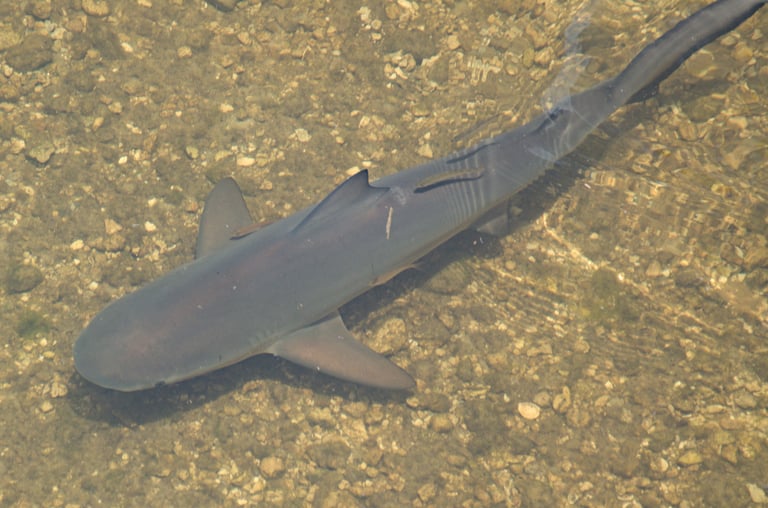
The single best field mark is its skin: a rough, sandpaper-like texture covering a slender body with a blunt, rounded head. The upper body is greyish brown, covered in small dark brown spots, while the underside is pale greyish white, creating strong contrast between the two surfaces.
Adults reach up to 1 meter in length and can weigh more than 2 kilograms, though most individuals encountered are smaller. Two dorsal fins sit far back on the body, close to the tail, giving the shark an elongated, streamlined silhouette. The nostrils, positioned on the underside of the snout, connect to the mouth by a distinctive curved groove.
Males and females differ subtly but consistently: male teeth are larger than those of females, and males from West African waters develop stronger, larger, and more heavily calcified jaws. Researchers suspect these differences in mouth dimensions and tooth length reflect either divergent feeding habits between the sexes or adaptations tied to reproductive behavior, such as gripping a mate during courtship.
Distribution and Habitat
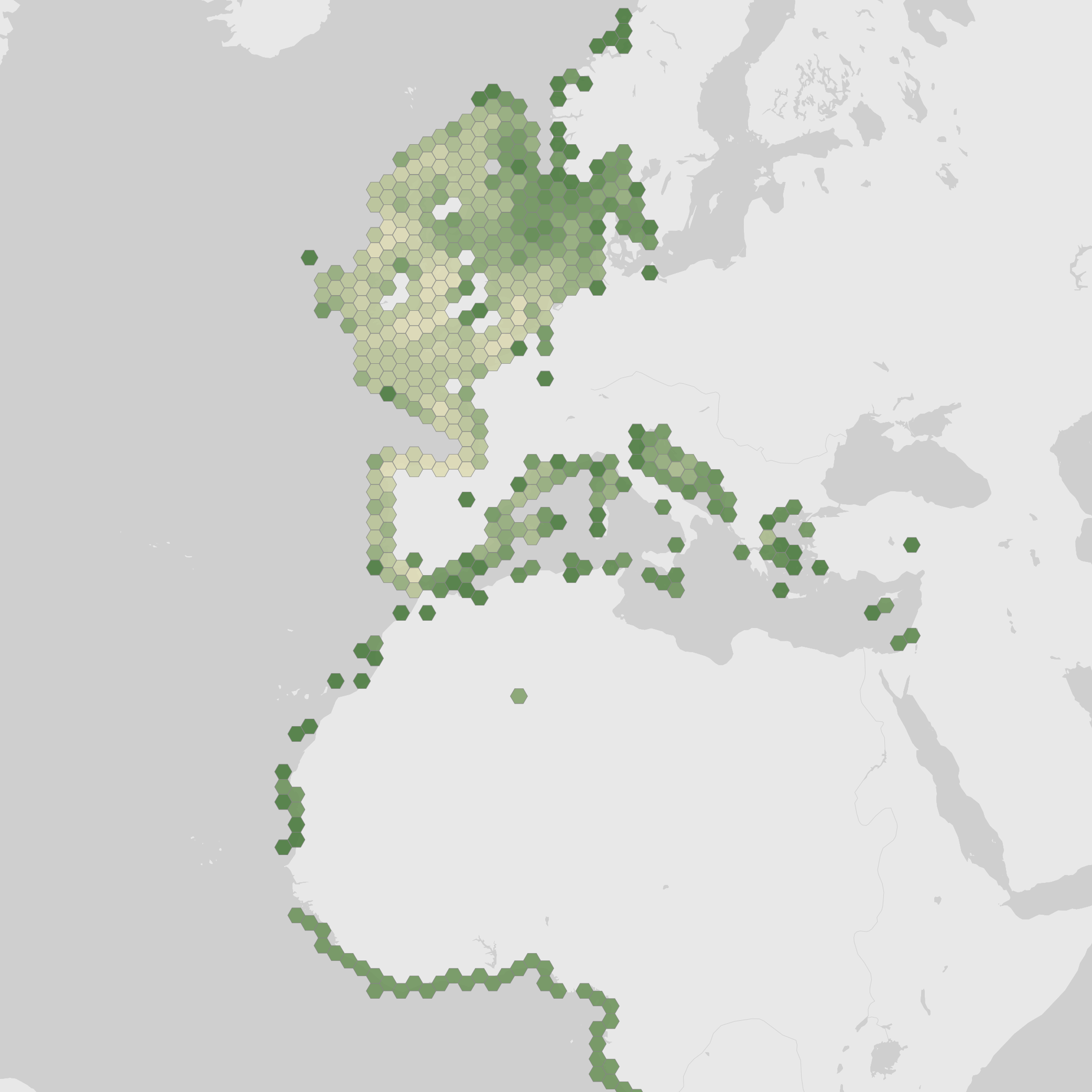
Scyliorhinus canicula occupies continental shelves and the uppermost continental slopes from Norway and the British Isles south to Senegal, and throughout the Mediterranean Sea, spanning latitudes from 63° N to 12° N. Within this range it favors sandy, gravelly, or muddy seafloors, from depths of just a few meters down to 400 meters.
Monthly observation data show counts rising sharply from a low in April and May, climbing through summer, and peaking between September and November before dropping again in December. This pattern likely reflects seasonal differences in survey effort, water temperature, or shark activity near the surface rather than true changes in population size, since these figures record presence, not abundance.
The species' broad depth tolerance and habitat flexibility, from shallow inshore shelves to slope waters, help explain why it is found so consistently across such a wide latitudinal range.
Hunting and Diet
As a hunter, Scyliorhinus canicula relies on an unusual technique to subdue prey: juveniles anchor a food item against the sharp dermal denticles near their tail, then tear off bite-sized pieces with rapid head and jaw movements, a behavior called
Reproduction and Life Cycle
Courtship leads to egg-laying rather than live birth: Scyliorhinus canicula is oviparous, depositing paired egg cases protected by a horny capsule with long tendrils. These cases are usually attached to macroalgae in shallow coastal waters, though egg cases laid farther offshore are instead anchored to erect sessile invertebrates.
Each egg case typically measures about 4 cm by 2 cm, never exceeding 6 cm. Inside, embryos develop for 5 to 11 months, with development time governed largely by sea temperature. Hatchlings emerge at 9 to 10 cm in length, already resembling miniature adults with no further parental care.
Spawning occurs almost year-round, but with regional seasonal peaks: females off the Mediterranean coast of France lay eggs from March to June and again in December, British waters see spring egg-laying with a gap between August and October, and on the Tunisian coast egg-laying starts in spring, peaks in summer, and tapers through autumn. Males mature at a length of about 37.1 to 48.8 cm, and females at 36.4 to 46.7 cm, close to the size range at which hatchlings later reach adulthood themselves.
Conservation and Threats
The IUCN lists Scyliorhinus canicula as Least Concern, reflecting no evidence of significant global population decline. It is one of the most abundant elasmobranchs in the northeast Atlantic and Mediterranean, and surveys show populations stable or even increasing across most of its range, despite localized depletion in some areas.
The main pressure comes from near-shore fisheries: the species is caught regularly by commercial fishermen and recreational anglers, though most catches are discarded rather than retained. Post-discard survival is extremely high, around 98 percent, which helps explain why fishing pressure has not translated into broader population declines.
Since 2003, the public aquarium Havets Hus in Lysekil, Sweden, has released more than 90 individuals into the Gullmarn fjord as part of an ongoing program; one shark released there was recaptured in southern Norway a decade later, showing the species can live at least 14 years in the wild.
Conservation status
- LC
- NT
- VU
- EN
- CR
Least Concern
Fun Facts
- A subspecies described in 1906, Scyliorhinus canicula albomaculata Pietschmann, is now considered simply a synonym of Scyliorhinus canicula.
- Some records describe its depth range more narrowly, around 80 to 100 meters, even though the species is known to range from just a few meters down to about 400 meters.
- Its migratory behavior is still listed as unknown in some scientific records, despite how well-studied the species otherwise is.
- The small-spotted catshark goes by several regional names, including sandy dogfish, lesser-spotted dogfish, rough-hound, and morgay.
Ecology
Habitat
- Marine
- Coastal
Diet
- Carnivore
Behavior
- Predator
- Aquatic