Tawny sedge has vanished from Massachusetts, yet it still grows across much of Europe and in parts of eastern Canada. This flowering plant belongs to the sedge genus Carex in the family Cyperaceae.
It is a member of the Carex flava species complex, a group of closely related sedges. Its name marks it as a plant of wet, lime-rich ground, where it forms part of open fen and meadow vegetation.
Identification and Appearance
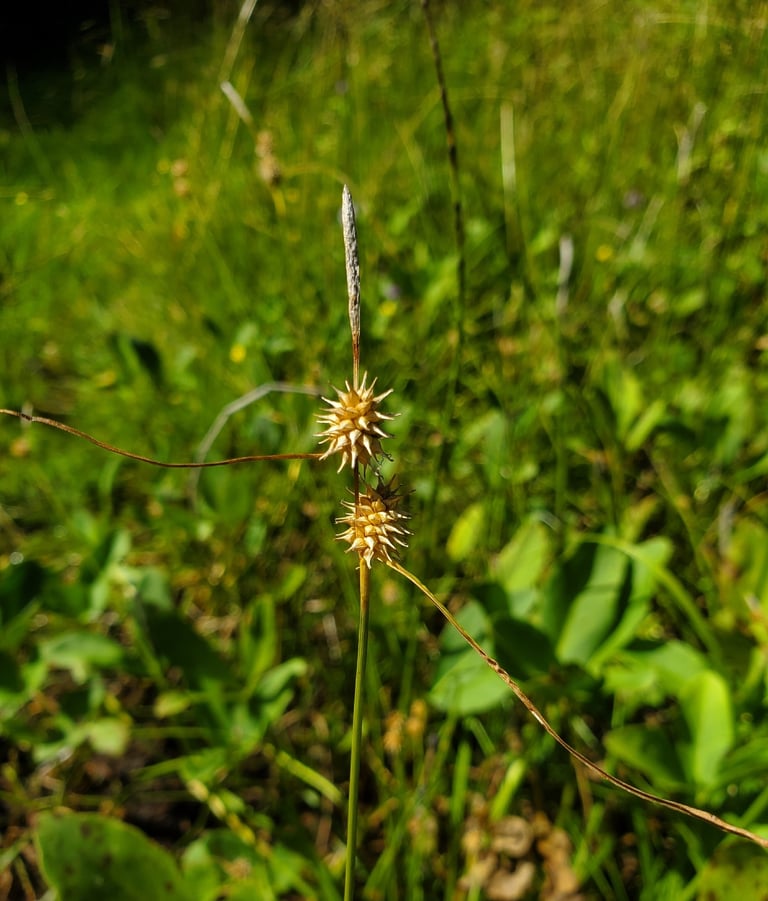
The most useful field mark is the spike at the top of the stem. The inflorescence sits at the tip of the culm as one or more spikes 5 to 70 mm long.
The stems, called culms, are straight and stand 25 to 60 cm tall. Each culm has a triangular cross section, which helps separate it from round-stemmed plants in wet meadows.
The leaves on the flowering stems are linear, reaching up to 14 cm long and only 1.5 to 4.5 mm wide. They are narrow and grass-like, so the three-angled stems are often the quickest clue.
Because it belongs to the Carex flava species complex, it resembles related yellow-green sedges. Careful checking of the spike and stem shape is needed to separate it from those close relatives.
Distribution and Habitat
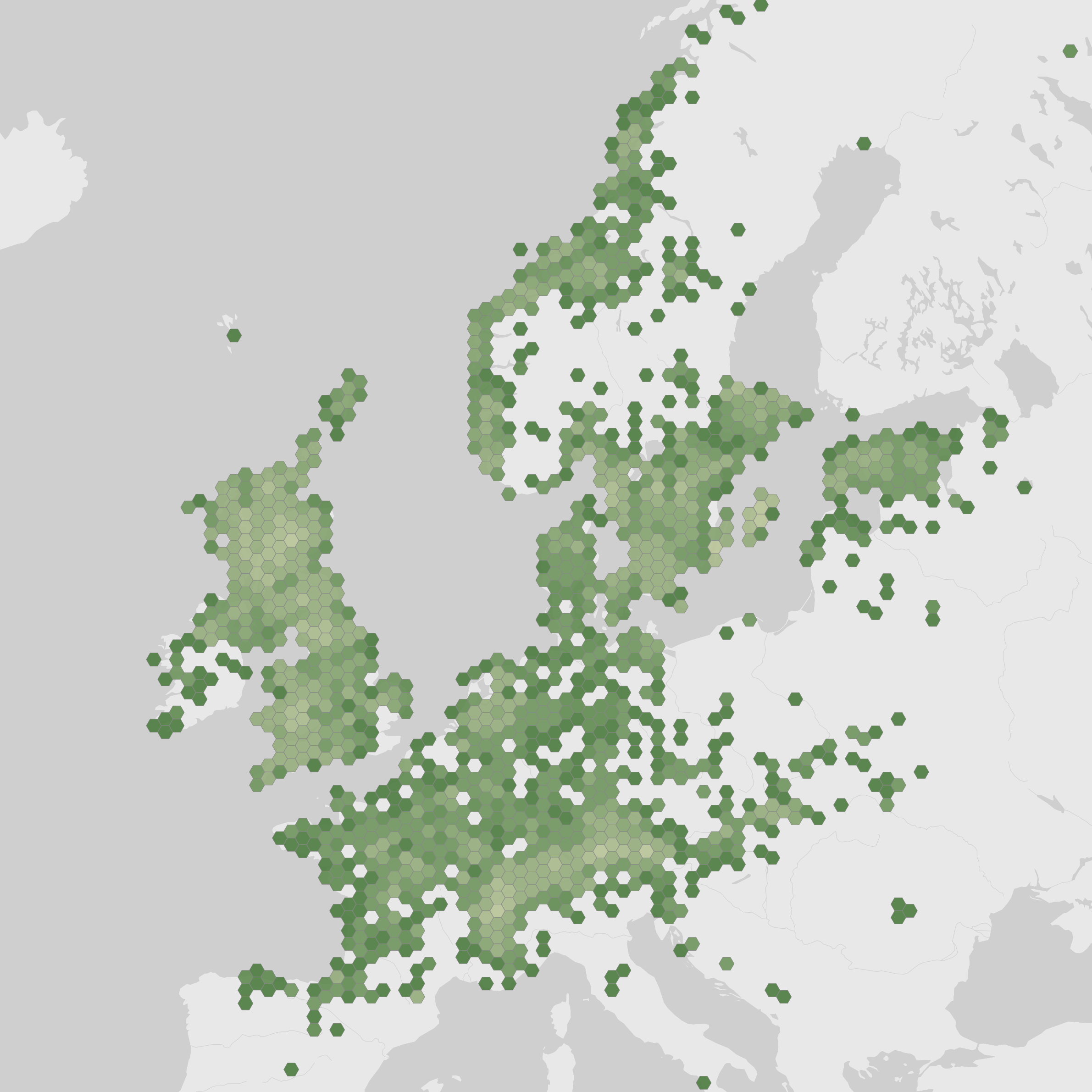
Tawny sedge grows across a wide band of Europe. Its range extends from Spain in the west to Ukraine in the east, and from Italy and Greece in the south to Finland, Norway and Sweden in the north.
In North America it occurs in Quebec and Newfoundland in Canada. It has been lost from Massachusetts, where it is now extinct.
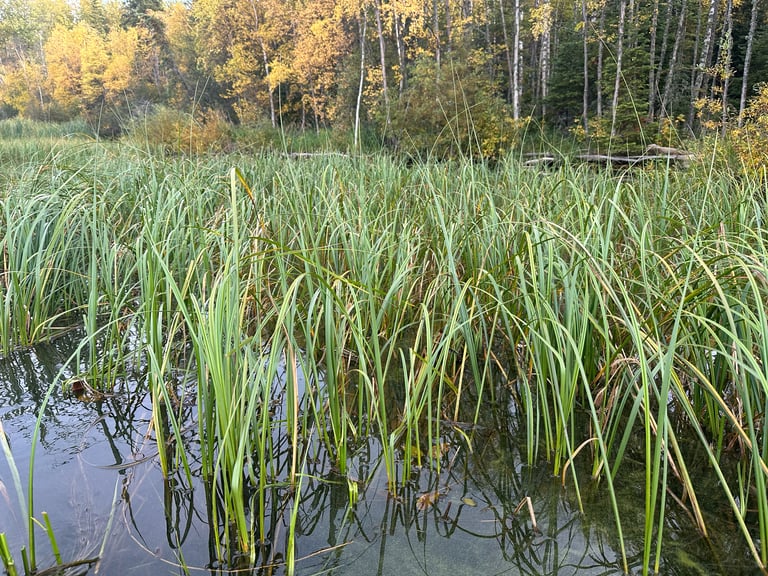
The plant prefers moist to wet, open fens and meadows on lime-rich soils. It is found from sea level up to 500 m.
Observations are concentrated in June and July, when the sedge is most often encountered in the field.
Growth and Form
Tawny sedge is a graminoid, a grass-like plant with narrow leaves and inconspicuous flowers. It is a perennial, living for several years and returning from the same root system each season.
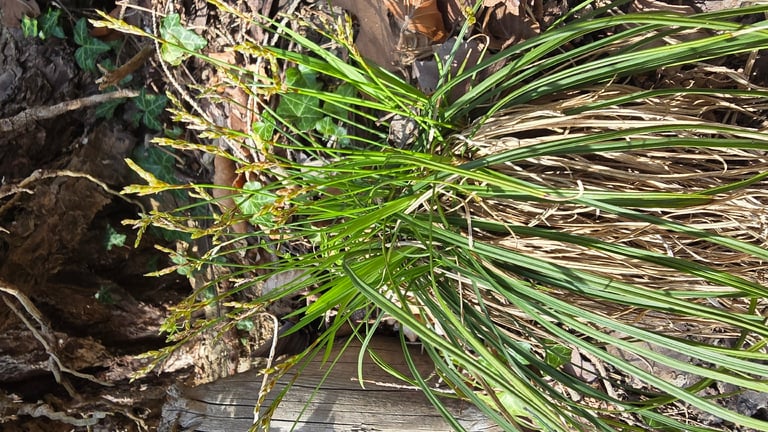
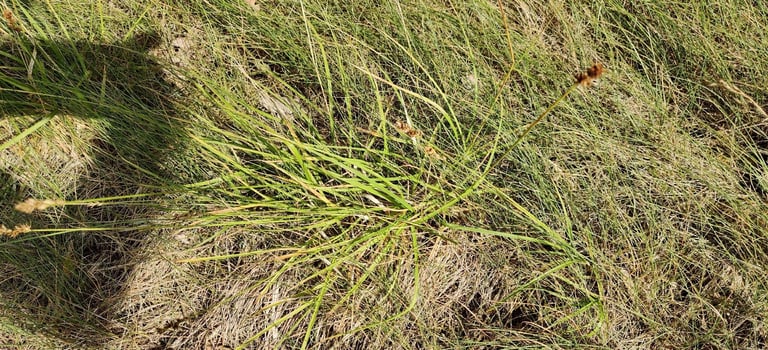
It grows as a tufted plant, with many culms arising from a spreading rhizome. The rhizome allows the clump to persist and expand in wet ground.
The plant can be evergreen or deciduous, so its leaves may persist through winter or die back, depending on conditions. Its stems reach 25 to 60 cm, and its leaves on the flowering stems are up to 14 cm long.
Ecology and Relationships
Insects and birds feed on tawny sedge. Grasshoppers and other orthopterans, including the meadow grasshopper Chorthippus parallelus, are among its most frequent insect consumers, alongside true bugs, beetles, flies and moths.
Seed-eating and grazing birds also use it. Songbirds, including the skylark Alauda arvensis, feed on it, as do gamebirds and waterfowl such as the mallard Anas platyrhynchos.
Its habitat is open, wet and lime-rich ground. Fen and meadow conditions with high groundwater and open light suit the plant and the animals that depend on it.
Photos
Photographs from via iNaturalist, licensed under CC0 1.0., by Anne Heckmann via iNaturalist, licensed under CC BY 4.0., by betony13 via iNaturalist, licensed under CC BY 4.0., by crothfels via iNaturalist, licensed under CC BY 4.0., by Alexis Tinker-Tsavalas via iNaturalist, licensed under CC BY 4.0., by Daniel Buczkiewicz via iNaturalist, licensed under CC BY 4.0., by Rocco Lieghio via iNaturalist, licensed under CC BY 4.0., and by Terry Instone via iNaturalist, licensed under CC BY 4.0., credited on each photo.
Ecology and classification
Classification
- Phylum
- Tracheophyta
- Class
- Liliopsida
- Order
- Poales
- Family
- Cyperaceae
- Genus
- Carex
- Species
- Carex hostiana
Sources
- GBIF Species names and classification
- iNaturalist Photos
- Wikidata Common names and conservation status
- Wikipedia Summary extract
- Encyclopedia of Life Habitat, diet and behavior traits
- Plants of the World Online Native range, life form and climate (WCVP)
- USDA Plants US plants: growth habit and growing conditions
- GloBI What it eats, what eats it, parasites and pollinators
- trophiCH