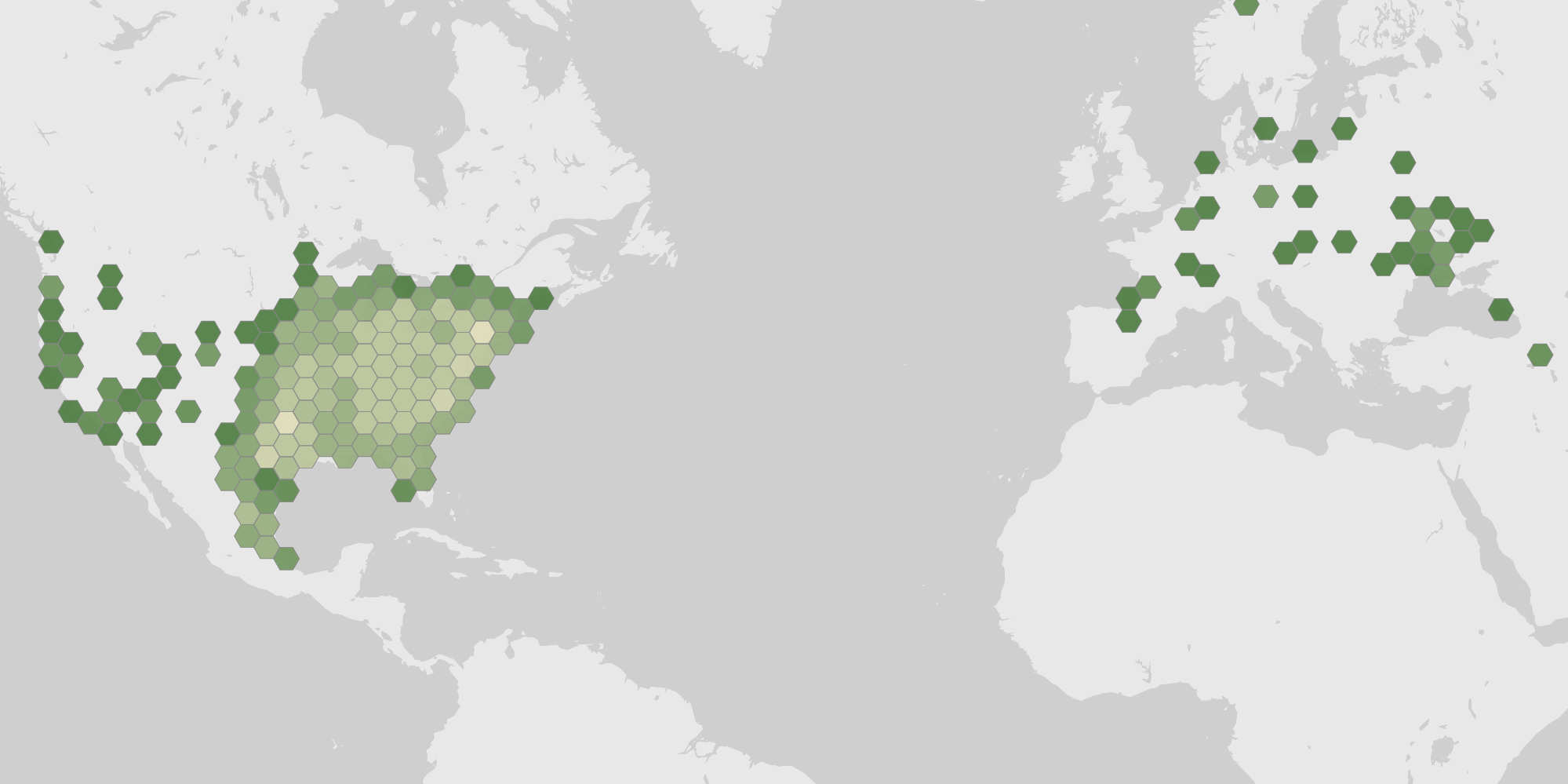
Clusters of magenta-pink flowers open on bare branches in spring, before the leaves unfold. Cercis canadensis, the eastern redbud, is a large deciduous shrub or small tree native to eastern North America. Its natural range runs from southern Michigan south to central Mexico and west to New Mexico, and it grows well as far north as southern Ontario. The IUCN lists the species as Least Concern.
The eastern redbud is the state tree of Oklahoma and the official city tree of Huntington Beach. In Columbus, Wisconsin, residents have embraced the plant as part of their town's identity, and a selection known as the 'Columbus strain' has become a common source of nursery seed. The town calls itself the 'Redbud City' and holds 'Redbud Day' each year on the Saturday before Mother's Day, with a range of themed events.
Identification and Appearance
The heart-shaped leaves are the most useful field mark. They are alternate, simple and have smooth edges, measuring 7 to 12 cm (3 to 4.5 in) across. They are thin and papery, and may be slightly hairy on the underside. The leaves emerge folded along the midrib, tawny green, and mature to a smooth, dark green above and paler beneath.
A mature tree typically grows 6 to 9 m (20 to 30 ft) tall, with a spread of 8 to 10 m (26 to 33 ft). It usually has a short, often twisted trunk and spreading branches. The bark is dark and smooth when young, becoming scaly with faint ridges and sometimes showing maroon patches. The slender, zigzag twigs are nearly black and dotted with pale lenticels. The winter buds are tiny, rounded and dark red to chestnut.
The flowers are about 1.5 cm (1/2 in) long and appear in clusters of four to eight, from spring into early summer. They are typically light to dark magenta pink, and cultivars with white flowers also exist. The flat, brown, pea-like pods are 5 to 10 cm (2 to 4 in) long and hold flat, elliptical brown seeds about 6 mm (1/4 in) long. The pods ripen from August to October.
Distribution and Habitat
The eastern redbud occurs across a broad part of the eastern and south-central United States and into northeastern Mexico. Its native range includes Alabama, Arkansas, Connecticut, Florida, Georgia, Illinois, Indiana, Iowa, Kansas, Kentucky, Louisiana, Maryland, Massachusetts, Michigan, Mississippi, Missouri, New York, North Carolina, Ohio, Oklahoma, Pennsylvania, Tennessee, Texas, Virginia, Wisconsin and several other eastern states. Outside North America, it has been introduced to Romania, the Transcaucasus and Ukraine.
The climate across its range varies widely. Mean annual precipitation is less than 510 mm (20 in) in dry south Texas and about 1,270 mm (50 in) in moist central Florida. At the northern edge of its range, mean annual snowfall is about 90 cm (35 in). Mean January temperatures range from -8 °C (18 °F) to 16 °C (61 °F), and frost-free periods last from 160 to 300 days.
The tree grows on sites from dry to moist, but it does best on moist, well-drained ground. It is more abundant on south-facing slopes, where sunlight is more intense and competition from other plants is lighter. It does not tolerate flooding or poorly aerated soil, and it is not found on coarse sands. It tolerates a wide range of soil pH but grows best above pH 7.5, and it is common on limestone outcrops and alkaline soils derived from them.
In the southeastern part of its range, the upper elevational limit is about 2,200 feet (670 m). In Trans-Pecos Texas, it grows between 2,300 and 5,000 feet (701 to 1,524 m). In the Konza Prairie of Kansas, it grows on rocky breaks in the grassland, and in Kentucky it grows on exposed limestone cliffs within eastern redcedar communities.
Growth and Form
The eastern redbud is a perennial that can grow as either a shrub or a tree. It typically reaches a mature height of about 9.1 m (30 ft). Its growth is slow, and a 10-year-old tree is generally about 5 m (16 ft) tall.
The short, often twisted trunk and spreading branches give the mature plant a broad, open form. Trees growing in the open or along woodland edges develop this spreading habit more readily than those in dense shade.
Ecology and Relationships
Caterpillars of several moths and butterflies feed on the leaves. The list includes Henry's elfin, the redbud leaffolder, the red-humped caterpillar, the fall webworm, the white flannel moth, the American dagger moth, the grape leaffolder and the Io moth. The red-humped caterpillar can strip large areas of foliage in late summer, but it generally causes no lasting harm to a healthy tree. The fall webworm is also a late-season defoliator.
The flowers are pollinated by long-tongued bees, such as blueberry bees and carpenter bees. Short-tongued bees cannot reach the nectaries.
The eastern redbud belongs to the legume family, Fabaceae, but it does not form the nitrogen-fixing root nodules common to many relatives. It lacks the gene needed to form them and does not host nitrogen-fixing microbes. It usually grows as an understory tree along the edges of woods, often alongside flowering dogwood (Cornus florida).
Cultivation and Care
The eastern redbud grows best in rich, moist soil, usually in partial shade. Its shade tolerance is low, so it performs poorly in dense shade, and in full sun it is less tolerant of dry conditions. The soil pH range is wide, from about 5.0 to 7.9, and the tree is most vigorous on alkaline ground.
Its listed drought tolerance is high, though older sources describe the species as usually not drought tolerant. It is hardy to about -33 °C (-28 °F). Growth is slow, and the tree blooms in spring.
The tree has had success in cooler northern areas, including Columbus, Wisconsin, but it is difficult to grow farther west into arid regions west of western Kansas and Colorado because of limited rainfall.
Uses and Human Relationships
Cultivars are widely grown in parks and gardens for their showy flowers and foliage. 'Forest Pansy' and 'Ruby Falls' have both received the Royal Horticultural Society's Award of Garden Merit, confirmed in 2017. Both are grown for their purple leaves, which turn brilliant shades of red and orange in autumn. 'Ruby Falls' is a weeping form.
In the wild, the eastern redbud is a frequent native understory tree in mixed forests and hedgerows, and it is widely planted as an ornamental. The 'Columbus strain' from Wisconsin serves as a seed source for nurseries. The variety Cercis canadensis var. mexicana tolerates high salinity, which suits it to areas such as the southwestern United States.
The flowers are eaten fresh or fried, and Native Americans ate the flowers and roasted seeds. In parts of southern Appalachia, green twigs are used as a seasoning for wild game such as venison and opossum, which is why the tree is sometimes called the spicewood tree.
Photos
Photographs from by Kaden Slone via iNaturalist, licensed under CC BY 4.0. and via iNaturalist, licensed under CC0 1.0., credited on each photo.
Ecology and classification
Classification
- Phylum
- Tracheophyta
- Class
- Magnoliopsida
- Order
- Fabales
- Family
- Fabaceae
- Genus
- Cercis
- Species
- Cercis canadensis
Sources
- GBIF Species names and classification
- iNaturalist Photos
- Wikidata Common names and conservation status
- Wikipedia Summary extract
- Encyclopedia of Life Habitat, diet and behavior traits
- Plants of the World Online Native range, life form and climate (WCVP)
- USDA Plants US plants: growth habit and growing conditions