The sea pea owes its remarkably wide native range to an unusual trick: its seeds can float in seawater for up to five years, drifting across oceans before germinating on a distant beach.
This perennial legume, also called the beach pea or circumpolar pea, belongs to the pea family Fabaceae. It grows on sandy and stony seashores and is currently assessed as Least Concern. Its combination of coastal toughness and ocean-borne dispersal makes it a distinctive member of its genus.
Identification and Appearance
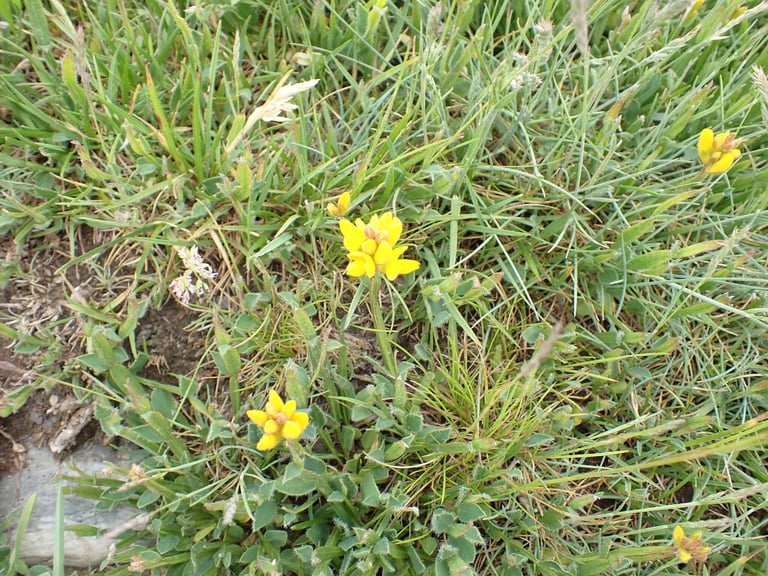
The most useful field mark is the plant's greyish-green, somewhat succulent foliage combined with clusters of purple flowers that turn bluer with age. The stem is limp, wingless, and often hairless, reaching 15 to 30 centimeters.
Leaves are alternate and almost stalkless, with large, wide stipules. Each leaf blade is pinnate, bearing three to five pairs of narrow, blunt-tipped leaflets with entire margins, ending in a terminal tendril that helps the plant climb or sprawl.
The inflorescence sits on a long stem and carries five to twelve flowers, each 14 to 20 millimeters long. Like other legumes, the flowers are irregular, with five sepals, five petals arranged as a standard, two wings, and a fused keel, plus ten stamens and a single carpel. Flowering occurs in mid-to-late summer, July and August in the Northern Hemisphere.
The fruit is a long brown pod reaching up to 50 millimeters.
Distribution and Habitat
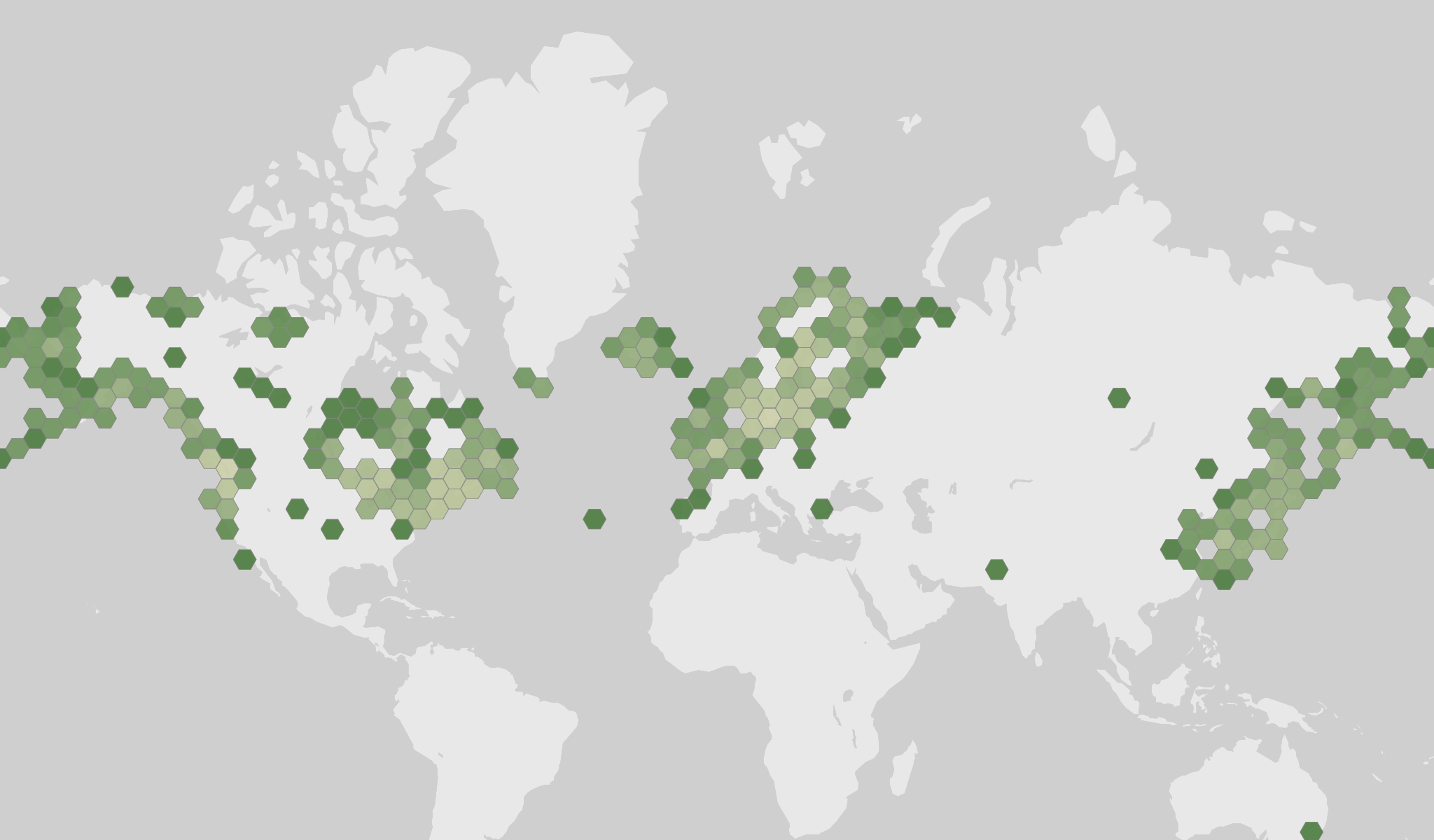
Lathyrus japonicus occurs across temperate coastal areas of Europe, Asia, and North and South America, from the Aleutian Islands and Alaska through Scandinavia, Britain, and Japan, to scattered sites in the northeastern and northwestern United States and Canada. It has also become established in central Chile.
Its typical habitat is sandy or stony seashores and other coastal locations, where wave action abrades the hard seed coat and triggers germination directly on beach sand or gravel.
The species' unusually broad native range is explained by seeds that remain viable while floating in seawater for as long as five years, letting them drift across ocean basins to reach distant shores.
Observation records peak sharply in the warmer months, consistent with the plant's mid-to-late summer flowering and greater visibility during that period, though such records only show where the species has been seen, not how abundant it is.
Growth and Form
Lathyrus japonicus is a climbing perennial, sprawling low over coastal sand and gravel rather than standing upright. Its limp, wingless stems typically reach 15 to 30 centimeters, supported by tendrils at the tips of its leaves that let it grip nearby structures or vegetation as it spreads across the beach.
Ecology and Relationships
As a legume, Lathyrus japonicus forms relationships with nitrogen-fixing bacteria, including Rhizobium leguminosarum and Rhizobium phaseoli, which associate with its roots. This partnership likely helps the plant establish in the nutrient-poor sandy and stony soils typical of its coastal habitat.
Its purple flowers are visited by several bumblebee species, including Bombus hortorum, Bombus lapidarius, and Bombus terrestris, though a flower visit alone does not confirm that pollination occurs.
The plant's tolerance of sandy, stony seashores and its climbing growth habit suit the harsh, exposed conditions of open coastal ground where few other legumes persist.
Fun Facts
- The beach pea's common names include sea pea, circumpolar pea, and sea vetchling, reflecting both its coastal habitat and its vast, near-global distribution.
- At their peak, the small peas inside the pods have been described as tasting even sweeter than delicate petit pois, despite being much smaller than garden peas.
- Beyond its native range across the Northern Hemisphere, the species has also established itself as far south as Argentina.
Photos
Photographs from via iNaturalist, licensed under CC0 1.0., by Matt Berger via iNaturalist, licensed under CC BY 4.0., by Alexis Tinker-Tsavalas via iNaturalist, licensed under CC BY 4.0., by Emerson via iNaturalist, licensed under CC BY 4.0., by Patrice Dupont via iNaturalist, licensed under CC BY 4.0., by Полина Полежанкина via iNaturalist, licensed under CC BY 4.0., by Rosario Douglas via iNaturalist, licensed under CC BY 4.0., by John A Haskins via iNaturalist, licensed under CC BY 4.0., by Mary Krieger via iNaturalist, licensed under CC BY 4.0., and by maureen_c-m via iNaturalist, licensed under CC BY 4.0., credited on each photo.
Ecology and classification
Habitat
Growth habit
- Vine
Classification
- Phylum
- Tracheophyta
- Class
- Magnoliopsida
- Order
- Fabales
- Family
- Fabaceae
- Genus
- Lathyrus
- Species
- Lathyrus japonicus
Sources
- GBIF Species names and classification
- iNaturalist Photos
- Wikidata Common names and conservation status
- Wikipedia Summary extract
- Plants of the World Online Native range, life form and climate (WCVP)
- GloBI What it eats, what eats it, parasites and pollinators
- Wardeh et al. 2015 (EID2)
- DoPI