The soybean is the world's most cultivated legume, a single East Asian species that now feeds livestock and people on nearly every continent. It belongs to the legume family Fabaceae, within the order Fabales, and is grown almost exclusively as a domesticated crop rather than found wild. Its two great products, a protein-rich bean and a widely used vegetable oil, have made it a staple of both animal feed operations and human diets.
There is no formal conservation status to speak of, since Glycine max exists today almost entirely as an agricultural crop rather than a wild population. What makes it worth attention is less its rarity than its reach: few plants have reshaped global agriculture, trade, and diets as thoroughly as this one.
Identification and Appearance
The clearest field mark of a mature soybean plant is its compound trifoliolate leaf, made of three to four leaflets each 6 to 15 centimeters long and 2 to 7 centimeters wide. Young seedlings look different: they emerge with a pair of simple cotyledon leaves that function briefly as both leaves and a nutrient source before the first true, single-bladed leaves appear, followed by the three-leaflet form typical of the mature plant.
Fully grown plants stand between 50 and 125 centimeters tall, with roots reaching 75 to 150 centimeters into the soil. Under good conditions the stem adds a new node roughly every four days, and before flowering the roots can extend 2 centimeters per day. Small, inconspicuous, self-fertile flowers form in the leaf axils in white, pink, or purple, and although they need no pollinator, their nectar is high in sugar and draws bees regardless.
The fruit is a hairy pod, 3 to 8 centimeters long, borne in clusters of three to five, with each pod holding two to four seeds 5 to 11 millimeters across. Seed coats vary widely in color, from black and brown to yellow and green, sometimes variegated or bicolored, and each bears a distinct scar called the hilum. A hard, water-resistant hull protects the embryo inside; if that hull cracks, the seed will not germinate.
Flowering timing depends heavily on day length, typically beginning once days shorten below about 12.8 hours, though this threshold varies by variety. Varieties that keep adding nodes after flowering starts are called indeterminate types, better suited to regions with long growing seasons, while others stop node growth once flowering begins.
Distribution and Habitat
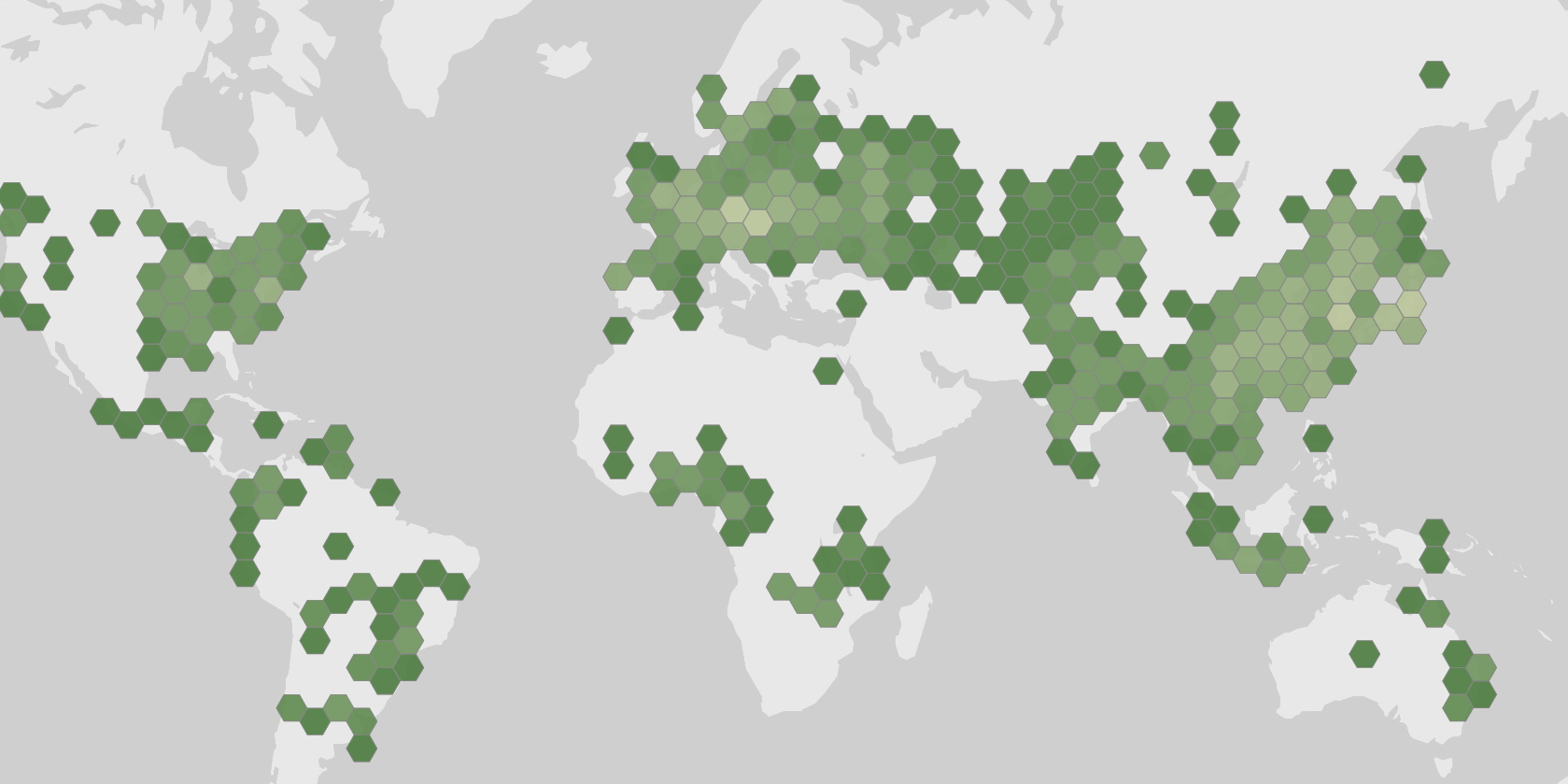
Soybean occurrence records show a pronounced seasonal pattern, with monthly observation counts climbing sharply from June (821) through a peak in September (2,118), after August's 2,067, before falling away to fewer than 220 records from November through March. This pattern almost certainly reflects when the plant is visibly present and actively growing in cultivated fields rather than any change in its underlying range, since these are presence records rather than measures of abundance or population size.
The low counts recorded from November through May likely correspond to periods when soybean plants are absent from fields as bare or fallow ground, harvested, or not yet emerged, rather than the species disappearing from a region. Read together, the data point to a crop whose visible presence is concentrated in the mid-to-late growing season, consistent with a plant sown in late spring and maturing by early autumn.
Ecology and Relationships
The defining ecological relationship of the soybean is its partnership with nitrogen-fixing Rhizobia bacteria, which colonize its roots and convert atmospheric nitrogen into a form the plant can use. This symbiosis begins early: once rhizobia are present in the soil, root nodulation can start by the time the plant's third node appears, and the infection process typically continues developing for about eight weeks before stabilizing.
This nitrogen-fixing capacity, shared with many other legumes, reduces the plant's dependence on nitrogen already present in the soil and instead lets it manufacture a portion of its own nutrient supply through this bacterial relationship.
Uses and Human Relationships
Soybean is grown at enormous scale as a source of protein and oil, planted mechanically in straight rows and harvested with dedicated machinery once mature. It thrives in fertile, well-drained soils under warm temperate conditions, with optimum growth at mean temperatures between 20 and 30°C; growth stalls significantly below 20°C or above 40°C. The crop is concentrated in the United States, Brazil, and Argentina, and modern cultivars typically reach about 1 meter in height and mature in 80 to 120 days from sowing.
Beyond the field, soybeans feed directly into food products such as tofu and cooking oils, as well as animal feed and various industrial uses. Its nitrogen-fixing partnership with the bacterium Bradyrhizobium japonicum lets farmers cut back on nitrogen fertilizer and boost yields in rotation with other crops, though long-term soil organic matter can be affected when soy is rotated intensively with crops like corn. The transformation of Brazil's Cerrado savanna into productive soybean cropland was significant enough that soil scientists Edson Lobato, Andrew McClung, and Alysson Paolinelli received the 2006 World Food Prize for the work.
Growing soybeans at scale also means managing a long list of adversaries: bacterial blight, bacterial pustule, downy mildew, soybean cyst nematode, the Soybean dwarf virus spread by aphids, and insect pests such as the Japanese beetle and corn earworm moth. Whitetail deer and groundhogs can also damage fields, with a single groundhog den capable of consuming a tenth to a quarter of an acre of crop, while resistant cultivars, such as anthracnose-resistant Indian lines carrying two major resistance genes, offer one line of defense.
Fun Facts
- Domesticated soybeans were likely selected from the wild species Glycine soja in northeastern China sometime before the 10th century BCE.
- Long before soy attracted attention in Western food culture, East Asian cooks were already liquidizing, powdering, and curdling soybeans into protein- and oil-rich foods.
- Historical Ayurvedic commentary attributed to Dhanvantari, a student of Charaka, describes a legume called "Vigna Masha"—thought to be Glycine max—used in decoctions to soothe coughs and act as a mild coolant for fevers.
Ecology
Growth habit
- Herb