The green sea turtle owes its name not to the color of its shell—which ranges from olive to nearly black—but to the greenish fat found beneath its carapace, a byproduct of a lifelong diet built almost entirely on seagrass.
Chelonia mydas is a large marine turtle in the family Cheloniidae and the only living species in its genus. It ranges across tropical and subtropical oceans worldwide, with genetically distinct populations centered in the Atlantic and eastern Pacific, plus nesting grounds scattered through the Indian Ocean. The IUCN lists the species as Endangered.
Few reptiles connect the seafloor and the open ocean as thoroughly as this turtle does. Its grazing shapes seagrass meadows that shelter fish and crustaceans, and its decades-long migrations between feeding grounds and natal beaches have made it one of the most closely studied sea turtles in the world.
Identification and Appearance
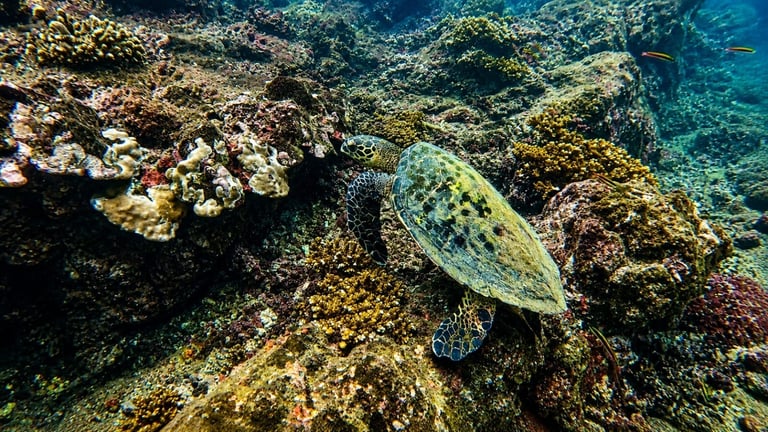
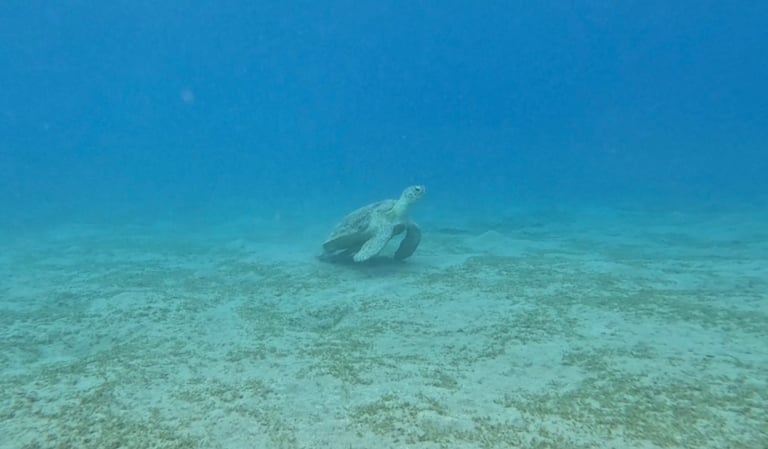
The clearest way to separate this species from other sea turtles is its head: a short, blunt snout tipped with an unhooked beak, unlike the sharp, hooked bill of the closely related hawksbill turtle. Its front flippers typically carry a single claw each, whereas hawksbills carry two, though a second claw sometimes appears on young green turtles.
Adults typically measure 78 to 112 centimeters along the carapace and weigh between 68 and 190 kilograms, though exceptional individuals have topped 315 kilograms, and the largest confirmed specimen weighed 395 kilograms with a 153-centimeter shell. In United States waters, only the leatherback turtle grows larger.
Color changes with age. Hatchlings have mostly black carapaces and pale plastrons; juveniles turn dark brown to olive; mature adults show carapaces that are entirely brown or spotted and marbled with variegated rays. The plastron underneath is yellow, and the dark limbs are lined with yellow and usually marked with a large brown spot at the center of each flipper. The shell itself is built from five central scutes flanked by four pairs of lateral scutes, with four pairs of inframarginal scutes covering the seam between shell and plastron.
Males and females differ in tail and claw length: adult males have a tail that visibly extends past the shell and longer front claws than females. Sex itself is set not by genetics alone but by nest temperature—eggs incubating above 30°C tend to produce females, those below 30°C produce males, and eggs laid in the warmer center of the nest are more likely to hatch as females.
Distribution and Habitat
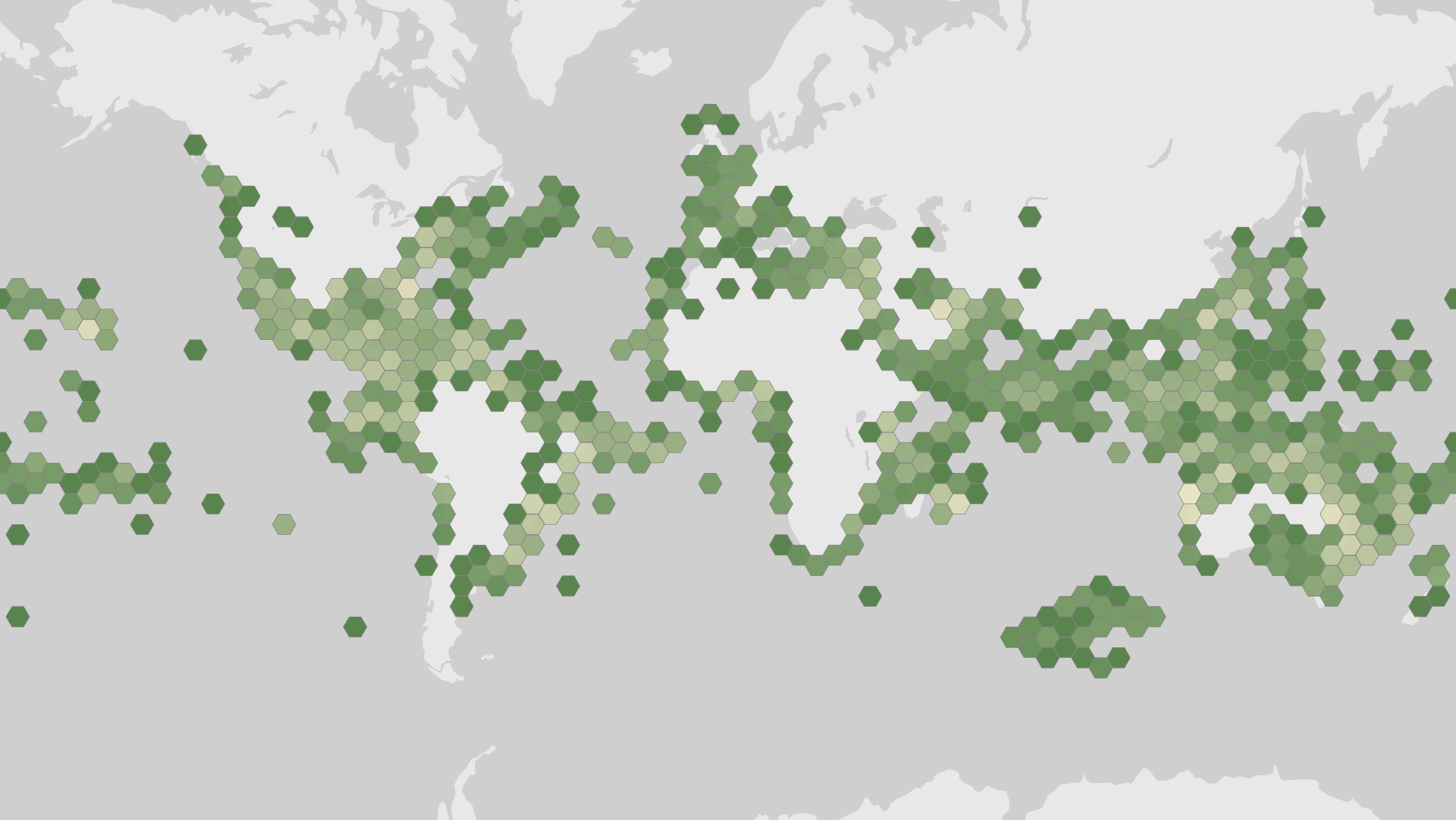
The green sea turtle's native range spans tropical and subtropical waters along continental coasts and islands roughly between 30°N and 30°S, with the species recorded in coastal areas of more than 140 countries and nesting documented in over 80. Two genetically distinct subpopulations dominate the range, one centered in the Atlantic and Mediterranean and one in the eastern Pacific and Indian Ocean, distinguished by different mitochondrial DNA lineages that likely diverged when the cold waters around the southern tips of Africa and South America cut off migration between them.
Habitat use shifts with life stage. Newly hatched turtles drift for years in open-ocean convergence zones as part of the pelagic mininekton, rarely seen inshore. As they mature, they settle into shallow coastal waters, favoring seagrass meadows, coral reefs, and salt marshes in bays, lagoons, and shoals. Water temperature sets a hard boundary on this range: the species avoids waters colder than about 7 to 10°C.
Regionally, the turtle is recorded along the US Atlantic coast from Texas to Massachusetts and along the Pacific coast from southern California to Alaska, with its largest US populations in Hawaii and Florida. Globally, the biggest concentrations occur in Australia's Great Barrier Reef and the Caribbean Sea, alongside major nesting grounds in places such as Costa Rica, the Hawaiian Islands, and the Philippines' Turtle Islands.
Monthly observation counts show a rise from around 18,000 in February to a peak near 33,300 in May, tapering to their lowest point of roughly 18,100 in September before recovering by year's end. These figures are presence records rather than a measure of abundance, but the spring peak hints at seasonal shifts in where and how often the turtles are encountered.
Behavior and Lifestyle
Green sea turtles spend nearly their entire lives submerged, surfacing only briefly to breathe. During routine activity they dive for about four to five minutes at a time and surface for just one to three seconds, exchanging the air in their lungs with a single explosive exhalation and rapid inhalation; when resting rather than actively swimming, they can remain underwater for hours. Migratory individuals cover real distances too, swimming roughly 20 to 90 kilometers a day between feeding grounds and nesting beaches.
The species is not territorial, but individuals do maintain home ranges that combine a coastal feeding area used outside the breeding season with the natal beach visited to nest; these ranges vary enormously, from about 3.8 to 642.2 hectares. Turtles from the same natal beach often travel together in large groups, giving the population a distinctly colonial character even without defended territory.
At night, adults commonly wedge themselves under rocks, ledges, or coral outcrops to rest, and many return to the same sleeping spot night after night. This nocturnal shelter-seeking likely reduces exposure to predators while the turtle is less alert.
Mating behavior includes a social wrinkle: while a pair copulates in the shallow water off nesting beaches, other "escort" males often approach and try to dislodge the mounted male by latching onto him for hours at a time. A threatened male may briefly disengage from the female to drive off these rivals before resuming.
Communication
Vision is the green sea turtle's primary channel for finding food and reading the intentions of other turtles, with courtship and mating governed almost entirely by visual displays rather than sound. Beyond sight, the species also senses the direction of wave propagation—research by Lohmann and Lohmann found that the turtle's inner ear can detect wave acceleration and direction—and it appears to use magnetic cues to orient itself in the open ocean far from any visual landmarks.
Females rely on distinct visual signals to communicate willingness to mate. A receptive female goes completely still and submissive when mounted, while a female rejecting a male either swims away with her hind legs held closed or bites him if he presses too close. A more formal "refusal" posture involves floating upward with her plastron facing the male and all four limbs extended outward.
Hunting and Diet
The green sea turtle's diet shifts dramatically over its lifetime, moving from omnivory to near-total plant-eating as it matures. Hatchlings and juveniles feed on small marine invertebrates and drifting neustonic material, including hydrozoans, bryozoans, and sea hare eggs, giving the young turtles a carnivorous start unlike the herbivorous adults they will become.
Adults graze heavily on marine plants and algae. They consume wetland vegetation such as Avicennia schaueriana and salt-water cord grass (Spartina alterniflora) in salt marshes, along with a range of red and green algae including sea lettuce (Ulva lactuca), lobster horns (Polysiphonia), crinkle grass (Rhizoclonium), and several other named genera.
Because adults are highly mobile and range across many habitats over their lives, their feeding is opportunistic, tracking whatever seagrass or algae is available in a given area rather than specializing on one plant. When grazing seagrass, they characteristically trim only the tops of the blades and leave the roots intact, a feeding style that lets the meadow keep regrowing rather than being stripped bare.
Nesting and Breeding
Green sea turtles are polygynandrous, with both sexes taking multiple mates in a season. Courtship follows a fairly consistent sequence: a male searches for and approaches a female, who either submits or rejects him, and if she accepts, mating follows in the shallow water off the nesting beach, with the male gripping "mating notches" near her shoulders. Copulation can last for hours, and the longest recorded mounting episode stretched to 119 hours, complicated by rival males that try to latch onto the pair and dislodge the mounted male.
Females return to their natal beach, or one with similarly textured and colored sand, at intervals of two to four years to nest between June and September. On arriving, a female clears debris from the site, digs a chamber with her front flippers, lays her eggs, then fills and camouflages the nest with sand before heading back to the sea.
A single female can lay one to nine clutches in a season, though three is typical, and each clutch holds 75 to 200 eggs. After 45 to 75 days of incubation, the eggs hatch and the hatchlings, weighing only about 26 grams each, make their own way to the water.
Parental care ends the moment the nest is camouflaged; the mother provides no further protection or provisioning. The hatchlings then spend an extended juvenile period, taking 27 to 50 years to reach sexual maturity before returning to breed near their own natal beach.
Population and Ecological Role
Beyond its own numbers, the green sea turtle functions as an ecosystem engineer of seagrass meadows. By grazing only the tops of seagrass blades, adults keep the meadow regrowing rather than exhausting it, and their nitrogen-rich feces act as a natural fertilizer that supports plant growth benefiting the fish and crustaceans that shelter there; on nesting beaches, leftover hatched eggshells similarly return nutrients to the sand. On coral reefs, yellow tang fish groom algae, barnacles, and parasites off the turtles' shells and flippers, a partnership that feeds the fish while reducing drag and improving the turtle's health.
Predation pressure varies sharply by life stage. Tiger sharks are the principal predator of adults, hunting turtles of all sizes and often concentrating near nesting beaches in places like Hawaii, where turtles are confined and vulnerable. Hatchlings and juveniles face a much longer list of predators, including crabs, small marine mammals, and shorebirds, while unhatched eggs are targeted by scavengers such as red foxes and golden jackals.
Disease and parasites take a further toll. Barnacles and leeches attach to the shell, flippers, and skin, causing tissue damage and blood loss, while protozoans, cestodes, and nematodes cause fatal liver and intestinal infections. The most serious disease threat is fibropapilloma, a herpesvirus-driven condition that produces lethal tumors on the scales, lungs, stomach, and kidneys and is spread by the leech Ozobranchus branchiatus, which feeds almost exclusively on green sea turtles. Turtles also carry several fluke species, including Learedius leardei and Hapalotrema postorchis, which inflame cardiovascular tissue and commonly prove fatal.
Conservation and Threats
The IUCN Red List classifies the green sea turtle as Endangered, and CITES places it on Appendix I, the strictest category, banning international commercial trade except under research permits. Listings differ by region: the US Federal List treats Mediterranean, Central West Pacific, and Central South Pacific populations as endangered, while most other populations are classified as threatened.
Marine fisheries pose the most severe ongoing threat, catching mature and juvenile turtles in foraging areas and on nesting grounds through harpooning, hand-capture, netting, noosing, and flipping turtles onto their backs. Artificial light near nesting beaches is a serious secondary threat, since turtles can mistake it for sunlight; this has been linked to disoriented adult return crawls and incomplete nest construction. Poaching for eggs, meat, and shells persists in parts of the world despite legal protection.
Enforcement and international agreements have blunted some of these pressures. In the United States, the Fish and Wildlife Service and National Marine Fisheries Service enforce laws against capturing turtles on land or in water, and multilateral agreements such as the Memorandum of Understanding on ASEAN Sea Turtle Conservation and Protection, the Atlantic Coast of Africa marine turtle MOU, and the Inter-American Convention for the Protection and Conservation of Sea Turtles have reduced fishery-related harm even as near-shore fishing pressure continues.
Cultural Significance
The genus name Chelonia comes from the Greek Χελώνη (Khelônê), and Greek mythology tells of Chelone, a nymph turned into a tortoise by Zeus as punishment for her insolence or laziness, a story echoed in one of Aesop's fables. The species epithet mydas is likewise Greek, meaning "humid," a reference to the turtle's aquatic life.
For many First Nations peoples across Australia, sea turtles including the green sea turtle carry deep spiritual and cultural significance and have long served as a traditional food source; it is one of six marine turtle species found in Australian waters.
That cultural and culinary importance persists in less sustainable forms today: despite widespread legal protection, green sea turtles are still poached for their eggs and meat in some parts of the world, including Southeast Asia, and their shells are turned into jewelry or displayed as decoration.
Fun Facts
- Green sea turtles are the fastest of the sea turtles, capable of swimming up to 40 miles per hour (about 64 km/h).
- Hatchlings weigh only about 26 grams when they emerge from the nest, barely more than a handful of coins.
- The longest recorded mating clasp between a male and female lasted 119 hours.
- On coral reefs, yellow tang fish groom green turtles, picking algae and parasites off their shells in a relationship that benefits both species.
- Chelonia mydas is the only living species in its genus, making it taxonomically distinct among the world's sea turtles.
Ecology
Habitat
- Wetland
- Marine
- Coastal
Behavior
- Predator
- Aquatic
- Social
- Migratory
Diet
- Omnivore
Photos
SourcesGBIFiNaturalistWikidataWikipediaEncyclopedia of LifeAnimal Diversity WebAnAge