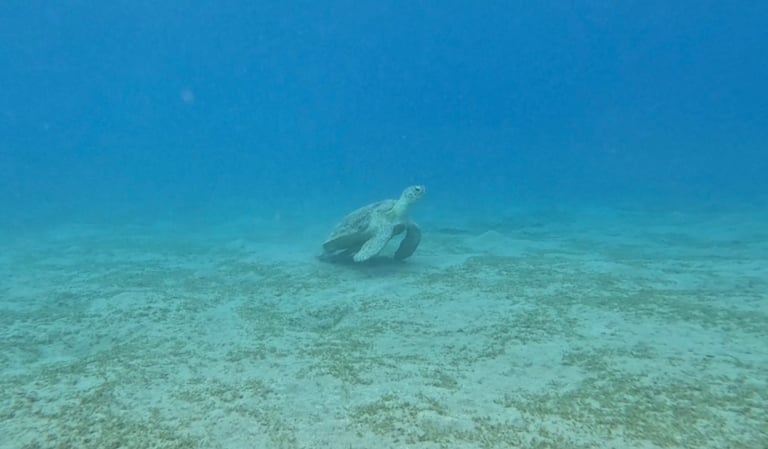
Few sea turtles face a bleaker outlook than the hawksbill: it is classified as Critically Endangered across its entire global range.
Eretmochelys imbricata is the only living species in its genus and belongs to the sea turtle family Cheloniidae. It ranges through tropical and subtropical waters of the Atlantic, Indian, and Pacific Oceans, moving between coral reefs, rocky shoals, mangrove estuaries, and the open sea. Its Critically Endangered status reflects centuries of hunting for its patterned shell alongside continuing pressure from habitat loss and fishing bycatch.
What sets the hawksbill apart is not just its rarity but its role as a specialist reef feeder: it is the first reptile ever documented to glow under blue light, and its selective diet helps shape the very reefs it depends on.
Identification and Appearance
An elongated, tapering head ending in a sharply hooked, beak-like mouth is the hawksbill's most reliable field mark, giving the species its common name. Each flipper carries two visible claws, a trait shared by few other sea turtles.
Adults typically reach about 1 m (3 ft) in shell length and weigh around 80 kg (180 lb) on average, though the heaviest individual ever recorded weighed 127 kg (280 lb).
The carapace carries an amber background overlaid with irregular streaks of black and mottled brown radiating toward the sides. Five central scutes and four pairs of lateral scutes make up the shell, and the posterior scutes overlap to give the rear margin a serrated, saw-like edge, a pattern found in few other cheloniids.
Males show more intensely pigmented shells and skin than females, though the behavioral purpose of this difference is unclear. The species is also biofluorescent under blue light, the first reptile documented with this trait, possibly linked to biofluorescent prey such as the hard coral Physogyra lichtensteini. On sand, its alternating gait leaves asymmetrical tracks, unlike the more symmetrical trails left by green or leatherback turtles. Because hawksbills feed on venomous cnidarians, their flesh can become toxic to humans who eat it.
Distribution and Habitat
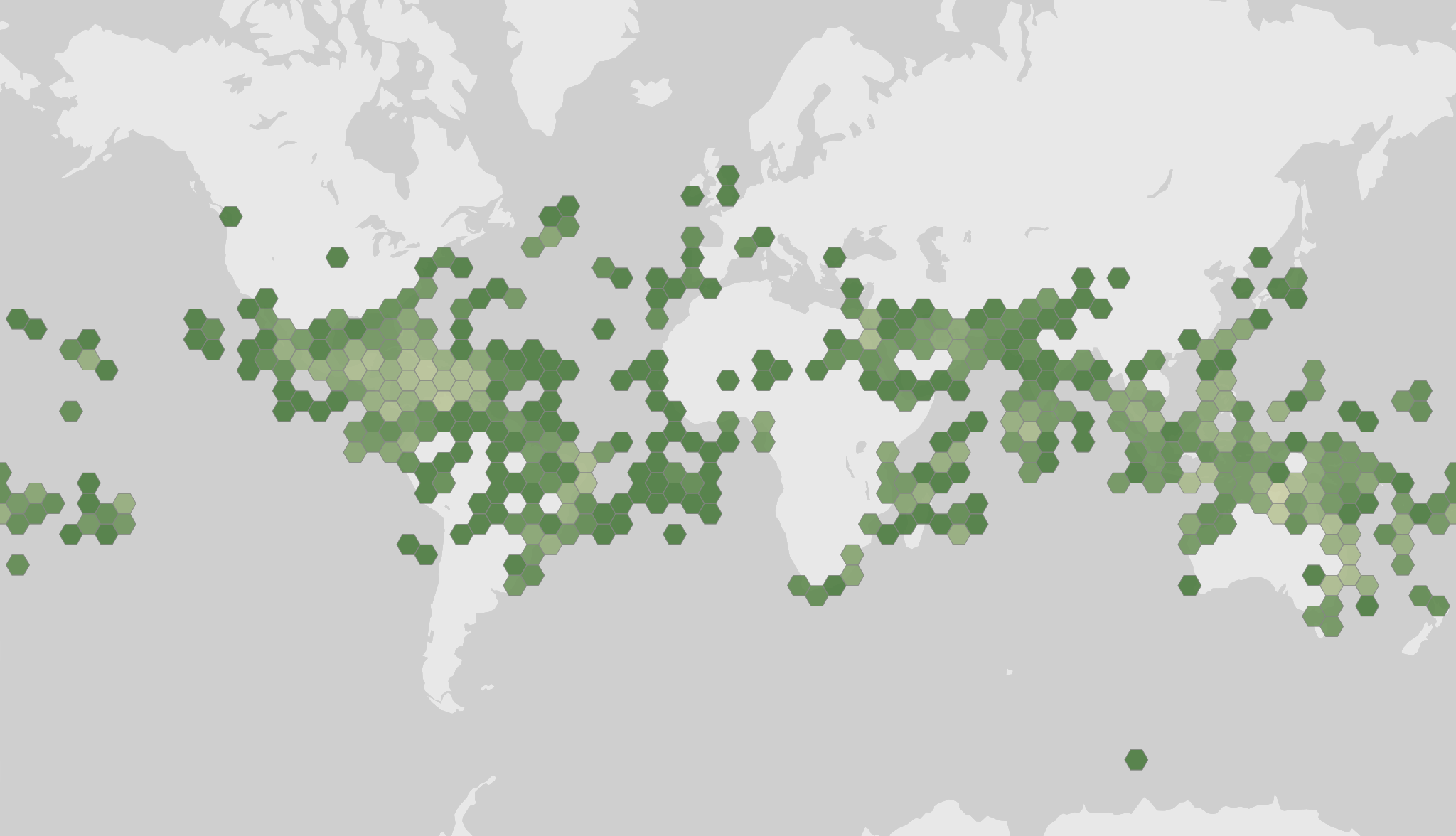
Hawksbill sea turtles occur throughout tropical and subtropical waters of the Atlantic, Indian, and Pacific Oceans, with two recognized subpopulations centered in the Atlantic and Indo-Pacific. They favor hard-bottomed reef habitats rich in sponges, resting in caves and ledges among coral and rock by day, and also use rocky outcrops, oceanic lagoons, and continental shelves.
The species rarely dives below about 18 m (60 ft) and also uses mangrove-lined estuaries, shallow lagoons, and open water during long migrations. Young hawksbills cannot yet dive to depth and instead drift among floating mats of sargassum and other sea plants until they are large enough to settle on reefs.
Monthly observation records show counts rising from roughly 1,300 to 2,000 sightings between January and June to a peak above 3,000 in August and October, before tapering off by December. This pattern likely reflects seasonal changes in surface activity and observer effort near reefs rather than a true measure of abundance.
Behavior and Lifestyle
Hawksbills are solitary, diurnal foragers, spending their days combing reefs and continental shelves in search of sponges and other prey rather than traveling in groups.
Long thought to stay near a single reef for life, the species is now known to undertake long-distance migrations between feeding grounds and remote nesting beaches, sometimes crossing entire ocean basins.
Activity patterns shift around the mating season, when turtles become more active and gather near nesting beaches, a departure from their otherwise steady daytime routine.
Communication
Hawksbills rely mainly on visual and tactile cues, particularly during ritualized mating behavior between males and females in shallow water near nesting beaches.
Beyond mating displays, the species also perceives its surroundings through acoustic, chemical, and magnetic senses. The mechanism that guides females back to their natal nesting beaches is still not fully understood, but researchers suspect a combination of magnetic-field orientation and cues tied to lunar phase and position.
Diet and Nutrition
Sponges make up the core of the hawksbill's diet, and the species shows strong feeding selectivity, targeting only certain sponge species, including some that are toxic to other animals, while ignoring others nearby.
Sea jellies and other cnidarians are also regular prey, supplementing a diet that is broadly omnivorous. Hawksbills additionally take mollusks, fish, crustaceans, marine algae, and other invertebrates as they become available.
Preferred feeding grounds include shallow shoals thick with brown algae, where sponge colonies and other prey are abundant enough to support the turtle's highly selective feeding strategy.
Nesting and Breeding
Courtship and mating take place mainly in shallow water near nesting beaches, with males waiting offshore for females and occasionally following them onto the sand, though this is rarely observed. Mating timing varies by region: Atlantic hawksbills breed between April and November, while Indian Ocean populations such as those in the Seychelles mate from September to February.
Nesting itself takes one to three hours. A female hauls herself onto the beach at night, clears debris from a chosen site, digs a pit with her hind flippers, deposits her clutch, and fills and disguises the site before returning to the sea. Females typically lay three clutches per season at intervals of roughly 13 to 15 days, with around 140 eggs per clutch in Caribbean and Florida nests; nesting there runs mainly from July to October.
Eggs incubate in the sand for about 60 days with no further attention from the mother. Hatchlings emerge at night weighing less than 24 g (0.85 oz), with dark, heart-shaped carapaces around 2.5 cm (about 1 in) long.
Guided toward the water by the moon's reflection on the sea, hatchlings that fail to reach the surf by daybreak fall prey to shorebirds, shore crabs, and other predators; artificial lighting near beaches can disrupt this orientation and strand them ashore.
Population and Ecological Role
Because hawksbills are migratory and scattered across dozens of countries, and because historical baselines are poorly documented, assessing overall population size and trend is difficult: numbers appear stable or even recovering in some locations while remaining scarce in others.
Ecologically, the species acts as something of a reef engineer. By selectively grazing on sponges, hawksbills trigger successional turnover on reefs, opening space for other invertebrates and organisms to settle and helping maintain a diverse, open substrate.
Conservation and Threats
The hawksbill sea turtle is classified as Critically Endangered by the IUCN, listed under CITES Appendix I, and protected as Endangered under the US federal list, among the strictest tiers of international and national protection, reflecting severe, long-term population declines.
Historically, the greatest threat has been direct hunting, chiefly for its scutes, the source of tortoiseshell, along with harvest of its meat and eggs. Trade in hawksbill products is now illegal worldwide, though enforcement varies, and the species' migratory, wide-ranging habits make coordinated protection difficult without cooperation among every nation whose waters it passes through.
Some protected sites show encouraging signs: the Seychelles' Cousine Island has legally protected its nesting hawksbills since 1994, and its population has begun to recover. Programs such as the Florida Hawksbill Project also monitor reef aggregations and educate divers along Florida's roughly 350-mile barrier reef tract.
Conservation status
- LC
- NT
- VU
- EN
- CR
Critically Endangered
Cultural Significance
Sea turtles including the hawksbill hold lasting importance in the folklore and spiritual life of coastal and Indigenous peoples worldwide, appearing in art, mythology, and ritual practice across many cultures.
On Rapa Nui and other Pacific islands, turtles feature prominently in traditional art, symbolism, and ceremonial life, reflecting a connection maintained across generations. In ancient Egypt, turtle carapaces and scutes, including those from Red Sea hawksbills, were fashioned into rings and other ornaments, even as turtles later came to be regarded with suspicion as an "abomination of Ra."
For people today, the species' most consequential cultural role remains the market for its scutes and meat: hawksbills have long been hunted for tortoiseshell, and both their flesh and eggs have been eaten in various regions.
Fun Facts
- The hawksbill is the only living species in the genus Eretmochelys.
- The Philippines' "Turtle Islands" take their name from the hawksbills and green sea turtles that nest there.
- In 2018, about 120 hawksbill hatchlings emerged from nests on Pulau Satumu, a tiny island off Singapore.
- A hawksbill's wedge-shaped shell lets it squeeze into tight crevices and gaps within coral reefs for shelter.
Ecology
Habitat
- Wetland
- Marine
- Coastal
Behavior
- Solitary
- Aquatic
- Diurnal
- Migratory
Diet
- Omnivore
Photos
SourcesGBIFiNaturalistWikidataWikipediaEncyclopedia of LifeAnimal Diversity WebAnAge