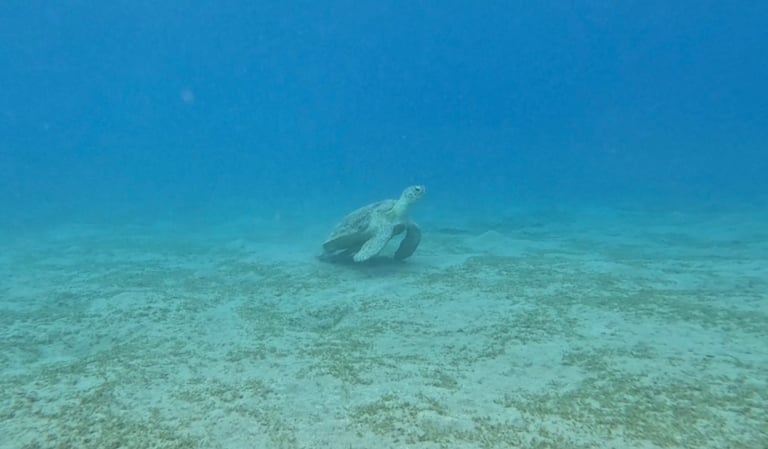
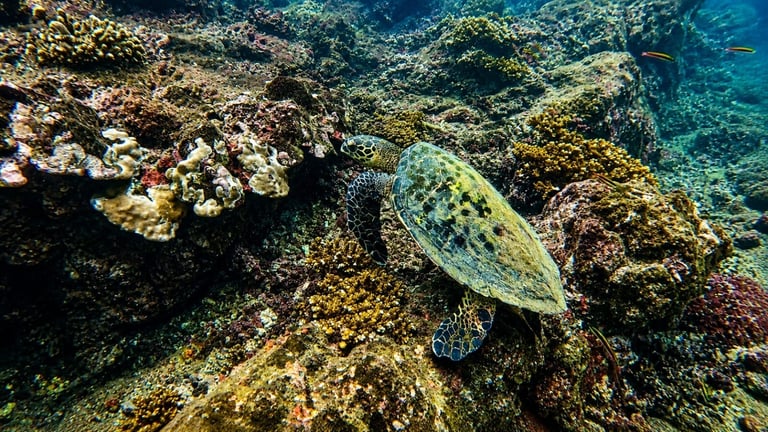
The loggerhead sea turtle can weigh as much as 200 kilograms, with an average adult tipping the scales around 135 kg and a carapace length near 90 cm — making it one of the largest hard-shelled turtles in the world's oceans. Caretta caretta is a marine reptile in the family Cheloniidae, found throughout the Atlantic, Pacific and Indian Oceans as well as the Mediterranean Sea. The IUCN lists the species as Vulnerable.
Its reddish-brown shell and yellow-brown skin blend into coastal waters worldwide, and the species' long migrations and deep nesting history make it one of the most closely studied sea turtles on the planet.
Identification and Appearance
The single best way to recognize a loggerhead is its oversized head and powerful, crushing jaws, built for cracking hard-shelled prey. It is the largest hard-shelled turtle in the world, slightly heavier at average and maximum weights than the green sea turtle or the Galápagos tortoise, and second in size only to the leatherback sea turtle among all living turtles. Adults typically weigh between 80 and 200 kg (averaging about 135 kg) and measure 70 to 95 cm in straight carapace length, though the largest recorded individual weighed 545 kg with a total length of 213 cm.
The head and carapace range from yellow-orange to reddish brown, while the plastron beneath is pale yellow; the neck and sides are brown above and yellow below. The carapace is built from large scutes: typically 11 to 12 pairs of marginal scutes ring its edge, five vertebral scutes run down the midline, and five pairs of costal scutes flank them, with a single nuchal scute at the base of the head. Three pairs of inframarginal scutes form the bridge connecting the carapace to the plastron. Unlike many turtles, loggerheads cannot retract their head or flippers into this shell.
Sexual dimorphism only appears once turtles reach adulthood. Males grow longer tails and claws than females, and have shorter plastrons — likely to accommodate their larger tails — along with wider, less domed carapaces and broader heads. Juveniles and subadults show no external differences between the sexes; determining sex before maturity requires internal examination such as laparoscopy or hormone assays.
A close look at the skull reveals another identifying trait: the maxillae meet at the midline of the palate, and the area behind the eyes is noticeably large and bulbous from the bulk of the jaw muscles that power its bite. Paired lachrymal glands behind each eye excrete excess salt absorbed from seawater; on land, especially during nesting, this gives the false impression that the turtle is crying.
Distribution and Habitat
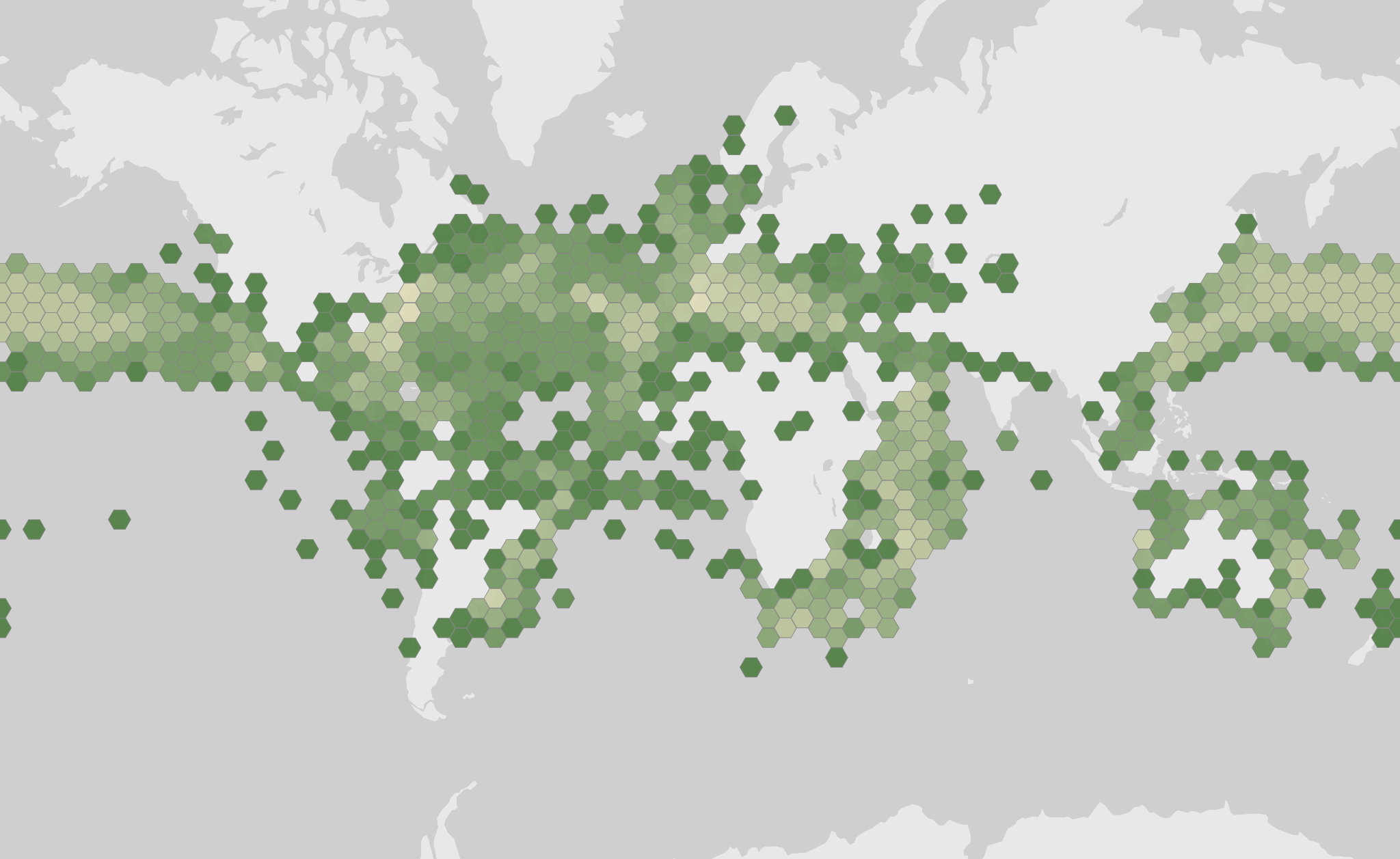
Loggerhead sea turtles have a cosmopolitan range and nest across a broader geography than any other sea turtle, occurring in the Atlantic, Indian and Pacific Oceans as well as the Mediterranean Sea. In the Atlantic, the largest concentrations are along the southeastern coast of North America and the Gulf of Mexico; Florida alone hosts more than 67,000 nests a year, with nesting extending from Virginia south to Brazil and east to Cape Verde, the only significant nesting site on the Atlantic's eastern side.
In the Indian Ocean, loggerheads feed along the coasts of Africa and the Arabian Peninsula and nest from Mozambique's Bazaruto Archipelago to South Africa's St Lucia estuary; Oman alone supports around 15,000 nests, the world's second-largest nesting population, while Western Australia adds 1,000 to 2,000 nests annually. In the Pacific, major nesting grounds are in eastern Australia and Japan — genetic and tracking studies suggest roughly 95% of loggerheads found along the Americas hatched on Japanese beaches, drifting across one of the longest migration routes of any marine animal. One tracked female, Adelita, swam 14,500 km from Mexico back across the Pacific toward Japan in 1996, the first animal of any kind ever tracked across an entire ocean basin.
The Mediterranean Sea functions as a nursery for juveniles and a seasonal home for adults in spring and summer; nearly 45% of its juvenile population originated in the Atlantic. Greece hosts the region's largest nesting concentration, with more than 3,000 nests a year centered on Zakynthos and Kyparissia Bay, followed by Cyprus and Turkey.
Habitat use shifts through life: hatchlings head straight offshore, young juveniles drift for years among Sargassum mats in warm currents, and older juveniles and adults settle into coastal waters with rocky or muddy bottoms, venturing into coral reefs, salt marshes, brackish lagoons and river mouths. GBIF presence records — not a measure of abundance — show observations rising from around 12,000 in January to a peak near 25,000 in July, consistent with greater seasonal presence in nearshore waters during the warmer months.
Behavior and Lifestyle
Loggerheads are most active during daylight hours, whether resting motionless on the seafloor with forelimbs half-extended or swimming using an alternating-limb stroke that juveniles adopt fully by one year old. They spend up to 85% of each day submerged, with typical dives lasting 15 to 30 minutes, though individuals can remain underwater for more than ten hours — longer than any other air-breathing marine vertebrate. Males dive and swim more actively than females.
The species undertakes extensive migrations between nesting beaches, feeding grounds, and seasonal refuges, with some individuals covering up to 4,828 km. Adults and juveniles in temperate waters move toward the equator each winter to avoid cold-stunning, a lethargic, floating state triggered once water temperatures drop below about 10 °C and potentially fatal below 5 °C; younger turtles tolerate cold slightly better, only stunning below 9 °C. Many adults show strong homing behavior, returning to the same nesting beach — often the one where they themselves hatched — year after year, and juveniles removed from their feeding grounds can find their way back.
Female-female aggression, unusual among marine vertebrates, is common in loggerheads and follows a ritualized escalation: initial contact leads to circling, then direct confrontation, jaw-snapping combat, and finally separation, either mutual or as one turtle chases off the other. An upright tail signals willingness to keep fighting, while a curled tail signals submission. Because aggression is costly, turtles are most likely to escalate conflicts over access to good foraging grounds, and similar territorial disputes have been documented in captivity.
Communication
Loggerhead communication relies mainly on visual, tactile and chemical cues rather than sound. During courtship, males use nuzzling, biting and flipper movements, and glandular secretions — particularly from Rathke's gland — may help bring the sexes together through scent.
Hatchlings orient themselves almost entirely through perception rather than memory: emerging from the nest at night, they head toward the brightest light on the horizon, historically moonlight or starlight over open water, and toward the lower-elevation side of the beach. Once at sea, they switch to chemical and magnetic cues to find the ocean currents that will carry them through their juvenile years.
Adults and older juveniles continue to rely on magnetic and chemical information to navigate during migration, using on-site cues rather than memory of previous routes — a form of map-based orientation. Food is located primarily by sight and smell.
Diet and Nutrition
Loggerheads are dietary generalists with a primarily carnivorous diet that also includes algae and seagrasses, making them functionally omnivorous. Their oversized heads and powerful jaws are adapted for crushing hard-shelled prey such as horseshoe crabs, bivalves, barnacles, whelks and conchs.
Beyond hard-shelled prey, they take a wide range of other invertebrates and small vertebrates, including sponges, jellyfish, cephalopods, shrimp, sea urchins, insects, and fish and fish eggs from genera such as Brevoortia, Ceratoscopelus and Diodon. Plant matter — algae including Ascophyllum, Ulothrix, Urospora and Sargassum, and seagrasses such as Cymodocea, Thalassia and Zostera — supplements the diet.
Diet varies slightly by life stage but stays generalist throughout: pelagic juveniles feed opportunistically among drifting Sargassum mats, while older juveniles and adults forage over reefs and rocky or muddy coastal substrates where hard-shelled invertebrates are common.
Nesting and Breeding
Courtship begins as males migrate to offshore mating grounds ahead of the nesting season and wait for females, a period that can last more than six weeks. A male circles a female, approaches to bite her neck or shoulder, and attempts to mount her; if she is unreceptive she covers her cloaca and dives, though a persistent male may try again when she surfaces for air. Rival males often bite and ram a mounted male's flippers and tail hard enough to expose bone, and mating itself can last for hours. Mating typically happens along migration routes rather than near the nesting beach, and ovulation appears to be induced by mating itself — a trait rare outside mammals.
In the Northern Hemisphere, mating runs from late March to early June and nesting from May to August; in the Southern Hemisphere nesting falls between October and March. A female nests every 12 to 17 days, producing an average of 3.9 clutches per season before becoming reproductively quiescent for two to three years. Because females can store sperm from multiple males, a single clutch of eggs may have as many as seven different fathers.
To nest, a female crawls ashore, digs a body pit, then excavates an egg chamber with her hind limbs and deposits an average of about 112 round, soft-shelled eggs — typically 110 to 130 — before covering the nest and returning to the sea, a process taking one to two hours. Eggs incubate for 45 to 80 days depending on temperature. Females favor steeply sloped, high-energy beaches near dune grass that helps camouflage the nest, and most return to nest close to where they themselves hatched.
There is no parental care after nesting; a female's investment ends with the yolk she provisions each egg, which can sustain a hatchling for days or weeks after emergence. Loggerheads do not reach sexual maturity until their carapace exceeds about 90 cm, typically between 12 and 35 years of age, and females that survive to breed may continue doing so for decades given the species' recorded lifespan of up to 77 years.
Population and Ecological Role
Loggerheads have been described as a keystone species because of their outsized ecological footprint. By consuming large numbers of hard-shelled invertebrates, they influence prey populations directly, and the broken shells they leave behind become a calcium source for other marine species.
Their own bodies support an entire community: more than 100 species from 13 animal phyla and 37 kinds of algae live on a loggerhead's carapace, and a 2018 Florida State University study of 24 turtles found an average of 33,000 tiny organisms per shell, with one individual carrying 150,000. This has led researchers to describe loggerheads as a kind of mobile reef.
Eggs and hatchlings feed a wide range of predators, from ghost crabs, ants and beetles to raccoons, foxes, feral dogs and seabirds, and a substantial share of every clutch is lost this way before turtles even reach the water. Introduced predators have caused severe local damage: red foxes introduced to Australia once destroyed up to 95% of clutches at some eastern coastal sites in the 1970s, while raccoons along the southeastern United States have wiped out nearly 100% of clutches on some Florida beaches in a single season. Disease also takes a toll, including fibropapillomatosis tumors linked to a herpes-type virus and trematode infections that can damage the heart and brain.
Conservation and Threats
The IUCN lists Caretta caretta as Vulnerable, and it is classified as Threatened under the U.S. Endangered Species Act and listed on CITES Appendix I, restricting international trade. Even so, loggerheads remain the most common and least-threatened sea turtle in North American waters, while populations elsewhere continue to decline.
Bycatch in commercial fishing gear — longlines, gillnets, shrimp trawls, traps and dredges — is the leading cause of decline worldwide, drowning or injuring turtles caught in unattended equipment; in 2000 alone, pelagic longlining in the Pacific killed an estimated 2,600 to 6,000 loggerheads. Direct exploitation for meat and eggs continues in parts of Central and South America, Africa, Asia and the Mediterranean despite falling demand elsewhere, and consuming turtle products carries its own risk of bacterial illness and toxic metal accumulation.
Coastal development compounds these pressures: artificial lighting near nesting beaches disorients hatchlings, drawing them toward buildings instead of the sea and causing tens of thousands of deaths a year, while beachfront construction and human disturbance of nesting females further reduce nesting success. Plastic pollution adds another threat — turtles mistake floating debris for jellyfish, leading to intestinal blockage, malnutrition and exposure to toxic compounds like polychlorinated biphenyls that can thin eggshells. Rising temperatures and sea levels from climate change threaten to skew hatchling sex ratios and flood nesting beaches outright.
Turtle excluder devices (TEDs) are now required in U.S. commercial shrimping and fishing nets, alongside gear modifications and seasonal area closures, and the United States has embargoed shrimp caught without such protections; wire mesh covers over nests have also sharply cut raccoon predation in Florida.
Conservation status
- LC
- NT
- VU
- EN
- CR
Vulnerable
Cultural Significance
Sea turtles like the loggerhead appear in the art and mythology of several ancient civilizations, often as symbols of wisdom, longevity and a connection to the sea. Some traditions have linked turtles more broadly to Hindu concepts of dharma and ahimsa, the principle of avoiding harm to living beings, reflecting the wider reverence turtles have held across cultures.
Today the loggerhead's most direct relationship with people is practical rather than symbolic: it draws ecotourists who come to snorkel, dive, or watch nesting females on beaches, and because it is the most common sea turtle in U.S. waters, it is also the species most sea turtle research is based on. In parts of Central and South America, Africa, Asia and the Mediterranean, loggerheads and their eggs are still harvested as food, and their body parts have been used as a source of material.
Fun Facts
- The loggerhead's name comes from its unusually large, block-like head, built to house the powerful jaw muscles it uses to crush hard-shelled prey.
- In 1996, a tracked female named Adelita swam 14,500 km from Mexico back across the Pacific toward Japan — the first animal of any kind ever tracked across an entire ocean basin.
- A loggerhead's carapace can host more than 100 species of hitchhikers, from barnacles to skeleton shrimp, earning it the nickname a mobile reef.
- Nesting females appear to shed tears, but they are simply excreting excess salt through glands located behind their eyes.
- A single clutch of eggs can have as many as seven different fathers, thanks to the female's ability to store sperm from multiple mates.
- Loggerheads can hold their breath for over ten hours while resting, longer than any other air-breathing marine animal.
Ecology
Habitat
- Wetland
- Marine
- Coastal
Behavior
- Solitary
- Territorial
- Diurnal
- Migratory
Diet
- Omnivore
Photos
SourcesGBIFiNaturalistWikidataWikipediaEncyclopedia of LifeAnimal Diversity WebAnAge