The largest living species of tortoise, the Galápagos tortoise can weigh up to 417 kg (919 lb), making it also the largest surviving terrestrial cold-blooded animal on Earth.
Chelonoidis niger is a giant tortoise of the family Testudinidae, native to the Galápagos Islands off Ecuador. The species is made up of 15 subspecies, but the nominate form, C. n. niger, was hunted out of existence in the 19th century and is now classified as Extinct.
Its history stretches from deep evolutionary roots on the South American mainland to near-total loss at human hands, followed by one of the most determined tortoise recovery efforts ever attempted.
Identification and Appearance
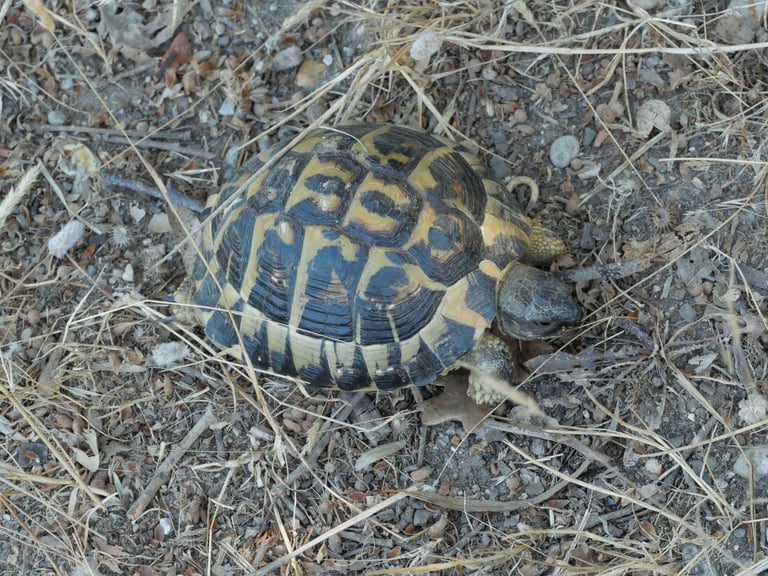
The single most useful field mark is shell shape: Galápagos tortoises range from domed, evenly rounded carapaces to saddleback shells that arch sharply upward at the front. Domed tortoises come from larger, humid islands like Santa Cruz where ground vegetation is abundant, while saddlebacks evolved on smaller, drier islands such as Española and Pinzón, where their upturned shell rims let them stretch their necks higher to reach sparse food.
These are enormous animals. The largest recorded individuals have topped 400 kg (880 lb) and reached 1.87 meters (6.1 ft) in length. Mature males of the larger-bodied subspecies typically weigh 272 to 317 kg (600 to 699 lb), while females run smaller at 136 to 181 kg (300 to 399 lb). Size varies enormously by island: Pinzón tortoises max out around 76 kg (168 lb) with shells near 61 cm (24 in), compared to shells of 75 to 150 cm (30 to 59 in) on Santa Cruz. Their size overlaps heavily with the Aldabra giant tortoise, though Galápagos individuals average slightly larger.
The shell is dull brown or grey, its plates fused rigidly to the ribs, and lichens often grow across its surface on these slow-moving animals. The legs are thick and stumpy with dry, scaly skin; the front feet carry five claws, the back feet four. A tortoise can pull its head, neck, and forelimbs into the shell for protection, though in saddlebacks this leaves a wide, unprotected gap over the neck — a sign that predation played little role in shaping this form.
Sexes and lineages can be told apart by subtle shell features and neck length, with saddleback males in particular developing longer necks tied to their dominance displays. Growth bands on the shell are not reliable for judging age, since the outer layers wear away over the decades.
Distribution and Habitat
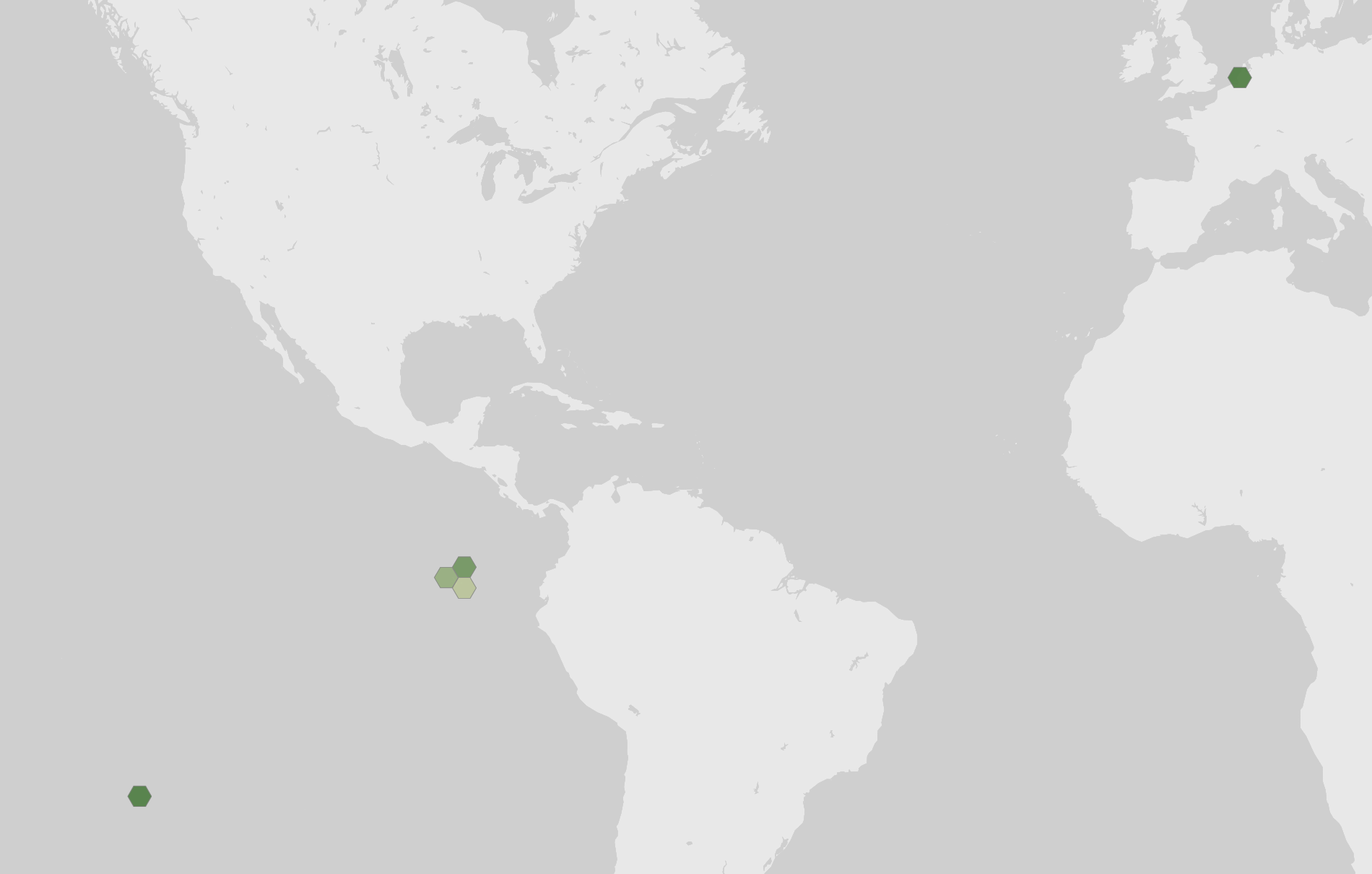
Galápagos tortoises are found only across the Galápagos Islands, where separate subspecies occupy separate islands or volcanoes. Habitat use spans a wide elevation range: arid, sparsely vegetated lowlands and dry, sandy coasts used for nesting, up through humid highland meadows at elevations up to about 610 meters (2,000 ft) on the larger, wetter islands.
On these larger islands, tortoises shift seasonally between low-elevation grassy plains that green up in the wet season and higher meadowed zones used in the dry season, following the same routes across generations until they wear visible "tortoise highways" through the undergrowth.
Monthly observation counts show a clear seasonal pattern, rising from around 100–130 records in January through April to a peak of 248 in June, staying elevated through July and August before dropping sharply to 78 in September. As presence records rather than population counts, this pattern more likely reflects when researchers and visitors are active on the islands than any true change in tortoise numbers, so it should be read cautiously as an index of observation effort rather than abundance.
Behavior and Lifestyle
Being ectothermic, Galápagos tortoises bask in the sun for one to two hours after dawn to warm their dark shells before spending 8 to 9 hours a day foraging, typically moving between resting and grazing grounds in the early morning or late afternoon. They are unhurried by nature, walking at only about 0.3 km/h (0.2 mph).
On humid islands, tortoises migrate seasonally between low grassy plains and higher meadows up to 610 meters (2,000 ft), using the same well-worn "tortoise highways" for generations. Social structure tracks this habitat split: domed tortoises on the wetter islands are gregarious and often gather in large herds, while saddleback tortoises from drier islands tend to be solitary and territorial.
Tortoises cool off and shed parasites by resting in mud wallows or rain pools and taking dust baths in loose soil; some shelter under overhanging rocks or sleep in shallow depressions called "pallets," which repeated use can wear into small sandy pits. Charles Darwin once assumed they were deaf because they ignored his approach, but tortoises hear reasonably well and simply rely far more on vision and smell.
Tortoises also share a grooming partnership with Galápagos finches and mockingbirds: the birds hop conspicuously to signal readiness, the tortoise rises and extends its neck and legs to expose hard-to-reach spots, and the birds pick off ectoparasites. Some tortoises exploit this trust, though — after luring a bird beneath its raised body, the tortoise can suddenly drop flat, crushing and then eating the bird, apparently to supplement its diet with protein.
Diet and Nutrition
Galápagos tortoises are herbivores that graze on cacti, grasses, forbs, leaves, lichens, berries, melons, oranges, milkweed, and stinging nettle, along with more specific foods such as the endemic guava Psidium galapageium, the water fern Azolla microphylla, the bromeliad Tillandsia insularis, the Galápagos tomato Solanum cheesmaniae, and even the toxic poison apple, Hippomane mancinella.
Juveniles eat heavily for their size, consuming an average of 16.7% of their own body weight in dry plant matter each day, and digest it about as efficiently as hindgut-fermenting mammals like horses and rhinos.
Water comes mostly from dew and from sap in vegetation, especially the Opuntia cactus, letting tortoises go more than six months without drinking at all. Combined with a very slow metabolism, this lets them survive up to a year without any food or water, breaking down stored body fat to generate water as a byproduct.
When water is available, tortoises may drink large volumes very quickly, storing it in the bladder and around the "root of the neck." On arid islands, generations of tortoises licking morning dew from the same boulders have worn shallow, half-sphere depressions into the rock.
Nesting and Breeding
Mating can occur at any time of year but peaks between February and June in the humid uplands during the rainy season. Rival males face off in ritualized dominance displays, rising on their legs and stretching their necks upward with mouths open; the shorter tortoise usually backs down, though head-biting sometimes breaks out. This posturing is most intense in the more aggressive, longer-necked saddleback subspecies. Courtship itself can turn rough, with the male ramming the female's shell and nipping at her legs before the awkward business of mounting, balanced by the concave underside of his own shell.
Females travel up to several kilometers between July and November to reach dry, sandy nesting grounds along the coast. Using only her hind legs and working blind, a female digs a cylindrical nest hole about 30 cm (12 in) deep, a task that can take several hours a day over many days.
Into this hole she lays up to 16 hard-shelled eggs, each 82 to 157 grams and roughly the size of a billiard ball; domed populations average larger clutches (around 9.6 eggs in C. porteri on Santa Cruz) than saddlebacks (around 4.6 in C. duncanensis on Pinzón), and a female may lay one to four clutches in a season. She seals the nest with a mud plug of soil and urine before leaving the eggs to incubate in the sun; incubation temperature determines hatchling sex, with cooler nests producing more males and warmer nests producing more females.
Hatchlings receive no further parental care in the wild, and historically many were killed by introduced predators before reaching safety. Since 1965, breeding and rearing programs have collected eggs from threatened nesting sites and reared hatchlings in captivity for four to five years before release, a head start that has helped bring seven of eight endangered subspecies to safer population levels — most dramatically the Española tortoise, rebuilt from just 15 founders into a population of over 1,200 released, naturally reproducing descendants.
Conservation and Threats
The nominate subspecies, C. n. niger, carries an IUCN status of Extinct, meaning it no longer exists anywhere, having been wiped out by human exploitation in the 19th century; a second subspecies, C. n. abingdonii, followed it into extinction on 24 June 2012 with the death of its last known individual, Lonesome George. Every other surviving subspecies is listed as at least Vulnerable.
The dominant historical threat was direct exploitation: an estimated 200,000 tortoises were taken before the 20th century, collected alive by sailors, whalers, and pirates who prized them as slow-spoiling meat and portable water stores that could survive a year or more aboard ship without food. Later, introduced predators compounded the damage — on Pinzón, black rats killed every hatchling for perhaps a century, leaving fewer than 200 aging adults by the time conservationists intervened.
The cumulative toll was severe: wild numbers fell from an estimated 250,000 tortoises at the time of the islands' 16th-century discovery to a low of just 3,060 individuals recorded in a 1974 census. Sustained conservation work has since driven a recovery to an estimated 19,317 tortoises for 1995–2009.
Conservation status
- EX
Extinct
Fun Facts
- Genetic comparisons between the Galápagos and Indian Ocean tortoise radiations found their divergence had been overestimated, supporting a 2021 reclassification of all Galápagos tortoises as subspecies of one species, C. niger.
- On arid islands, generations of tortoises licking morning dew from the same boulders have worn shallow, half-sphere depressions into solid rock.
- Tortoises can store swallowed water in the bladder and around the "root of the neck," a trait sailors historically exploited by treating captive tortoises as living water casks.
- Juvenile tortoises eat about 16.7% of their own body weight in dry plant matter every day, digesting it with an efficiency comparable to horses and rhinos.
- Despite their bulk, Galápagos tortoises move at only about 0.3 km/h (0.2 mph), one of the slowest paces of any large land animal.
Ecology
Habitat
- Coastal
- Mountain
- Grassland
- Desert
Behavior
- Territorial
- Social
- Diurnal
- Migratory
Diet
- Herbivore