Size in this species depends almost entirely on which population a tortoise belongs to: the eastern subspecies, Testudo hermanni boettgeri, can grow to 28 centimeters and weigh 3–4 kilograms, while the western T. h. hermanni rarely tops 18 centimeters, and some adults stay as small as 7 centimeters.
The Hermann's tortoise is a terrestrial reptile of the family Testudinidae, native to southern Europe, where it inhabits Mediterranean woodlands, dry meadows, and rocky hillsides. The IUCN lists it as Near Threatened, a reflection of steady habitat loss across its range.
Beyond its size variation, the species stands out for its black-and-yellow shell patterning, its strict seasonal rhythm of hibernation and activity, and a long history of coexistence with people across the Mediterranean basin.
Identification and Appearance
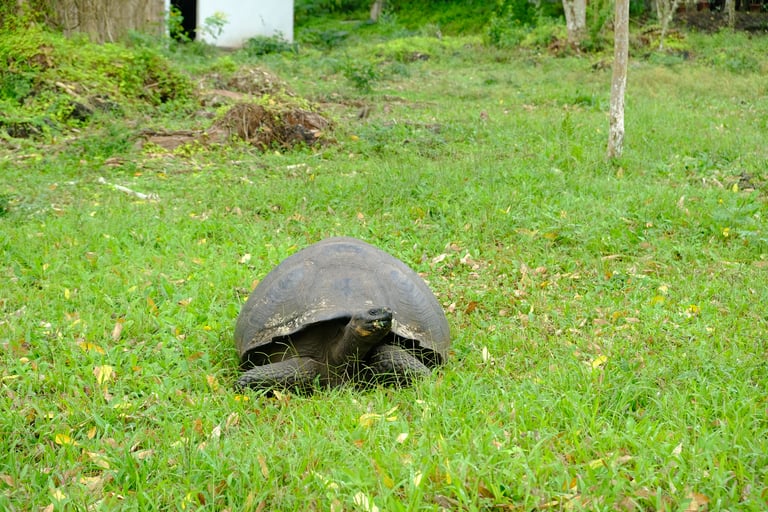
The clearest field mark is the shell pattern: a black-and-yellow carapace that is boldest in young animals and fades with age toward gray, straw, or dull yellow in some adults. Overall size varies by subspecies, with eastern T. h. boettgeri reaching up to 28 centimeters and 3–4 kilograms, while western T. h. hermanni rarely exceeds 18 centimeters and can be as small as 7 centimeters.
The head ends in a slightly hooked upper jaw and a toothless, horn-covered beak typical of tortoises. Limbs are scaly and greyish to brown with scattered yellow markings, built for slow walking rather than speed.
A distinguishing feature sits at the tip of the tail: a horny spur present in the species. Adult males carry noticeably longer, thicker tails with more developed spurs than females, making tail shape one of the most reliable ways to separate the sexes in mature animals.
Color intensity also shifts with age, since the sharp black-and-yellow contrast of juveniles and young adults tends to soften over the years, so an old individual may look far more washed-out than a hatchling of the same population.
Distribution and Habitat
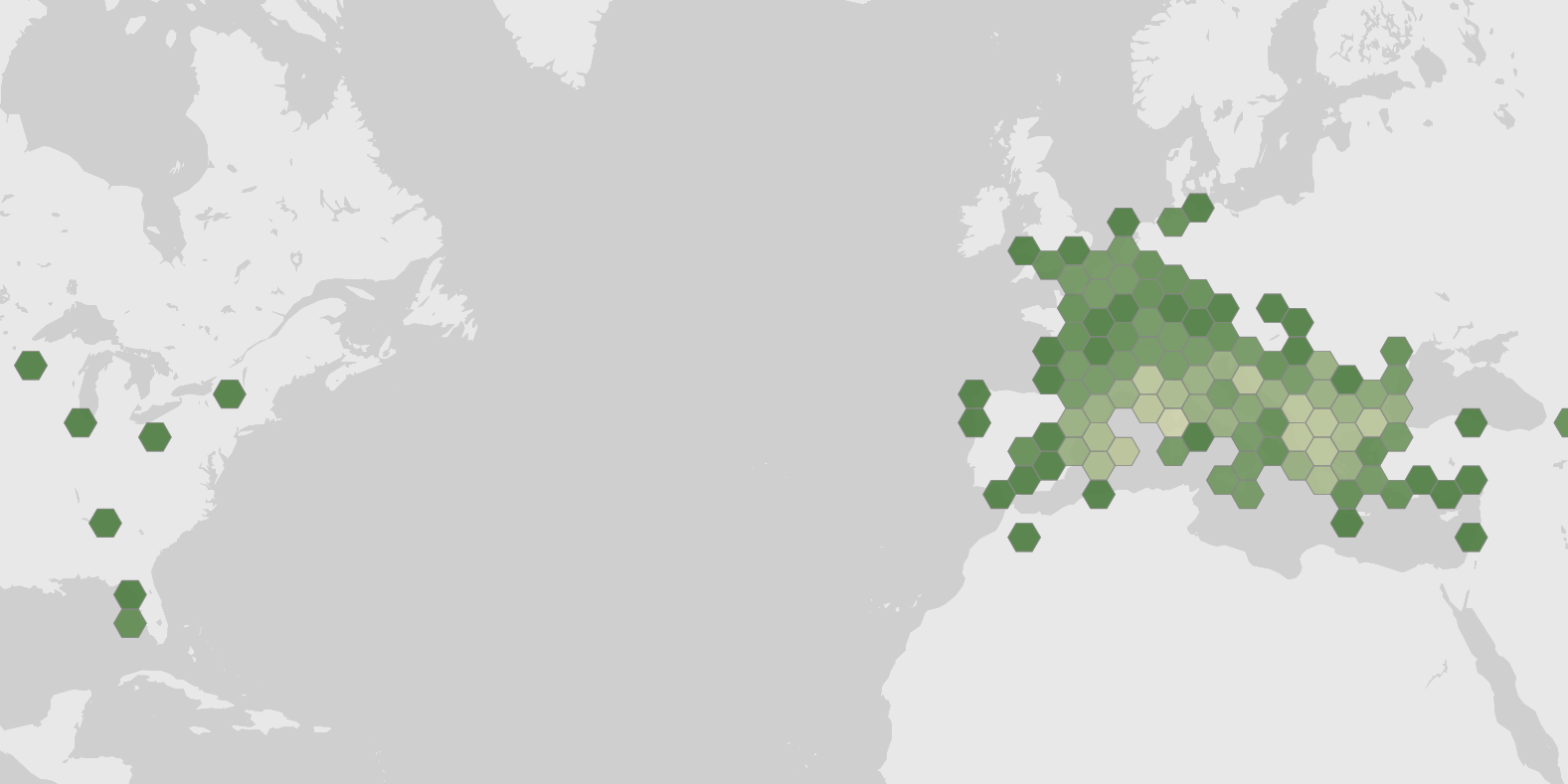
Hermann's tortoise occurs across southern Europe, with distinct populations recognized by subspecies. The western T. h. hermanni is found in eastern Spain, southern France, the Balearic Islands, Corsica, Sardinia, Sicily, and southern and central Italy including Tuscany. The eastern T. h. boettgeri ranges through Serbia, Kosovo, North Macedonia, Romania, Bulgaria, Albania, Turkey, and Greece, while T. h. hercegovinensis occupies the coasts of Bosnia and Herzegovina, Croatia, and Montenegro.
The species favors evergreen Mediterranean oak forest, but so much of this habitat has been lost that tortoises now also live in dry meadows, arid hillsides, rocky slopes, and farmland. Moist areas are generally avoided, and the tortoises seek out shade and hidden resting places, whether in native forest or in the suboptimal farmland and scrubland that has replaced much of it.
On Sardinia, a fossil from the early Pleistocene at Monte Tuttavista shows the species has an ancient presence there, yet molecular evidence suggests today's Sardinian population, like that on Cyprus, actually descends from more recent introductions rather than continuous native occupation.
Monthly observation data show counts rising sharply from a low in winter months to a strong peak in spring, consistent with tortoises emerging from hibernation in late February and becoming most visible and active through the following months before activity tapers off by late autumn. As presence records rather than population counts, this pattern reflects when tortoises are seen, not how many exist.
Behavior and Lifestyle
Hermann's tortoises are diurnal, foraging and basking by day before retreating into shelters, usually hollows protected by thick bushes or hedges. Winter is spent in hibernation, beginning as the tortoises bury themselves in beds of dead leaves and lasting until they re-emerge in late February; in summer they may aestivate if conditions demand it.
Home range size varies widely by population and appears limited by habitat loss, spanning roughly 7,000 to 74,000 square meters overall. Females typically hold larger ranges than males, from 0.9 to 7.4 hectares compared with 0.7 to 4.6 hectares in males, likely reflecting the greater search effort needed to find nesting sites and forage.
Activity follows a split daily pattern: tortoises leave their shelters in the early morning to bask and feed, retreat during the hottest midday hours when the sun becomes too intense, then re-emerge in the late afternoon to resume feeding. They rely on a strong sense of direction, using the sun's position, landmarks, and apparently the Earth's magnetic field, to find their way back to shelter.
During the breeding season immediately after hibernation, males compete for mates through ramming contests, and courtship itself is rough on females, who are pursued, rammed, and bitten before mating occurs.
Communication
Communication in this species draws on visual, acoustic, chemical, and tactile signals, most of them tied to reproduction. Males produce high-pitched calls to attract females, and a female that accepts the call allows the male to mount and mate.
Visual cues also matter for mate choice, as females assess males based on favorable physical traits before accepting a suitor. Chemical signaling plays a role too: tortoises sniff for olfactory cues, likely pheromones, emitted by females before mating, though exactly what information these scent signals convey remains unclear.
Diet and Nutrition
Hermann's tortoises feed mainly on ground vegetation, grazing on grasses, leaves, and flowers as they roam the Mediterranean meadows and scrub of their habitat. They locate suitable plants largely by smell, sniffing out which leaves and flowers to eat as they move through the landscape.
When plant food becomes scarce, the diet shifts opportunistically to small insects, snails, and slugs, giving the species a degree of dietary flexibility beyond its primarily herbivorous, folivorous habits. This foraging typically happens in two daily bouts, in the morning and again in the late afternoon, with a midday retreat from the heat interrupting feeding.
Not all plants are safe: some wildflowers, such as buttercups, are toxic to the tortoises, and others, including dandelion and kale, carry oxalic acid that can accumulate over time and contribute to renal failure if eaten in excess. Legumes, tomatoes, and cabbage can likewise prove harmful despite being readily eaten, and prepared food pellets are considered detrimental, since tortoises can become dependent on them and refuse natural forage, developing unnatural growth rates as a result.
Fruit makes up only a small, occasional part of the diet, treated as a supplementary rather than staple food source.
Nesting and Breeding
Breeding begins immediately after hibernation ends in late February, when courtship and mating start without delay. The mating system is polygynandrous, with both males and females taking multiple partners in a season; males compete for access to females through ramming contests, and courtship itself involves the male pursuing, ramming, and biting the female's legs before mounting her.
Between May and July, females dig flask-shaped nests up to 10 centimeters deep and deposit two to twelve pinkish-white eggs per clutch, often laying more than one clutch in a season. Incubation lasts around 90 days, and because sex is temperature-dependent, eggs incubated near 26 degrees Celsius produce only males, while those around 30 degrees Celsius produce only females. Under ideal incubation temperatures, up to 75 percent of eggs laid prove viable.
Hatchlings emerge around early September, timed to coincide with the start of autumn rains; if the rains are late or nesting itself occurred late in the year, the young may instead stay underground through winter and emerge the following spring. Once hatched, young tortoises receive no further parental care, since females leave the eggs entirely on their own after laying.
Juveniles remain within a few meters of the nest for their first four to five years while their shells harden, and they stay highly vulnerable to predators until the carapace fully develops around six to eight years of age.
Population and Ecological Role
Adult Hermann's tortoises have few natural predators, but the picture is very different for the young: hatchlings and juveniles fall prey to black rats, badgers, magpies, red foxes, wild boar, large snakes, and European hedgehogs until their shells fully harden at six to eight years old. In turn, the tortoises themselves prey on small mollusks and insects, giving them a modest role as both predator of small invertebrates and prey for a range of opportunistic hunters during their vulnerable early years.
The species also hosts commensal or parasitic organisms, including the nematode Tachygonetria conica, part of the community of small organisms tortoises carry through their long lives.
Longevity in the wild is generally put around 30 years, with one documented record of 31.7 years, though some sources suggest this may be an underestimate and that Hermann's tortoises, like the related Testudo graeca, could potentially live 90 years or more.
Conservation and Threats
Hermann's tortoise is classified as Near Threatened by the IUCN Red List, meaning the species is not yet endangered but faces pressures that could push it toward that status if left unaddressed. It carries no special protection under the US Federal List or in the State of Michigan, but it is listed on CITES Appendix II, so any international export or import requires official CITES documentation.
The most severe threats come from construction, which causes drastic habitat loss and fragmentation, with road building in particular splitting populations apart and causing direct vehicular mortality. Wildfires pose another major danger, with reports of blazes eradicating up to half of local populations in a single event. Poaching and herbicide use add further pressure, and because the species is long-lived and slow to reach sexual maturity, populations recover only slowly once numbers drop.
Conservation responses have included reintroduction programs aimed at stabilizing existing populations. One program launched in 1989 and 1990 reintroduced tortoises and installed fencing to reduce highway-related mortality, an effort credited with helping increase local population numbers.
Conservation status
- LC
- NT
- VU
- EN
- CR
Near Threatened
Cultural Significance
Hermann's tortoise has a documented human history stretching back to the Neolithic period, suggesting a long relationship with people across its Mediterranean range. In Greek mythology, the species is tied to the god Hermes, who is said to have made his lyre from the empty shell of this tortoise.
In Serbia, folk beliefs, religion, and mythology shaped by various cultural influences have contributed to a mix of ecological awareness and superstition surrounding the species, shaping how local communities regard it even today.
Beyond myth and folklore, the tortoise has practical uses: it has entered the international pet trade through European exports, and in some Asian countries it is also used as food.
Fun Facts
- The species has existed since at least the Neolithic period, pointing to a very long overlap with human settlement in the Mediterranean.
- Fossil evidence on Sardinia dates to the early Pleistocene of Monte Tuttavista, yet molecular evidence suggests today's Sardinian population was actually introduced in more recent times, as was the population on Cyprus.
- Egg incubation temperature determines the sex of hatchlings: about 26 degrees Celsius yields only males, while about 30 degrees Celsius yields only females.
- The tortoises appear to navigate using multiple cues at once, including the sun's position, landmarks, and possibly the Earth's magnetic field, to find their way back to shelter each day.
- Some flowers that tortoises readily eat, such as buttercups, are toxic to them, while dandelion and kale contain oxalic acid that can build up and damage the kidneys over time.
- The species hosts the nematode parasite Tachygonetria conica as part of its natural parasite community.
- Longevity records reach at least 31.7 years, though some researchers suspect the true lifespan could reach 90 years or more, based on comparisons with the related Testudo graeca.
Ecology
Habitat
- Coastal
- Forest
- Shrubland
- Grassland
Behavior
- Burrowing
- Solitary
- Hibernating
- Diurnal
Diet
- Herbivore
Photos
SourcesGBIFiNaturalistWikidataWikipediaEncyclopedia of LifeAnimal Diversity WebAnAge