The larvae of Chrysoperla carnea do something few garden insects manage: they inject digestive enzymes straight into their prey, liquefy the internal organs, and then drink the remains, sometimes lifting the still-struggling victim clear off the leaf so it cannot escape.
This common green lacewing belongs to the family Chrysopidae within the order Neuroptera, and it is one of several closely related species grouped under the Chrysoperla carnea complex. The adults live a very different life from their predatory offspring, feeding gently on nectar, pollen, and aphid honeydew rather than hunting.
What makes this insect worth a closer look is its double life: a delicate, plant-visiting adult paired with a larva so effective at destroying aphid populations that farmers and growers actively use it for biological pest control on crops.
Identification and Appearance
The clearest way to recognize an adult Chrysoperla carnea is its pale green body paired with glossy, golden compound eyes and long, thread-like antennae, a combination that sets it apart from most other small flying insects. Adults measure 12 to 20 millimeters long and carry two pairs of large, membranous, pale green wings that they fold tent-wise over the abdomen at rest, giving them a delicate, almost translucent look.
Their flight is weak and fluttery rather than direct, and they are most often noticed in the evening or at night, when they are drawn to artificial lights. This nocturnal habit, combined with their green coloring, makes them easy to mistake for other soft-bodied flying insects at a glance, though the golden eyes and folded wing posture are distinctive up close.
The life cycle looks nothing like the adult stage. Eggs are oval and pale green when freshly laid, darkening to gray over time, and each is set atop a long, slender stalk attached to a leaf. Larvae hatch at about one millimeter long, brown, and shaped like tiny alligators; they carry a pair of pincer-like mandibles used to seize and immobilize prey before feeding on the liquefied contents.
By the time they are ready to pupate, the larvae have grown to roughly eight millimeters and spin a circular cocoon in which the transformation to the winged adult takes place. No differences between sexes or seasonal forms are described, so identification relies mainly on these developmental stages and the adult's characteristic coloring and eye structure.
Distribution and Habitat
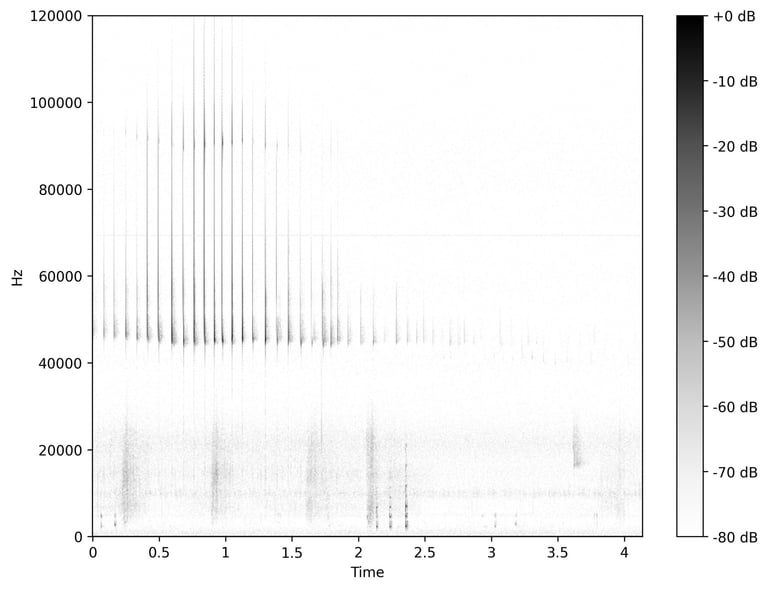
Chrysoperla carnea is found exclusively in Europe, though its exact boundaries are complicated by ongoing taxonomic revision of the wider carnea species group. Researchers have identified at least two candidate populations that may represent the true species: one known informally as "slow motorboat" (Cc2) and another as "motorboat" (Cc4), named for the distinct sounds of their courtship signals.
The more restricted candidate, Cc2, ranges from central Spain north to England and east to Greece and Hungary, and is confined to warmer sites below 1,000 meters in elevation. Cc4 is far more widespread, extending from the southern Alps north through the United Kingdom into southern Fennoscandia and east into western or central Russia, and it tolerates colder conditions well above the 1,000-meter mark that limits Cc2.
Monthly observation data show a strong seasonal pattern, with counts climbing sharply from a low of a few hundred in January and February to a peak of over 8,000 in June, then tapering off through autumn and into another winter low. This pattern, drawn from presence records rather than true population counts, likely reflects when adults are most active and detectable rather than the full extent of the species' range or true abundance.

Fun Facts
- Larvae can lift their aphid prey clear off the leaf surface while feeding, a tactic that prevents the victim from escaping mid-attack.
- Adults are weak, fluttery fliers and are most often spotted in the evening or at night, when they are drawn toward artificial lights.
- Their glossy, golden compound eyes are highly sensitive to green light, an adaptation that helps them spot fresh leaves bearing honeydew, suitable sites for egg-laying, and safe resting places.
- Despite their fragile, pale green appearance, these lacewings are put to practical use: growers rely on their aphid-hunting larvae as a natural method of pest control on crops.
Ecology
Behavior
- Nocturnal
- Predator
Diet
- Insectivore