Clusters of Clavaria fragilis can look like tufts of white worms or bundles of tiny icicles pushed up through leaf litter and grass, an image that earned it the common names fairy fingers, white worm coral, and white spindles. Each unbranched, tubular fruit body can reach 15 centimeters tall but only about half a centimeter thick, making the fungus as delicate as it is distinctive.
It belongs to the family Clavariaceae within the phylum Basidiomycota, and it is a typical member of the clavarioid, or club, fungi. Found across the Northern Hemisphere in woodland and grassland, it is one of the more recognizable coral-like fungi despite the existence of several similar species that can complicate identification in the field.
Fruiting Body and Identification
The clearest identifying feature of Clavaria fragilis is its growth form: irregularly tubular, unbranched, smooth-to-furrowed white fruit bodies that grow crowded together in dense clusters. Individual clubs reach up to 15 centimeters tall and 7 millimeters thick, and they are very fragile, breaking or crushing easily. There is no distinct stalk, though a short, semitransparent zone of tissue at the base of each club marks where it meets the substrate.
Each club tapers to a point at the tip, which may turn yellow and curve as the fruit body ages. Microscopically, the flesh is built from hyphae that swell up to 12 micrometers wide and lack clamp connections. The spores are smooth, colorless, and ellipsoid to oblong, measuring 5 to 7 by 3 to 4 micrometers, and they produce a white spore deposit. The spore-bearing basidia measure 40 to 50 by 6 to 8 micrometers and, like the hyphae, lack clamps at their bases.
Several other simple white or pale coral fungi can be confused with it. Clavaria acuta is equally widespread but usually grows singly or in small groups rather than dense clusters, and it can be separated microscopically by its clamped basidia and larger spores. Clavaria atkinsoniana, a rare species of the southwestern and central United States, cannot be told apart from C. fragilis by field characters alone and requires spore measurements of 8.5 to 10 by 4.5 to 5 micrometers for confirmation. Clavaria rubicundula is similar in stature but carries a reddish tint, while Multiclavula mucida is a lichenized species with smaller fruit bodies that grows on moist wood alongside its algal partner. Other fungi sometimes mistaken for it include Alloclavaria purpurea, Clavulinopsis fusiformis, C. laeticolor, and Macrotyphula juncea.
Distribution and Habitat
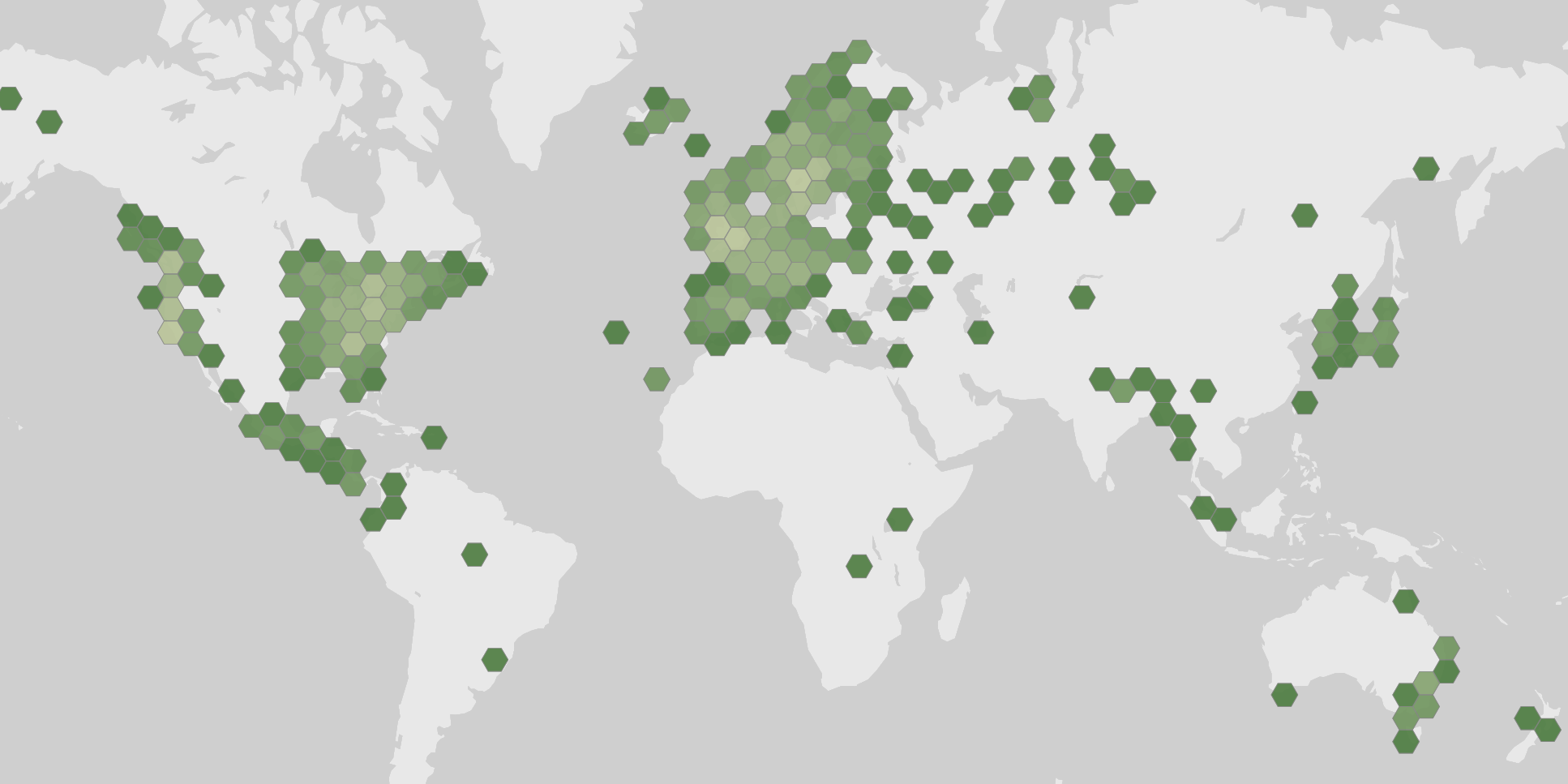
Clavaria fragilis occurs throughout the Northern Hemisphere, appearing across Europe from July to October, as well as in Asia and North America, where it is more common east of the Rocky Mountains. It has also been recorded in Australia and South Africa, and in 2006 it was documented in the Arctic zone of Russia's Ural Mountains, extending its known range well into cold-climate territory.
The fungus grows in woodland and grassland on moist soil, where it is presumed to act as a saprobe, breaking down fallen leaf litter and dead grass stems. Fruit bodies typically form in groups, tufts, or clusters; while they can appear singly, isolated specimens are easy to overlook and the fungus becomes conspicuous mainly when clustered.
Monthly observation counts, which reflect recorded sightings rather than true abundance, rise sharply from a low point in March and climb through summer to a clear peak in September and October before tapering off by December. This pattern lines up with the fruiting window reported in Europe and points to late summer and autumn as the season when the fungus is most often noticed, though the counts say nothing about total population size or the full extent of its range.
Conservation and Threats
No global IUCN assessment is noted for Clavaria fragilis, but regional records give a mixed picture of its status. In North America it has been described as "by far our most common Clavaria," suggesting a secure population there. In northern Europe, the species is one of the CHEG fungi group, an assemblage of Clavarioid, Hygrocybe, Entoloma, and Geoglossaceae species used as an indicator of old, unimproved grassland that has gone uncultivated for years.
That grassland habitat itself is under threat across Europe as agricultural intensification and land conversion reduce the amount of permanent, unimproved pasture available. Clavaria fragilis is described as one of the more common species within the CHEG group, giving it somewhat more resilience than its rarer indicator companions, yet it is still listed on the national red lists of threatened fungi in the Netherlands and Slovenia.
Fun Facts
- Clavaria fragilis is also known as fairy fingers, white worm coral, or white spindles, names inspired by its slender, worm-like clusters.
- It is synonymous with Clavaria vermicularis, an older name for the same species.
- It serves as the type species of the entire genus Clavaria.
- Despite its striking, otherworldly appearance, it holds no significant cultural, shamanic, or spiritual importance in recorded human history.
- In North America it has been called by far the most common species of Clavaria.
- In northern Europe it belongs to the CHEG fungi, a group used to identify old, unimproved grasslands that have escaped cultivation.
- Its fruit bodies can grow up to 15 centimeters tall while remaining only a few millimeters thick and extremely fragile.
Ecology
Habitat
- Woodland
- Grassland