The common basilisk earns its nickname, the Jesus Christ lizard, by sprinting upright across the surface of rivers and ponds on its hind legs alone, a feat few other vertebrates can match.
Basiliscus basiliscus is a lizard in the family Corytophanidae, native to the rainforests and riverbanks of Central and South America. The IUCN lists it as Least Concern, reflecting how common it remains across its range. Beyond its water-crossing trick, the species is a strong climber and swimmer capable of staying submerged for up to half an hour, making it one of the more versatile lizards sharing its lowland forest habitat.
Identification and Appearance
The tall, fin-like crest running along the back and tail is the clearest field mark, especially pronounced in males, which also carry a raised crest on the head. Both sexes share a brown to olive base color set off by a pale stripe—white, cream, or yellow—along the upper lip, with a second stripe running down each side of the body. These stripes stand out sharply in juveniles and fade with age, making young basilisks easier to identify by pattern than adults.
Size varies enormously between hatchlings and adults. Newly hatched basilisks weigh a mere 2 grams and measure 38 to 43 millimeters long, while adults reach a total length of up to 76 centimeters, tail included. That tail makes up 70 to 75 percent of the body length, so a lizard measuring 70 centimeters overall would have roughly a 50-centimeter tail. Females typically weigh 135 to 194 grams, about half the weight of males, making body mass a useful clue to sex in adults alongside crest size.
A large mouth lined with saw-like teeth on the inner jaw is another distinguishing feature, useful for gripping the varied prey the species takes. When startled, the lizard rises onto its hind legs and sprints for the nearest water, holding its forelimbs tucked against its sides, a posture that itself helps confirm identification when the animal is in motion.
Within its Costa Rican range, the Atlantic-slope equivalent is the green basilisk (Basiliscus plumifrons), which occupies similar habitat and shares similar biology but can be told apart by range and by its more vivid green coloration.
Distribution and Habitat
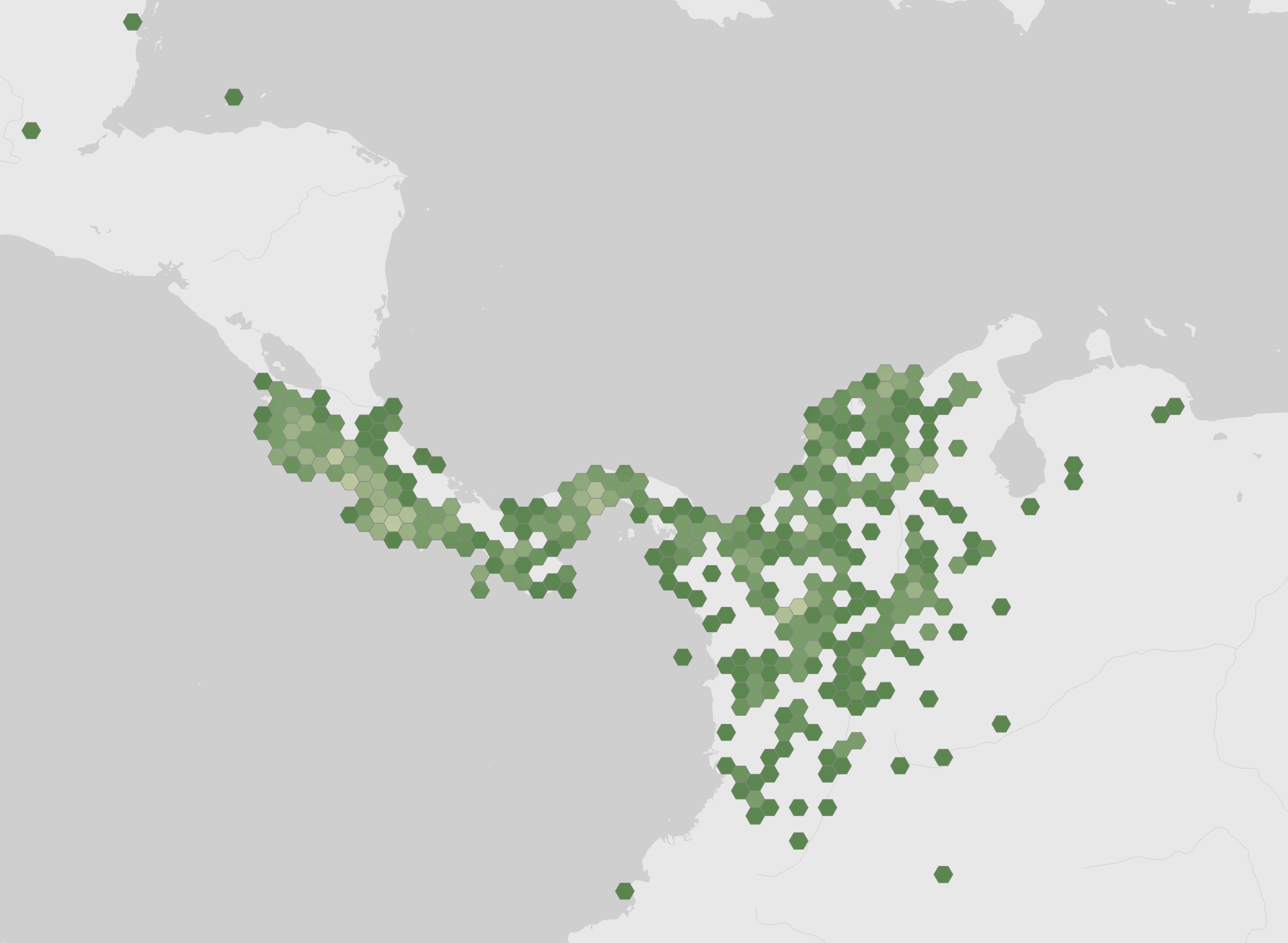
The common basilisk ranges through tropical lowland rainforest from southwestern Nicaragua to northwestern Colombia along the Pacific slope, and from central Panama to northwestern Venezuela along the Atlantic side. It has also turned up recently in South Florida. Most populations stay below 600 meters elevation, though in Costa Rica the species has been recorded as high as 1,200 meters in some localities.
It favors primary and secondary forest, forest edges, and open areas close to water, whether still or flowing, and tolerates a wide range of life zones from tropical dry forest to very wet tropical forest. In Costa Rica it is the most commonly seen large lizard on the Pacific side of the country, typically found in lowland dry and moist forest along rivers and streams. It spends most of its time on the ground but retreats at night to perches as high as 20 meters, often positioned over water.
The species also occurs within mangrove-associated ecosystems such as the Rio Negro–Rio San Sun region spanning Costa Rica, Nicaragua, and Panama, where it shares habitat with caimans, green iguanas, and nesting sea turtles along the coast.
Monthly observation counts show basilisks recorded year-round, with the highest tallies from January through March and a smaller peak in November, tapering through the mid- and late-year months. These figures reflect observation activity rather than true abundance or a complete range, but they suggest the species remains detectable throughout the year rather than disappearing seasonally.
Behavior and Lifestyle
Common basilisks are diurnal, spending their days foraging, basking, and resting along waterways before climbing to sleep on branches up to 20 meters high at night, often positioned over water to spot approaching predators early and escape by diving. When threatened or chasing prey, the lizard rises into a bipedal run, and while smaller individuals can cover 20 meters or more across the water's surface, larger adults sink after just a few meters and switch to swimming or diving instead.
Males are territorial and enforce a size-based dominance hierarchy, using head-bobbing displays to warn off rivals and physically attacking smaller males that intrude. This hierarchy has real consequences for reproduction, since dominant males monopolize breeding opportunities.
Home range size has not been directly measured in this species, but related basilisks vary widely: the green basilisk (Basiliscus plumifrons) ranges over roughly 1,700 to 1,900 square meters, while the striped basilisk (Basiliscus vittatus) uses areas as small as 7.9 to 19.8 square meters, hinting at similarly flexible spacing in B. basiliscus.
The lizard avoids water when it can, since aquatic predators pose their own threat, using its water-running ability mainly as an escape route rather than a routine mode of travel.
Communication
Vision plays the leading role in basilisk communication. The species has well-developed eyes, and the pronounced sexual dimorphism in crest size seen in males points to visual signaling, such as head-bobbing displays, as a key means of communicating between individuals.
Hearing is also well developed, serving the same functions found in most lizards: detecting sound waves, maintaining balance, and orienting the head toward stimuli. Beyond sight and sound, the species perceives its surroundings through touch, vibration, and chemical cues, giving it multiple channels for sensing predators, rivals, and mates even though visual display remains the primary signal for communicating with other basilisks.
Hunting and Diet
Common basilisks are omnivorous but lean heavily toward animal prey, with a Panama study finding diets made up of 78% animal material against just 22% plant matter. Arthropods form a staple, alongside small lizards, snakes, birds, mammals, fish, and freshwater shrimp, with frogs taken occasionally.
Diet shifts with age: juveniles are more strongly insectivorous, sometimes taking small fish, while herbivory increases as the lizards mature, with adults consuming more flowers and fruit than younger animals. This dietary flexibility likely reflects both the wider range of prey adults can physically overpower and their greater need for varied energy sources as they grow.
The combination of terrestrial, arboreal, and aquatic hunting grounds gives the species access to prey across several habitat layers at once, from insects on the forest floor to fish and crustaceans in adjacent streams.
Reproduction and Life Cycle
Breeding begins each March, when males compete through head-bobbing courtship displays typical of many iguanid lizards. The mating system is polygynous, and dominant males use their size advantage to physically exclude smaller rivals from mating, which pushes many males out of the breeding pool until they reach 3 or 4 years of age. Females mature faster, reaching reproductive age at around 20 months, while males typically mature in their second year but often cannot compete successfully for mates until later.
Over the ten months following the March onset of breeding, females lay three to four clutches of 10 to 20 eggs each, with egg-laying dropping off sharply during January, February, and March. Larger females produce more eggs per clutch than smaller ones. To lay a clutch, a female digs a hole, deposits the eggs, inspects the nest, then fills it with soil, packing it down with her snout using her forelimbs.
Eggs hatch after roughly three months. Hatchlings emerge weighing about 2 grams and measuring up to three inches (about 7.6 cm) long. There is no further parental care once the nest is sealed, leaving hatchlings to rely on camouflage, remaining motionless to avoid detection, as their main defense against predators.
Population and Ecological Role
As generalist omnivores, common basilisks prey on a wide range of animals while themselves serving as food for large reptiles, birds, and some mammals, placing them in the middle of their forest and riparian food webs. To avoid becoming prey, they hide motionless under leaf litter on the forest floor, and when discovered, rely on their water-running and swimming abilities to escape.
The species also hosts microbial parasites, with Panamanian populations found carrying Plasmodium basilisci and P. achiotense, a reminder that basilisks participate in local parasite cycles as well as predator-prey relationships.
No population figures or long-term trend data are given, but the species' broad ecological role, as both a mid-level predator and a food source for larger animals, makes it a consistent presence in the forest and stream ecosystems it inhabits.
Conservation and Threats
The common basilisk is classified as Least Concern by the IUCN, and it carries no special protective status under CITES, the US Federal List, or Michigan's state list. It remains common throughout its range with no immediate threats to current populations.
Continued habitat destruction in tropical regions stands as the most significant long-term conservation concern for the species, even though it faces no urgent crisis today.
Conservation status
- LC
- NT
- VU
- EN
- CR
Least Concern
Cultural Significance
The basilisk of legend looms far larger than the real lizard: in ancient Greek and Roman tradition, the basilisk was a fabled North African serpent whose gaze or breath could wither plants and kill people outright. That mythic creature, despite its fearsome reputation, came to represent power, including the power of Hell in Christian symbolism, and it became the guardian emblem and traditional symbol of the Swiss city of Basel.
The living Basiliscus basiliscus connects to this legacy mainly through its name and its water-walking trick, which echoes the supernatural qualities once attributed to its mythical namesake. Today the lizard has a more grounded relationship with people: it is a popular animal in the pet trade, and its fame as the "Jesus Christ Lizard" draws ecotourists who travel specifically to see it run across water in the wild.
Fun Facts
- The genus name Basiliscus comes from the Greek basilískos, meaning "little king" or "little prince," a nod to the crested, crown-like appearance of the lizard's head and back.
- Its water-running ability directly echoes the mythical basilisk serpent of Greek and Roman legend, giving the species one of the more fitting scientific names in herpetology.
- The lizard can remain submerged underwater for up to thirty minutes when escaping a predator, making diving as important an escape tool as running across the surface.
Ecology
Habitat
- Wetland
- Coastal
- Forest
- Freshwater
Behavior
- Predator
- Territorial
- Diurnal
- Arboreal
Diet
- Omnivore
Photos
SourcesGBIFiNaturalistWikidataWikipediaEncyclopedia of LifeAnimal Diversity Web