The common cuckoo does not build a nest, incubate an egg, or feed a single chick of its own. Instead, a female slips her egg into the nest of another species, and the newly hatched cuckoo chick pushes out its foster siblings and their eggs, monopolizing the care of parents that are not its own.
This is a medium-sized bird in the order Cuculiformes, alongside roadrunners, anis, and coucals. It breeds across Europe and Asia and winters in Africa, and the IUCN lists it as Least Concern. What makes it worth a closer look is the evolutionary arms race behind its habits: a slow tug-of-war between a parasite refining its disguise and hosts learning to see through it.
Identification and Appearance
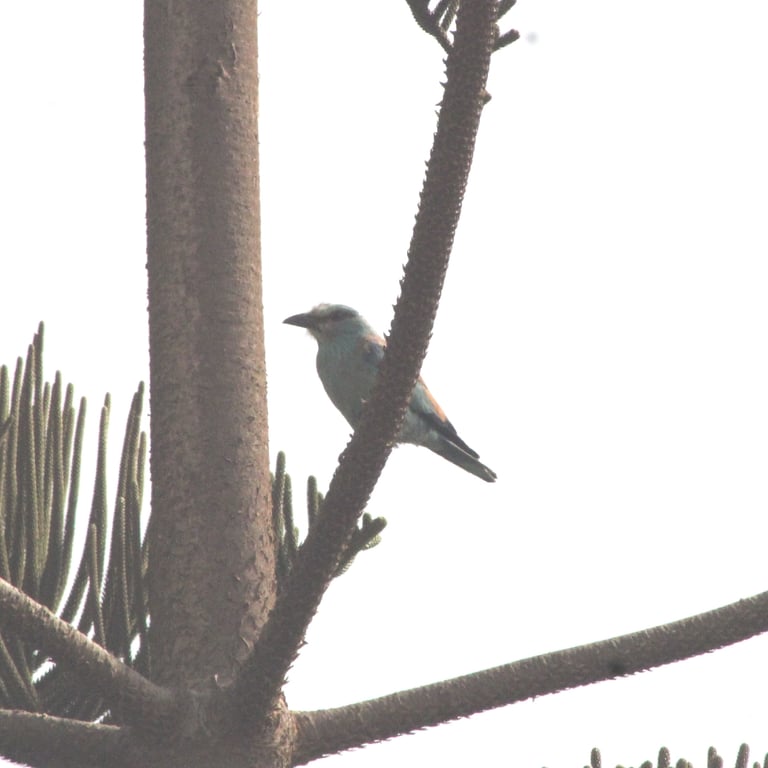
In flight, the common cuckoo is often mistaken for a small hawk: a grey, slender body, long tail, and regular wingbeats recall a sparrowhawk more than a songbird. Perched during the breeding season, it settles with drooped wings and a raised tail, a posture that is itself a useful field mark.
The bird measures 32–34 centimeters from bill to tail, with a tail of 13–15 centimeters and a wingspan of 55–60 centimeters. Males weigh around 130 grams and females about 110 grams. Adult males are slate-grey with a grey throat that extends well down the breast before giving way sharply to barred underparts; the iris, orbital ring, base of the bill, and feet are all yellow.
Grey females look similar but have a pinkish-buff or buff wash to the barring, sometimes with small rufous spots on the wing coverts. A rarer rufous morph, seen occasionally in adult females and more often in juveniles, shows reddish-brown upperparts crossed by dark bars; in rufous adults these black bars are narrower than in rufous juveniles, where they are broader. Juveniles are further marked by a white nape patch and pale feather fringes, and first-autumn birds show variable plumage ranging from strongly barred chestnut-brown to plain grey.
The species is easily confused with the Oriental cuckoo, which is only slightly shorter-winged and shares the same rufous morph, a resemblance that may trace back to a common ancestral form.
Distribution and Habitat
The common cuckoo breeds across Europe and Asia and migrates to Africa for the winter, arriving on its breeding grounds in April and departing again by September. It is a bird of open country, but its range of habitats is broad, including woodland of all kinds, marshes, heathland, farmland, and alpine terrain up to 3,800 meters, with habitat choice driven largely by food availability.
Monthly observation data show a sharp seasonal pulse: counts climb from a few thousand in winter to over 950,000 in May before falling away through the summer and autumn. This pattern lines up with the spring arrival and breeding presence in Europe rather than with any change in overall abundance, since these figures record sightings, not population size.
The species also turns up well outside its usual range as a vagrant, with records from Barbados, the United States, Greenland, the Faroe Islands, Iceland, Indonesia, Palau, the Seychelles, Taiwan, and China. Within the United Kingdom, its distribution has shifted northward between 1995 and 2015, with numbers falling by 69% in England while rising by 33% in Scotland.

Behavior and Lifestyle
Outside the breeding season, common cuckoos are solitary and largely silent, spending their time foraging and scouting new ground without singing or interacting with others of their kind. They travel as solitary, nocturnal migrants, and adults leave for Africa well before their own chicks have even hatched, meaning young cuckoos must find their way south entirely without guidance or company.
Once back on the breeding grounds, males become social in the sense that they actively compete for and defend territories, while females do not defend ground in the same way. Both sexes maintain separate foraging areas apart from the breeding territory itself, and estimates give an average home range of 27.3 hectares for egg-laying activity and 36.7 hectares for non-egg-laying foraging.
The species is arboreal and migratory, but its most defining behavior is brood parasitism: rather than raising young, females spend the breeding season searching out and exploiting the nests of other birds. Key stopover habitats during migration include forests, farmland, and wetlands.
Communication
The male's advertising call, a two-note goo-ko, is delivered from an open perch at intervals of roughly 1 to 1.5 seconds, in bursts of 10 to 20 notes separated by short rests. The song itself changes shape over the season: it starts as a descending minor third in April, widens through a major third to a fourth as the weeks pass, and by June the male effectively "forgets its tune," switching to other call types including ascending intervals.
Visual signals accompany intense calling: the wings droop, and in the presence of a potential mate the male often wags his tail from side to side or pivots his body. Females communicate with a distinct, loud bubbling call rather than the male's whistled song.
A subtler form of communication happens inside the host nest itself. Cuckoo chicks learn to mimic the specific calls of their foster parents' own young, an adaptation that appears to prompt the hosts to feed them more readily, and the chicks respond only to the alarm calls of their foster parents rather than to any cue from their biological species.
Diet and Nutrition
The common cuckoo feeds mainly on insects, with hairy caterpillars forming a large part of its diet, prey that most other birds avoid because of their bitter taste. It also takes crickets, beetles, various larvae, and dragonflies.
Female cuckoos add an unusual item to this insect diet: the eggs and nestlings of the host species whose nests they parasitize, consumed either while inspecting a nest or after removing a host egg to make room for their own.
Nesting and Breeding
Common cuckoos do not pair up; both males and females mate with multiple partners across a single breeding season that runs from April to September. Courting males call continuously while opening their wings, fanning their tails, and bobbing their heads, and females answer with a bubbling call.
Rather than building a nest, a female selects the nests of a host species and lays her eggs there, visiting as many as 50 candidate nests in a season but laying only 12 to 22 eggs in total, one every other day. Egg color and pattern vary to match the chosen host: over 100 host species have been documented, with meadow pipit, dunnock, and Eurasian reed warbler most common in northern Europe, garden warbler, pied wagtail, and European robin in central Europe, brambling and common redstart in Finland, and great reed warbler in Hungary. Females tend to specialize into groups called gentes, each favoring a particular host and matching that host's egg appearance.
Eggs hatch after 11 to 13 days of host incubation. The newly hatched cuckoo chick promptly evicts the host's own eggs or nestlings from the nest, leaving itself as the sole recipient of all food and care from foster parents that are often far smaller than the chick will become. Young cuckoos leave the nest at 17 to 21 days old but continue to depend on their foster parents for another 6 to 8 weeks before departing for Africa in September, and both sexes reach breeding age at two years old.
Population and Ecological Role
Common cuckoos act as a parasite in their ecosystem, and this has a direct cost for the species that raise them: by ejecting host eggs and chicks, and sometimes consuming them outright, cuckoos reduce the reproductive success of hosts such as the meadow pipit, Eurasian reed warbler, and dunnock. BirdLife International reported declines in some regional populations as of 2012, though not at a scale that threatens the species overall.
On the other side of the ledger, the cuckoo's heavy reliance on hairy caterpillars, including species that damage crops and garden plants, gives it a role in checking populations of these insects. The species also carries its own hangers-on, including feather lice of the genus Columbicola, picked up through contact with other adult cuckoos rather than from foster parents, and a nasal mite in the genus Sternostoma.
Conservation and Threats
The common cuckoo is classified as Least Concern by the IUCN, reflecting a wide range and a population not considered at risk overall, even though BirdLife International has noted declines in some areas. In the United Kingdom, for instance, numbers fell by 69% in England between 1995 and 2015 even as they rose by 33% in Scotland, a shift that points to changing conditions rather than a uniform range-wide collapse.
The species carries no special status under CITES or the US federal endangered species list, but it is protected in the United States under the Migratory Bird Treaty Act, which makes it illegal to possess, trade, or barter the birds, their parts, or their eggs.
Conservation status
- LC
- NT
- VU
- EN
- CR
Least Concern
Cultural Significance
The common cuckoo's call and its habit of tricking other species into raising its young have made it a lasting symbol of deception and misplaced trust. In Ancient Greek mythology it was linked to marriage and courtship: Zeus is said to have transformed himself into a disheveled cuckoo to win the pity, and eventually the affection, of Hera. In Japanese folklore, by contrast, the bird represents unrequited love and longing.
In English tradition the cuckoo is above all a herald of spring; the 13th-century round "Sumer is icumen in" celebrates its call as the sign that summer is coming. But the same call carried a darker meaning for Shakespeare, who in Love's Labour's Lost has the cuckoo "mock married men" with its two-note song, playing on the bird's association with cuckoldry, an association many scholars trace to its brood-parasitic habits. The cuckoo clock, with its mechanical bird imitating the male's call, and folk songs such as "The Cuckoo" and "The Cuckoo's Nest," carried this seasonal and symbolic weight into everyday life, as did the traditional rhyme tracking the bird's arrival in April and departure by September.
Beyond folklore, the species has a practical link to people: by feeding heavily on hairy caterpillars such as those of the garden tiger moth, which damage crops including raspberry, viburnum, and honeysuckle, cuckoos help hold down populations of these pests.
Fun Facts
- Ancient writers believed cuckoos physically transformed into hawks each winter to explain their seasonal disappearance; Aristotle rejected the idea, pointing out that cuckoos lack a hawk's talons and hooked bill.
- The Norwegian composer Frederick Delius wrote a symphonic poem titled On Hearing the First Cuckoo in Spring, inspired by the bird's traditional role as a herald of the season.
- The theme music for the film comedians Laurel and Hardy, "Dance of the Cuckoos" by Marvin Hatley, was built around the common cuckoo's two-note call.
- In Scotland, "gowk stanes," or cuckoo stones, are traditionally associated with the arrival of the first cuckoo of spring; "gowk" is an old northern English name for the bird.
- A folk tale about the Wise Men of Gotham describes them building a hedge around a tree to trap a cuckoo inside, in the belief that this would keep it summer forever.
Ecology
Habitat
- Wetland
- Woodland
- Mountain
- Grassland
Behavior
- Nocturnal
- Solitary
- Territorial
- Migratory
Diet
- Insectivore
Photos
SourcesGBIFiNaturalistWikidataWikipediaEncyclopedia of LifeAnimal Diversity WebAnAge