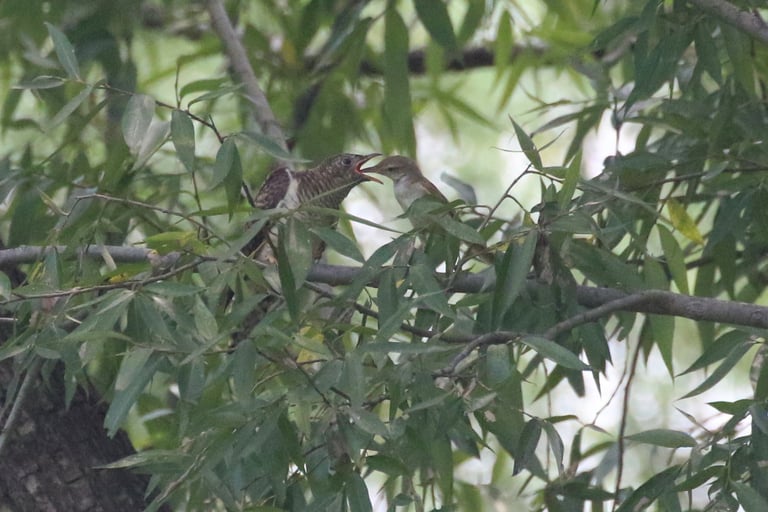
The fan-tailed cuckoo never raises its own young: it lays a single egg in the nest of another species, leaving fairywrens or thornbills to do the work of parenting.
This member of the cuckoo family Cacomantis flabelliformis belongs to the order Cuculiformes and is found across Australia, Fiji, New Caledonia, New Guinea, the Solomon Islands and Vanuatu. The IUCN lists it as Least Concern. Its combination of striking plumage, a distinctive descending trill, and an entirely parasitic breeding strategy makes it one of the more unusual birds sharing forests and gardens with fairywrens and thornbills.
Identification and Appearance
The yellow orbital eye ring is the fan-tailed cuckoo's most reliable field mark, separating it from its close relatives. The species measures about 25–27 cm long and weighs roughly 50 grams.
Its head, back and wings are slate-grey, contrasting with rufous underparts, while the tail is barred black and white in a fan-like pattern that gives the species its name.
The yellow eye ring is especially useful for distinguishing it from the smaller, paler brush cuckoo (C. variolosus) and the also smaller chestnut-breasted cuckoo (C. castaneiventris), both of which lack this feature.
Distribution and Habitat
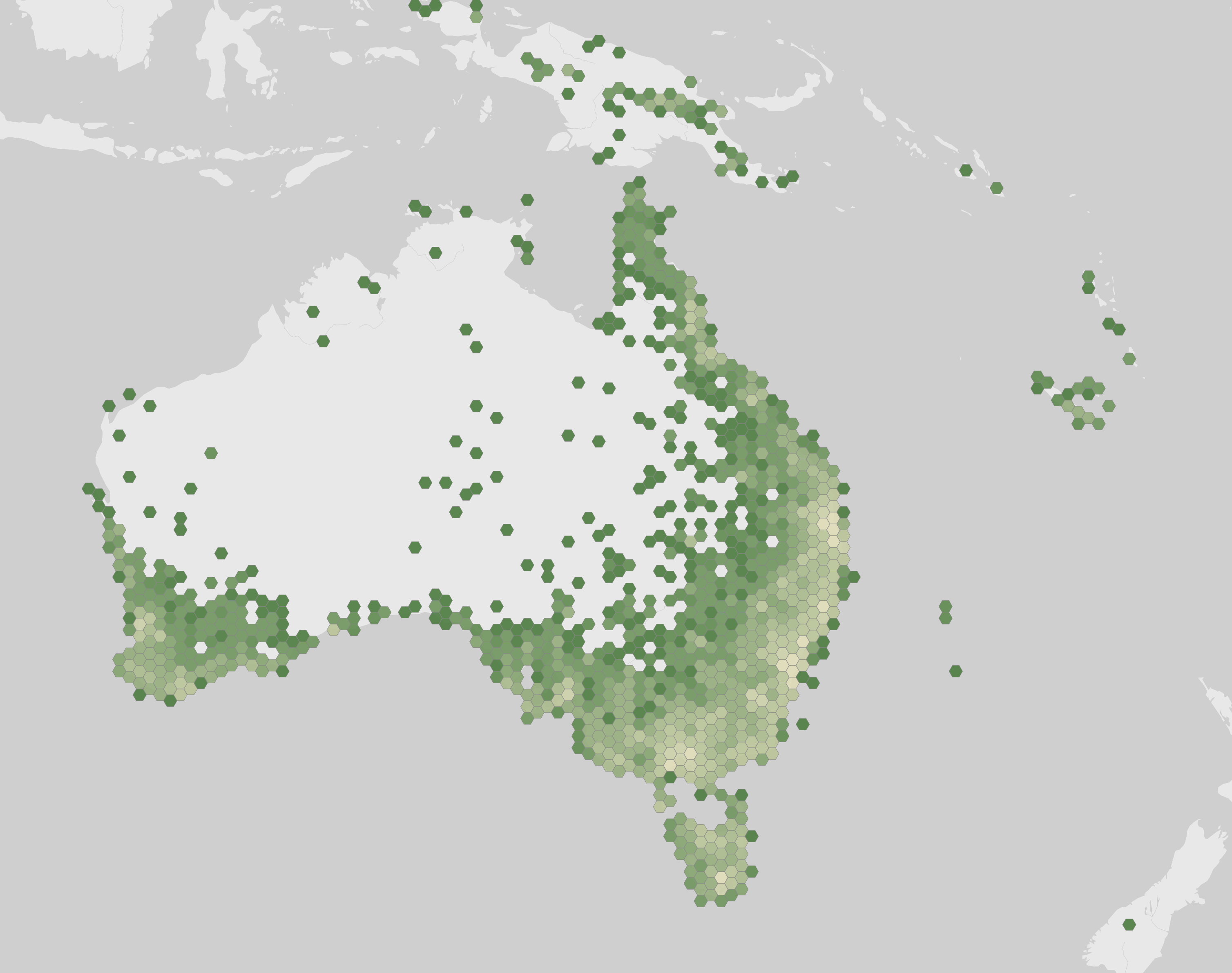
The fan-tailed cuckoo occupies a wide range across Australia, extending from Cape York in Queensland down the coast to Shark Bay in Western Australia, with a range that reaches no more than about 1,000 km inland along the west coast. In South Australia it occurs along the coast, avoiding the southeastern corner around Mount Gambier and the Eyre Peninsula, and it is also found in Tasmania. Its overall range covers roughly 2,430,000 square kilometers.
The species uses a broad mix of habitats, including temperate forests, subtropical and tropical mangrove forests, moist montane forests, and more open, human-influenced settings such as paddocks, orchards and gardens, reflecting its semi-open habitat preference.
Observation records show numbers rising through the southern spring and peaking around September, before tapering off into the southern summer, a pattern consistent with seasonal presence tied to breeding activity rather than a fixed year-round abundance.
Hunting and Diet
As an insectivore, the fan-tailed cuckoo hunts by perching in an exposed spot to scan for prey, then pouncing to seize it either in the air or on the ground. Insects and their larvae make up a large part of its diet in Australia.
Beyond invertebrates, it also takes fruits and vegetables, along with small reptiles, mammals and birds, showing a particular taste for bird chicks. This mix of plant matter and small vertebrate prey alongside insects marks it as a broadly opportunistic hunter rather than a specialist.
Nesting and Breeding
Breeding in Australia runs from July to January, during which the fan-tailed cuckoo practices brood parasitism rather than raising its own chicks. A female lays only one egg per nesting attempt, colored mauve-white with red and brown spotting, into the nest of a host species such as a fairywren or thornbill.
The preferred host nests are domed in shape, a structure that suits the cuckoo's parasitic strategy. Once the egg is laid, the host pair incubates and rears the chick, with the adult cuckoo taking no further part in its development.
The species' voice, a descending trill paired with a grasshopper-like chirp, is heard through the breeding season, likely tied to courtship and territorial signaling around this parasitic breeding cycle.
Conservation and Threats
The IUCN lists the fan-tailed cuckoo as Least Concern, a status supported by its wide range and a presumed large population. No particular threats to the species have been identified.
While the population trend is thought to be downward, the decline is not considered steep enough to warrant listing the species in a more threatened category, and it remains common across much of its range.
Fun Facts
- The genus name Cacomantis comes from the Greek kakos, meaning evil or ill-boding, and mantis, meaning prophet, reflecting an old association between these cuckoos' calls and predictions of rain or bad weather.
- The subspecies Cacomantis flabelliformis flabelliformis breeds in southwestern and eastern Australia south of Cape York Peninsula, including Tasmania, and winters as far north as southern New Guinea.
Photos
Photographs from via iNaturalist, licensed under CC0 1.0., by Sofia Zvolanek via iNaturalist, licensed under CC BY 4.0., by A.J. Anderson via iNaturalist, licensed under CC BY 4.0., by fungihunter via iNaturalist, licensed under CC BY 4.0., by TJ Jones via iNaturalist, licensed under CC BY 4.0., by Kagan Vainisi via iNaturalist, licensed under CC BY 4.0., by Mark Clarke via iNaturalist, licensed under CC BY 4.0., by Richard Littauer via iNaturalist, licensed under CC BY 4.0., by Mike Bowie via iNaturalist, licensed under CC BY 4.0., and by Scott W. Gavins via iNaturalist, licensed under CC BY 4.0., credited on each photo.
Ecology and classification
Classification
- Phylum
- Chordata
- Class
- Aves
- Order
- Cuculiformes
- Family
- Cuculidae
- Genus
- Cacomantis
- Species
- Cacomantis flabelliformis