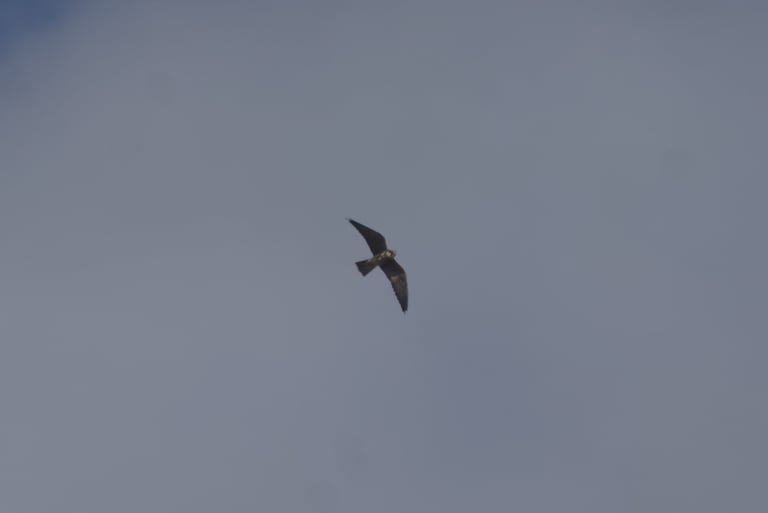
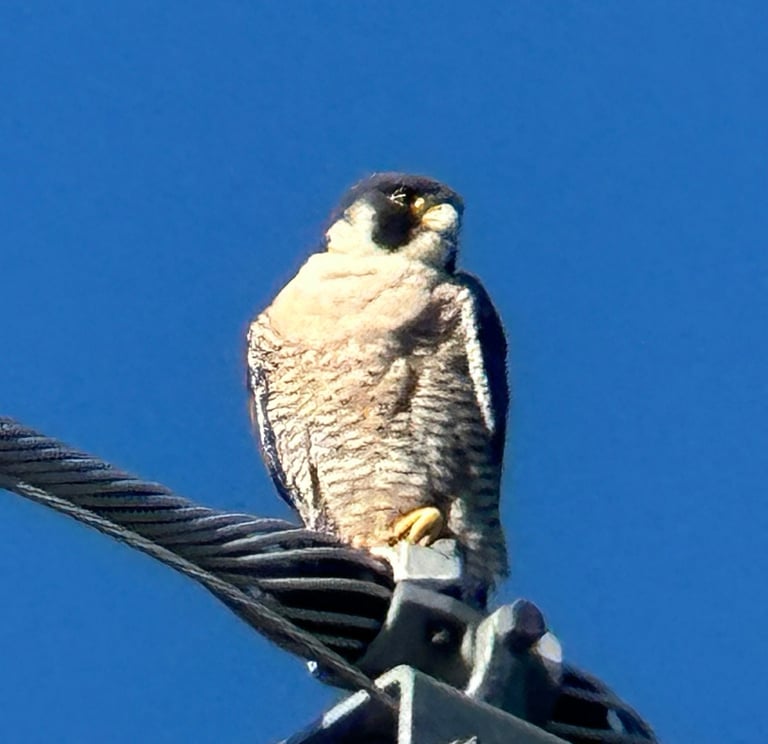
The common kestrel is a small falcon known for hovering almost motionless in mid-air while it scans the ground for prey, a hunting posture that gives it the name "windhover" in some regions. It belongs to the falcon family Falconidae and ranges across open country, farmland, and even cities throughout much of the Old World. The species is assessed as Least Concern by the IUCN.
Its adaptability to farmland, moorland, and urban rooftops alike, paired with its role as a natural check on rodent populations, makes it one of the more familiar birds of prey across its huge range.
Identification and Appearance
The most useful field mark is the combination of a chestnut-brown, black-spotted back and a long, narrow tail, often held fanned while hovering. The common kestrel measures 32 to 39 centimeters from head to tail with a wingspan of 65 to 82 centimeters, making it small among birds of prey but larger than most songbirds. Males average about 155 grams while females average about 184 grams, with females noticeably larger overall.
The plumage is mainly light chestnut brown with blackish spots above and buff with narrow blackish streaks below, and the flight feathers are blackish. Unlike most raptors, the sexes differ in color: males show fewer black spots and streaks and carry a blue-grey cap and tail, while females have a brown tail barred with black. Both sexes share a black tail tip edged with a narrow white rim and a prominent black stripe below the eye.
The cere, feet, and a narrow ring around the eye are bright yellow, contrasting with a dark bill, iris, and toenails. Juveniles resemble adult females but show wider streaking below and paler bare-part coloring. Hatchlings start out covered in white down before molting into a buff-grey second down coat ahead of their first true plumage.
Distribution and Habitat
The common kestrel occupies an enormous range, favoring open, grassy fields and farmland that give it clear sightlines and hunting space. It also turns up in forested edges, marshland, shrubland, savanna, and even suburban and urban settings, as long as enough open ground and perching sites are available.
The species tolerates a remarkable span of elevations, from sea level to nearly 5,000 meters in the most extreme parts of its range. Its presence has been recorded across temperate and tropical zones alike, spanning terrestrial biomes from grassland and chaparral to forest scrub and wetland margins.
Observation records through the year show activity in every month, without an extreme single-month spike, consistent with a mix of resident populations and short-distance migrants moving between summer and winter ranges depending on latitude.

Behavior and Lifestyle
The common kestrel is a diurnal hunter that spends much of its day perched and resting within its home range, taking flight mainly to hunt or during courtship. It is largely solitary outside the breeding season, when pairs come together to breed before dispersing again.
Home ranges vary from about 2 to 10 square kilometers, averaging around 5 square kilometers, and are shaped by the availability of food and nesting sites rather than always being centered on the nest itself. Birds may use parts of their range unevenly, concentrating where prey and good perches are richest.
In the cooler parts of its range the species migrates south for winter, while elsewhere it tends to stay put, with juveniles wandering more widely as they search for a place to settle. It readily adapts to human settlement, nesting on buildings and hunting over farmland, wetlands, moorlands, and arid savanna alike, needing only open vegetation and suitable perches rather than woodland itself.
Communication
Common kestrels rely mainly on visual and acoustic signals, most of which intensify during the breeding season though some occur year-round. A sharp "kee-kee-kee" alarm call is given by a member of a pair when their young are threatened.
Territorial defense includes a visual display in which a bird flies beneath an intruder, fans its tail, shivers its wings, and slowly rises underneath the trespasser, sometimes escalating to a direct attack. Because hunting from the air depends so heavily on sight, vision is the kestrel's dominant sense, though birds hunting on foot also draw on sound.
Diet and Nutrition
The common kestrel feeds mainly on small mammals, especially voles and mice such as the wood mouse, which make up the bulk of its diet. It hunts by soaring 10 to 20 meters above the ground and diving quickly onto prey it spots below, though it will also hunt on foot for small mammals and insects like beetles and grasshoppers.
Beyond mammals, it takes amphibians, reptiles, and other birds, with recorded prey including small songbirds such as tree sparrows, Eurasian bullfinches, and various pipits and larks. When prey is abundant, kestrels sometimes kill more than they can eat immediately and cache the surplus for later.
Nesting and Breeding
Courtship begins in February or March with a repertoire of calls and displays, including a slow "shivering" flight where both sexes beat their wings shallowly while calling a "quirrr-rr" sound, usually just before or after mating. Pairs also perform fast, high joint flights that sometimes end in a dramatic dive toward the nest with wings held in a sharp V.
The species nests in cavities rather than building its own nest, using ledges, cliffs, tree holes, buildings, or the abandoned nests of other birds such as corvids. From courtship through egg-laying, males bring prey to females as gifts while the females become increasingly sedentary. Pairs are usually monogamous and often bond for years, though polygyny occurs in a small fraction of males.
A clutch holds 3 to 7 eggs, patterned with brown spots ranging from a light wash to near-black blotches, laid roughly two days apart. Incubation, shared between both sexes though the female does most of it, lasts 26 to 34 days. Chicks hatch altricial and are fed by the female from prey the male supplies, fledging after about 27 to 32 days but remaining dependent on their parents for another 7 to 8 weeks while they learn to hunt.
In Britain, nesting pairs raise about 2 to 3 chicks on average, though a considerable share of broods fail entirely; pairs that do succeed often raise three or four young. First-hatched chicks tend to survive better than their younger siblings, likely due to reaching better body condition in the nest. Vole population cycles strongly affect how well breeding goes in a given year.
Population and Ecological Role
The common kestrel acts as a key predator of small herbivorous mammals in many areas, helping to hold down populations of voles and mice. It is itself preyed upon by larger raptors and owls, including eagle owls, tawny owls, and goshawks, as well as by mammalian predators like genets and martens, though it is not a primary prey source for any of them.
Parasite records include tapeworms, nematodes, and the protozoan Trichomonas gallinae, reflecting the range of organisms that interact with kestrel populations without necessarily threatening them at a population level.
Conservation and Threats
The common kestrel is assessed as Least Concern by the IUCN, reflecting its wide range and generally stable numbers. It carries no special protective status under CITES or comparable frameworks, consistent with a species not currently considered at risk.
Cultural Significance
The common kestrel carries symbolic weight in several cultures: among the Oyoko clan, it serves as a totem representing patience and vigilance, traits associated with the clan's members. In English literature, the kestrel has inspired notable works, including Gerard Manley Hopkins's poem "The Windhover," which celebrates the bird's mastery of flight, and Barry Hines's novel A Kestrel for a Knave, later adapted into Ken Loach's film Kes, centered on a boy's bond with a kestrel.
Local names reflect its hovering flight, such as the Pathan "Bād Khurak" and the Punjabi "Larzānak," both meaning roughly "wind hover." Historically, kestrels were used in Persia and Arabia as decoys to help capture other birds of prey, and in parts of Arabia trained greyhounds were set after jerboa-rats that kestrels had first flushed and disoriented with aerial dives.
Fun Facts
- The kestrel is so tied to human landscapes that in German it is described as largely a "Kulturfolger," a species that follows and thrives alongside human-altered habitats.
- It has historically been used in falconry and, in parts of Arabia, as a decoy bird to help hunters catch other birds of prey.
- The oldest common kestrel on record lived nearly 24 years, far beyond the typical lifespan in the wild.
Photos
Photographs from via iNaturalist, licensed under CC0 1.0., by Mourad Harzallah via iNaturalist, licensed under CC BY 4.0., by Lauren Gore via iNaturalist, licensed under CC BY 4.0., by Elia Lo Parrino via iNaturalist, licensed under CC BY 4.0., by Ирина Хохрякова via iNaturalist, licensed under CC BY 4.0., by Константин Селивёрстов via iNaturalist, licensed under CC BY 4.0., by Александр Краснов via iNaturalist, licensed under CC BY 4.0., by SkippingShoe via iNaturalist, licensed under CC BY 4.0., by Donsky via iNaturalist, licensed under CC BY 4.0., by Nico Hernandez via iNaturalist, licensed under CC BY 4.0., by greysquirrel300 via iNaturalist, licensed under CC BY 4.0., by Alison Copeland via iNaturalist, licensed under CC BY 4.0., by Zuzanna Kulis via iNaturalist, licensed under CC BY 4.0., and by Jess Hughes via iNaturalist, licensed under CC BY 4.0., credited on each photo.
Ecology and classification
Classification
- Phylum
- Chordata
- Class
- Aves
- Order
- Falconiformes
- Family
- Falconidae
- Genus
- Falco
- Species
- Falco tinnunculus
Sources
- GBIF Species names and classification
- iNaturalist Photos
- Wikidata Common names and conservation status
- Wikipedia Summary extract
- Animal Diversity Web Animal habitat, behavior and diet
- AnAge Longevity
- AVONET Bird mass, habitat, migration, diet and range size
- GloBI What it eats, what eats it, parasites and pollinators
- trophiCH
- Wardeh et al. 2015 (EID2)
- HWML Parasite Collection
- TETRA-EU