Few falcons match the aerial speed of the Eurasian hobby, a bird fast and agile enough to run down swifts and swallows, two of the quickest fliers in the sky, in direct pursuit.
Falco subbuteo is a small, slim falcon in the family Falconidae, order Falconiformes, part of a group of similar species often treated as a subgenus of Falco. It breeds widely across the Palearctic and is currently assessed as Least Concern by the IUCN.
Beyond its hunting speed, the hobby has a long history with falconers and has even lent its scientific name to a well-known tabletop game, details that make it more than just another small falcon of open country.
Identification and Appearance
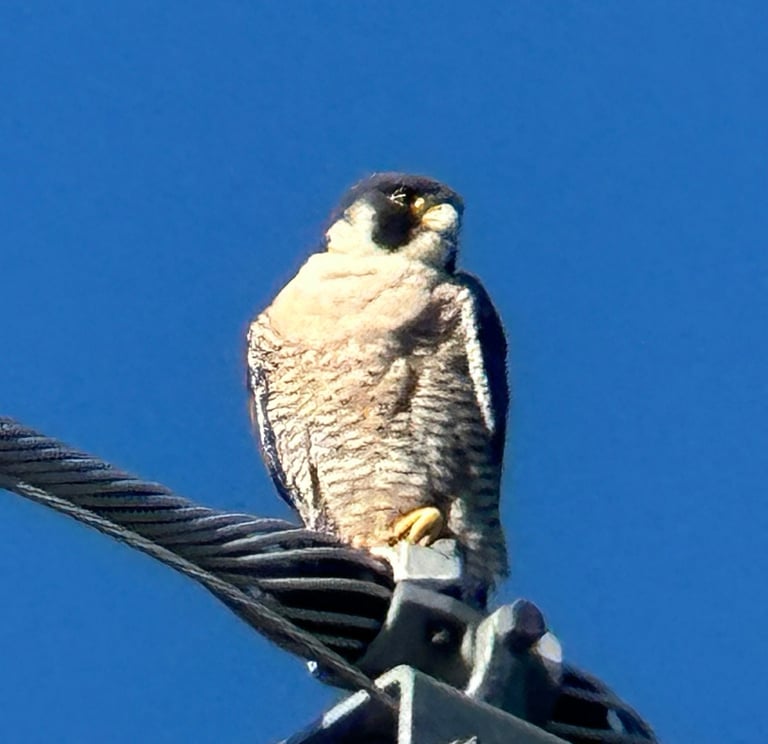
The clearest field mark is the combination of a dark, hooded head with two short black moustache stripes and an unstreaked white throat, set against slate-grey upperparts. At 29–36 cm in length with a wingspan of 74–84 cm and a weight of 175–285 g, it is a compact, narrow-winged falcon.
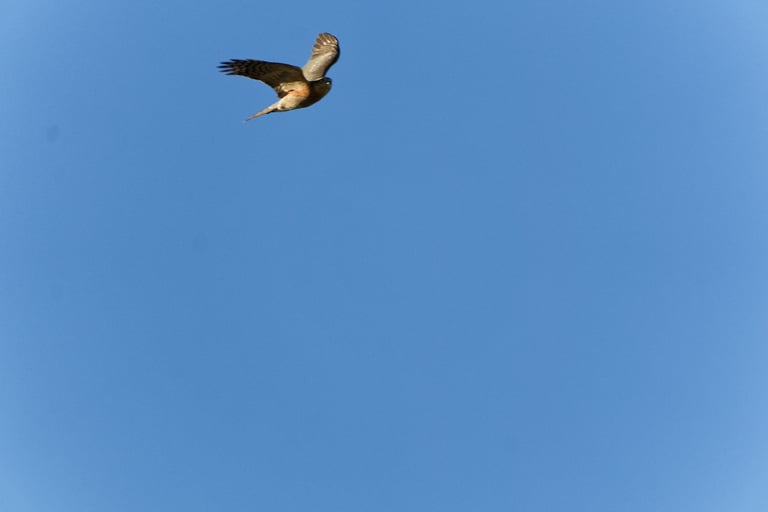
In flight it looks sickle-shaped, with long pointed wings and a square tail, and when gliding with wings folded it can resemble a swift rather than a bird of prey. The underparts are whitish with bold black streaking, while the thighs and undertail coverts are unstreaked rufous, the reddish "trousers" visible only on close views.
Sexes look alike, so plumage alone will not separate males from females. Juveniles differ clearly from adults: they are much browner overall, with scaled upperparts and streaked, buffy thighs and undertail coverts rather than the clean rufous of the adult.
The species also passes through a distinct first-summer plumage, an intermediate stage between the juvenile and full adult look, which can complicate ageing birds seen in their second calendar year.
Distribution and Habitat
The Eurasian hobby breeds across the Palearctic realm, from Europe through much of temperate Asia. The nominate subspecies, F. s. subbuteo, is a long-distance migrant that winters in Africa, while F. s. streichi is largely resident and does not undertake this seasonal journey.
The species favors open country such as farmland, marshes, taiga, and savanna, and is widespread in lowland landscapes with scattered small woods that provide nest sites and vantage points.
It is a rare vagrant well outside this range, with records from Massachusetts, Washington, and Alaska in the United States, Newfoundland and British Columbia in Canada, and sightings as far afield as Australia and Brazil.
Monthly observation counts peak sharply from May through August, with May alone accounting for over 211,000 records compared to fewer than 3,000 in each of January through March. This pattern likely reflects the birds' presence during the breeding season in Europe and Asia rather than any measure of total population, since these figures are presence observations only.

Behavior and Lifestyle
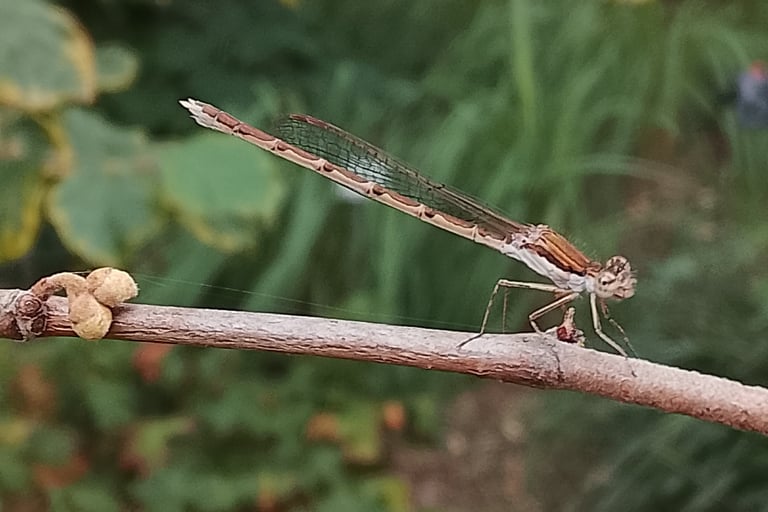
The hobby hunts on the wing with speed and precision, taking large insects such as dragonflies, which it transfers from talons to beak and eats while soaring slowly in circles. It also captures small bats and small birds in flight, and its aerobatic skill lets it run down swallows and even swifts.
It regularly harasses swallows at roosts, both while they are settled and as they disperse, a habit direct enough that barn swallows and house martins have developed a distinct alarm call just for this falcon's approach. Outside the breeding season it becomes crepuscular, concentrating its hunting into the morning and evening hours, and it may travel in small groups while migrating.
For nesting, hobbies do not build their own structures but take over old nests built by crows or rooks, typically raising a single brood of 2–3 eggs between June and August. Incubation lasts about 28 days and is shared by both parents, though the female carries the larger share of the duty.
Nest trees are usually chosen at the edge of a hedge or on the extreme margin of a small wood, positions that let the birds spot intruders from a considerable distance. The species has long been valued in falconry for its boldness, trained historically to hawk birds such as quails, larks, hoopoes, and drongos.
Fun Facts
- The tabletop football game Subbuteo takes its name from this falcon's scientific name, Falco subbuteo, reportedly chosen after British trademark rules blocked the use of "hobby" alone.
- Despite weighing as little as 175 grams, the hobby is fast enough to catch swifts and swallows outright in flight, birds renowned for their own aerial speed.
- Barn swallows and house martins have a dedicated alarm call used specifically when a hobby approaches their roost.
- The species has appeared as a vagrant far outside its normal range, with confirmed sightings in Alaska, Massachusetts, and even Australia and Brazil.
- Falconers have prized the hobby for centuries for its bold, courageous temperament, training it to hunt quails, larks, hoopoes, and drongos.
Photos
Photographs from via iNaturalist, licensed under CC0 1.0., by Arthur Gelling via iNaturalist, licensed under CC BY 4.0., by Priya Sandhu via iNaturalist, licensed under CC BY 4.0., by Cenaida via iNaturalist, licensed under CC BY 4.0., by Настя Бухвалова via iNaturalist, licensed under CC BY 4.0., by Donsky via iNaturalist, licensed under CC BY 4.0., by Paolo Zucca via iNaturalist, licensed under CC BY 4.0., by Fedotova Elena via iNaturalist, licensed under CC BY 4.0., by Jan Ebr & Ivana Ebrová via iNaturalist, licensed under CC BY 4.0., by Константин Селивёрстов via iNaturalist, licensed under CC BY 4.0., by Igor Balashov via iNaturalist, licensed under CC BY 4.0., and by Александр Краснов via iNaturalist, licensed under CC BY 4.0., credited on each photo.
Ecology and classification
Classification
- Phylum
- Chordata
- Class
- Aves
- Order
- Falconiformes
- Family
- Falconidae
- Genus
- Falco
- Species
- Falco subbuteo
Sources
- GBIF Species names and classification
- iNaturalist Photos
- Wikidata Common names and conservation status
- Wikipedia Summary extract
- AnAge Longevity