No animal on Earth moves faster than a diving Peregrine Falcon. In its hunting stoop, this falcon has been tracked at speeds that some observers put well over 300 km/h (200 mph), turning a routine hunt into the fastest deliberate movement in the animal kingdom.
This crow-sized raptor, Falco peregrinus, belongs to the falcon family Falconidae and ranges across nearly every continent, nesting on cliffs, mountains, coastlines, tundra, and increasingly on skyscrapers and bridges in cities. The IUCN lists it as Least Concern, a striking turnaround for a species that was nearly wiped out across large parts of its range within living memory. Few birds illustrate as clearly how close a species can come to disaster, and how completely it can recover, as this one does.
Identification and Appearance
The single best field mark is the black "moustache" or malar stripe running down each cheek, sharply contrasting with a white throat and the pale sides of the neck. Combined with a black hooded crown, a blue-grey to slate-grey back, and white to rusty underparts barred with thin, clean bands of dark brown or black, the pattern is distinctive at rest or in flight.
Body length runs from 34 to 58 cm (13–23 in) with a wingspan of 74 to 120 cm (29–47 in), and the wings are long, pointed, and black-tipped. The tail is long, narrow, and rounded, colored like the back but banded, with a black tip and a thin white terminal edge. As in most birds of prey, males and females share the same plumage pattern but differ sharply in size: females can be up to 30% larger than males, with males typically weighing under 700 g (25 oz) and females over 800 g (28 oz), occasionally reaching around 1,500 g (53 oz).
Immature birds look noticeably browner overall, with streaked rather than barred underparts and a pale bluish cere and eye-ring rather than the adult's yellow cere and black beak. The upper beak carries a small notch near the tip, an adaptation that helps the falcon sever a prey animal's spinal column at the neck.
A 2021 study of photographs from around the world found that the malar stripe grows larger in populations living under stronger sunlight, suggesting the dark feathering works like an eye-black stripe, cutting glare to sharpen the falcon's vision during high-speed pursuits.
Distribution and Habitat
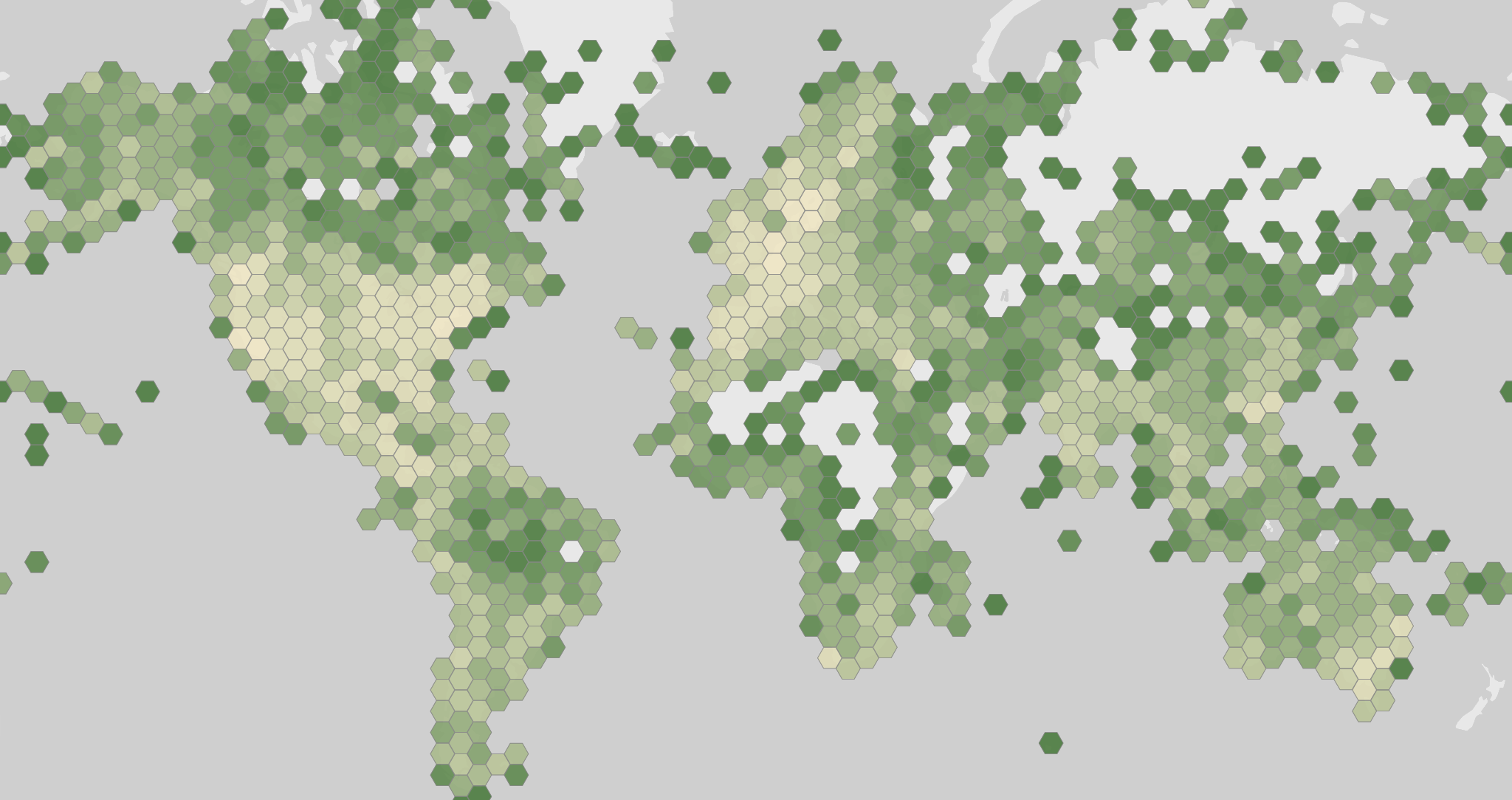
Peregrine Falcons occupy an unusually broad range of open landscapes, from Arctic tundra and subarctic river corridors to coastal cliffs, mountain ranges, deserts, grasslands, and, increasingly, city centers. They show little preference for any single ecological community and are most tied to open or lightly wooded country that lets them spot and chase flying prey; they avoid dense, closed-canopy forest and true alpine habitat.
Nesting sites range from sea level up to roughly 2,700 m (9,000 ft) in places like Arizona and California, with a few unconfirmed reports near 4,000 m. Most eyries sit within a few kilometers of permanent water, since lakes, rivers, marshes, and coastlines concentrate the shorebirds, waterfowl, and songbirds the falcon depends on. In mild-winter regions many pairs stay on their breeding territory year-round, while Arctic-breeding populations undertake long-distance migrations, and non-breeding or wintering birds often gather near wetlands, tidal flats, and other places where prey birds congregate.
Monthly GBIF observation counts show a clear rise from a summer low around June (roughly 120,000 records) to a peak in September (about 355,000 records), consistent with heightened detectability during fall migration rather than any real change in population size. These figures are presence records only, not counts of actual birds, and should not be read as a measure of abundance or as a complete picture of the species' range.
The species' growing use of tall buildings, bridges, and other structures for nesting reflects both the scarcity of natural cliffs in some regions and the abundance of feral pigeons as urban prey, a shift that has let Peregrine Falcons colonize cities on several continents.
Behavior and Lifestyle
Peregrine Falcons are diurnal hunters that are largely solitary outside the breeding season, each defending its own territory or feeding area. Nesting pairs typically space themselves at least 1 km apart and often several kilometers apart, with historical densities in Alaska and Greenland ranging from roughly one pair per 3 to over 100 km of coastline or river corridor depending on prey abundance; home ranges have been estimated from about 177 to 1,508 km².
Hunting is built around the stoop: a falcon soars to height, often 50 to over 1,500 m above a target, then dives steeply, striking prey with a closed foot rather than grabbing it outright. Cruising flight speed normally runs 40 to 97 km/h, but a diving falcon may reach 90 to over 400 km/h, with speeds of 112 to 140 km/h considered more typical of an average stoop. Hunting success varies enormously, from about 7% to over 80%, and is higher for adults than immatures and higher during the breeding season than outside it. Falcons also hunt via low surprise attacks, tail-chases of flying prey, and, over water, low fast passes that use wave cover to approach swimming or diving birds undetected.
Mated pairs cooperate in hunting during courtship and after fledging, and prey is regularly transferred between mates in mid-air. Excess prey is often cached and eaten later, particularly food captured early in the morning. During migration, falcons exploit thermals to glide long distances with minimal wingbeats, covering roughly 110 to 200 km a day, and they avoid flying in heavy rain, strong wind, or hurricanes.
A third eyelid, the nictitating membrane, sweeps across the eye to clear debris and spread tears while the bird is flying at speed, and an unusually fast flicker-fusion rate of 129 Hz lets it process fast-moving visual detail well beyond what most mammals can perceive.
Communication
Vocal signals in Peregrine Falcons are concentrated around breeding, and each call type serves a distinct social function. The harsh, repeated "cack" call, rendered as "kaa-a-aack," is used in alarm and nest defense and is individually distinctive enough that observers can recognize specific birds by voice 72 to 90% of the time.
Other calls include a rapid "chitter" used in several social contexts, an "eechip" call often reduced to just its high-energy "chip" portion, and a sharp, repeated "kee, kee, kee" given during hunting flights. Nestlings beg for food with a distinct "screea, screea" call.
Alongside sound, falcons rely heavily on posture. Raised feathers and bill-gaping signal aggression, while feathers held tight to the body, a lowered head, and an averted beak signal submission, and pairs reinforce their bond through mutual preening, toe-nibbling, and gentle bill-grabbing at the nest ledge.
Hunting and Diet
Peregrine Falcons hunt almost entirely from height, most often launching a stoop from a high perch or from soaring flight once prey is spotted below. They may also fly low to surprise ground-level targets, hover to scan for prey, pursue flocks to split off a vulnerable individual, or, over open water, use fast low passes that hide their approach behind waves before seizing a swimming or surfacing bird.
Birds make up the overwhelming majority of the diet, 77 to 99% of prey items, with pigeons and doves (Columbidae) forming the single most important group by biomass. Other common prey includes shorebirds, waterfowl, grouse and ptarmigan, and a wide range of smaller songbirds; worldwide, more than 2,000 bird species have been recorded as prey. Mammals make up a much smaller share, chiefly bats such as Tadarida, Eptesicus, Myotis, and Pipistrellus, along with voles, squirrels, and rats, and falcons occasionally take reptiles, amphibians, fish, and insects.
Kills are typically made with the beak, severing the neck vertebrae, rather than the talons used to strike the prey down. Small prey under about 100 g is often eaten immediately, sometimes plucked and consumed in flight, while larger prey is carried to a favored perch to be plucked and eaten, or cached and returned to later. Diet composition shifts with season and location: in the Arctic, falcons rely on resident ptarmigan and snow buntings early in the breeding season before switching to shorebirds and waterfowl once these migrants arrive, while urban falcons feed heavily on rock pigeons and European starlings.
Nesting and Breeding
Courtship centers on dramatic aerial display: pairs perform power dives, tight cornering, high soaring, and body rolls in flight before settling into ledge displays at the chosen nest site. Males also pass captured prey to females in mid-air, with the female flipping upside-down to take the food from the male's talons, a ritual that reinforces the pair bond and later carries over into cooperative hunting.
Pairs are monogamous and often reuse the same territory, and sometimes the same ledge, across many breeding seasons. No true nest is built; the female scrapes a shallow hollow into loose soil, sand, gravel, or dead vegetation on a cliff ledge, tall tree, or building, with south-facing, overhung sites favored where available. Egg-laying generally runs from March to May in northern populations, shifting to February–March or later depending on hemisphere and latitude, and clutches typically hold 2 to 6 eggs, averaging around 3 to 4, laid roughly every 48 hours.
Eggs are white to buff with red or brown markings and are incubated for 29 to 35 days, mainly by the female, though the male helps during the day. Chicks hatch fully dependent and are brooded almost continuously for their first 10 days, with both parents feeding them; the female typically does most of the feeding directly, while the male hunts.
Young fledge at 35 to 42 days old but remain dependent on their parents for about six weeks afterward, initially catching only dead prey dropped to them in the air before learning to hunt live prey themselves. Sexual maturity comes at 1 to 5 years in females and 2 to 8 years in males, though most individuals do not breed successfully until 2 to 3 years old.
Population and Ecological Role
As an apex predator, the Peregrine Falcon plays an outsized role in shaping the behavior and numbers of its prey, particularly pigeons and doves, ptarmigan, and ducks, whose populations it helps regulate through sustained predation pressure. This top position in the food web also makes the species a sentinel for environmental contamination, since toxins ingested by prey accumulate further up the chain in the falcon's tissues.
The species carries a range of parasites and pathogens, including avian pox virus, Newcastle disease virus, herpesvirus, fungal infections, the malaria parasite Plasmodium relictum (which rarely causes disease in the falcon itself), trematodes, the nematode Serratospiculum amaculata, tapeworms, chewing lice, a flea (Ceratophyllus garei), and hippoboscid flies. These associations are typical of a wide-ranging avian predator and are not generally reported as major drivers of population change.
Conservation and Threats
The Peregrine Falcon is currently assessed as Least Concern by the IUCN, a status that reflects one of the most complete recoveries of any raptor after a near-catastrophic 20th-century decline. Between the 1950s and mid-1970s, organochlorine pesticides, especially DDT and its breakdown product DDE, accumulated in the falcon's tissues after being ingested by prey species, and this thinned eggshells to the point that many eggs broke before hatching; dieldrin and aldrin also caused direct adult mortality. Breeding pairs disappeared entirely from the eastern United States by the mid-1960s, and populations crashed across much of Europe and North America.
Recovery followed the 1972 ban on DDT in the United States, combined with intensive captive breeding and reintroduction programs using a technique called hacking, run with falconers, The Peregrine Fund, and government agencies. North American populations grew by an estimated 2.9% to 25% annually between 1974 and 2000, and the species was removed from the US federal endangered species list in 1999, though it remains listed as endangered in Michigan. In Canada, the species was declared no longer at risk in 2017, and the UK's population, supported by RSPB-led conservation work, was estimated at 1,402 breeding pairs in 2011.
Remaining threats include continued use of organochlorine pesticides in parts of Central and South America where many populations winter, loss of wetland habitat used by migrating and wintering birds, human disturbance of nest sites (including recreational climbing), collisions with human-made structures, and predation of nests by great horned owls and Eurasian eagle-owls, the two most serious predators encountered during reintroduction efforts. The species is also protected under the Migratory Bird Treaty Act and listed on CITES Appendix I.
Conservation status
- LC
- NT
- VU
- EN
- CR
Least Concern
Cultural Significance
The Peregrine Falcon has long carried symbolic weight far beyond its role as a predator. Among Mississippi River cultures such as the Pascagoula, Cahokia, Choctaw, and Chickasaw, it held a revered position as a messenger between realms, and more broadly it has been regarded as a symbol of celestial power and ferocity in Native American tradition.
Its partnership with people is exceptionally old: falconers have flown Peregrine Falcons for more than 3,000 years, beginning with nomadic peoples in central Asia, prized for their athleticism, eagerness to hunt, and comparatively even temperament, which makes them easier to train than many other falcon species.
Today the bird's dramatic recovery from near-extinction has made it a widely used symbol of conservation success and environmental awareness, its urban nesting pairs on cathedrals and skyscrapers often drawing public attention and webcam followings that reinforce this modern symbolic role.
Fun Facts
- A flight-physics study calculated a theoretical top speed limit for an "ideal falcon" of about 400 km/h (250 mph) at low altitude and 625 km/h (388 mph) at high altitude, though the most reliable radar-tracked dives have measured closer to 184 km/h (114 mph).
- During World War II, trained Peregrine Falcons were used to intercept enemy homing pigeons carrying messages.
- Falconers have bred Peregrines with lanner falcons to create the "perilanner," and with gyrfalcons to produce large, strikingly colored hybrids favored for hunting big game birds like sage-grouse.
- Portland, Oregon, hosts about 10% of its state's entire population of Peregrine Falcon nests despite covering only around 0.1% of Oregon's land area.
- A falcon's nictitating membrane, a translucent third eyelid, sweeps across the eye in flight to clear debris and spread tears without blocking vision.
- In one documented incident, a snowy owl killed a newly fledged Peregrine Falcon, only to be killed in turn by the fledgling's stooping parent.
Ecology
Habitat
- Coastal
- Mountain
- Urban
- Tundra
Diet
- Carnivore
Behavior
- Predator
- Solitary
- Territorial
- Diurnal
Photos
SourcesGBIFiNaturalistWikidataWikipediaEncyclopedia of LifeAnimal Diversity WebAnAge