The common octopus ranks among the most studied and most intelligent invertebrates in the ocean, capable of learning, problem-solving, and recognizing individual people.
Classified as a mollusk in the class Cephalopoda, it currently carries an IUCN status of Least Concern. Its combination of wide distribution, adaptability, and sharp cognition makes it one of the more rewarding animals to understand in detail.
Identification and Appearance
The single best way to recognize Octopus vulgaris is by watching it vanish: it changes color, skin texture, and posture almost instantly to match rock, sand, or coral. Adults reach a mantle length of about 25 cm (10 inches), with arms stretching up to 1 m (3.3 feet), and can weigh as much as 9 kg (20 pounds); most individuals live only 1 to 2 years.
A hard beak lets it crack into the shells of crabs, lobsters, and bivalves such as cockles, and it carries venom to subdue prey before feeding. It hunts mainly at dusk, ambushing prey that strays too close and sometimes leaping onto unwary animals.
Behind this hunting skill lies an unusually large nervous system: roughly 500 million neurons, a number that approaches the neural complexity of a dog. Individuals can tell apart brightness, size, shape, and orientation, navigate mazes, unscrew jars, and even raid lobster traps. Some have been observed arranging shells and rocks into "gardens" alongside collected algae, a habit thought to have inspired the Beatles' song "Octopus's Garden."
The species was significant enough to become the first invertebrate protected under the UK's Animals (Scientific Procedures) Act 1986. Mating itself can turn cannibalistic, a stark exception to its otherwise placid, shell-gathering habits.
Distribution and Habitat
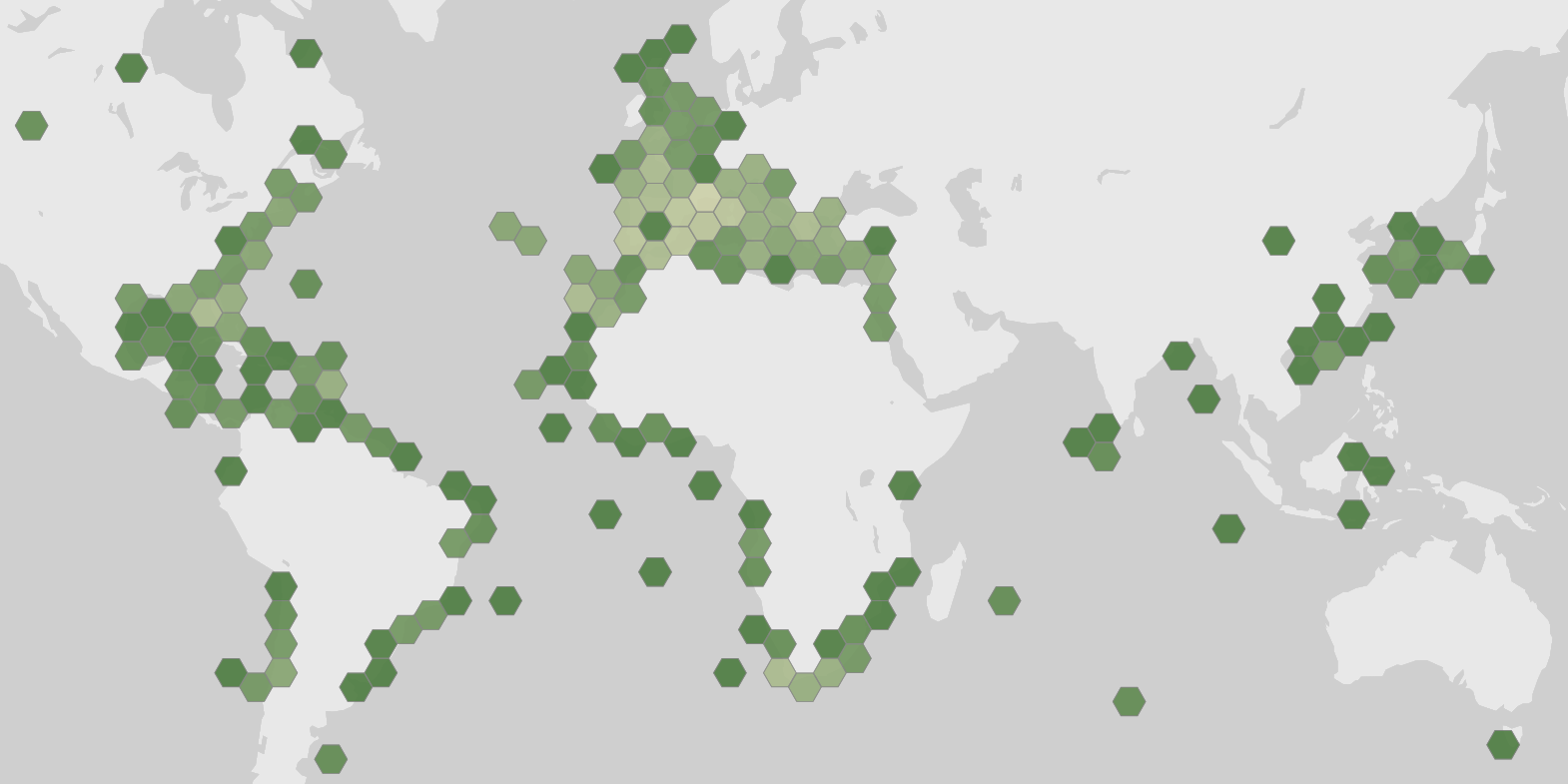
Octopus vulgaris has a worldwide distribution across tropical, subtropical, and temperate waters, avoiding only the polar and subpolar extremes. It favors rocky coastal seafloors and the upper continental shelf, typically no deeper than 200 m and most often within 100 to 150 m of the surface.
The species tolerates a wide salinity range, from roughly 30 to 45 grams per liter, though it prefers around 36 g/L, and it seeks water temperatures near 15 to 16 °C. During unusually warm seasons, individuals retreat to deeper, cooler layers, since temperature and pressure together govern how much oxygen the water can hold.
Monthly presence records show a low count in December and January (556 and 641 observations) rising to a broad peak from May through August (2,081 to 2,981), which may reflect seasonal shifts in coastal activity rather than a change in true abundance; these figures are presence observations, not population counts.
Movement through the water column carries a physiological cost: crawling raises oxygen demand about 2.4 times over resting levels, while swimming by jet propulsion squeezes the vessels around the heart and gills, making it an inefficient, rarely used mode of travel.
Behavior and Lifestyle
Octopus vulgaris is fundamentally solitary and territorial, denning near others of similar size but avoiding close contact except to mate. In shared tanks, individuals actively space themselves out or claim separate shelters.
It is strictly nocturnal, leaving its den at dusk to hunt and returning by dawn, with shorter foraging trips sometimes made during daylight. Some individuals hold the same den for extended periods, while others switch shelters every few days. Females reinforce their homes with gathered shells and stones for protection.
In the Catalonian Sea, near Banyuls and Port Vendres, the species shows a seasonal, largely vertical migration tied to reproduction. Large octopuses move inshore in early spring to spawn; females then vanish over summer as they brood and die, leaving a population dominated by maturing males. Some females spawn in autumn, others delay until winter passes, while immature animals move into shallow water in late spring, and abundance drops sharply with depth on the continental shelf.
The only real break in this solitary pattern comes during mating and spawning, and even then females brood their eggs completely alone.
Hunting and Diet
As an active predator, the common octopus locates and overpowers gastropods and bivalves, forming the core of its adult diet. This hunting lifestyle begins almost immediately after hatching.
Newly hatched octopuses spend several weeks as free-swimming predators in the plankton, feeding on tiny prey while adrift, before settling onto the seafloor once they reach about 0.2 grams. That shift from a planktonic to a benthic hunter marks a fundamental change in how, and on what, the animal feeds as it grows.
Reproduction and Life Cycle
Courtship begins when a male approaches a female, who initially fends him off before accepting him; he then sits beside or mounts her and uses his modified arm, the hectocotylus, to pass spermatophores into her mantle cavity, a process that can last several hours and repeat over about a week. Mating is promiscuous, with both sexes accepting multiple partners, and often occurs while females are still immature; only females ready to lay eggs consistently reject males.
Once ready, the female searches for a sheltered hole or crevice, sometimes among coral reefs, and fertilizes her eggs internally as they pass through the oviductal glands. She sticks the egg stalks into long strings using secretions and mucus, then attaches them to a substrate, which on sandy or muddy bottoms may be an empty mollusk shell or even a discarded can, bottle, or tire. A single female lays between 100,000 and 500,000 eggs, with spawning recorded from December through September and a distinct peak in spring.
During the 4 to 5 month brooding period at low temperatures, the female rarely leaves her egg mass and typically stops feeding altogether. She cleans the eggs with her arm tips, directs jets of water through the strings to aerate them, and drives off intruders, occasionally eating a crab left overnight.
This reproductive effort is fatal: females die shortly after the last eggs hatch, having lost about one-third of their pre-spawning body weight, making the species semelparous, reproducing only once in a lifetime.
Conservation and Threats
The common octopus is currently assessed as Least Concern, meaning it faces no immediate risk of extinction across its broad range. The main threat noted is the potential for overfishing, since the species is targeted heavily by fisheries.
At present, however, this pressure has not translated into a specific conservation risk, and no population decline severe enough to change its status has been documented in the available assessment.
Cultural Significance
The octopus left a lasting mark on Minoan and Cretan art and on Greek mythology, where it is thought to have inspired the many-headed Hydra and the paralyzing gaze of Medusa. In Polynesian tradition, a legend tells of a man named Kupe whose fishhooks were stolen by an octopus; his pursuit of the creature across roughly 2,400 miles supposedly led to the discovery of New Zealand, the origin story of the Maori according to this account.
Across cultures from South America to the Pacific Northwest and the Polynesian Islands, octopuses were traditionally seen not as fearsome but as divine protectors and spiritual guides.
The species also has substantial economic importance: fisheries caught about 121,000 tons of Octopus vulgaris in 1975 and 137,000 tons the following year, underscoring its long-standing role as a food resource.
Fun Facts
- A single female common octopus can lay up to 500,000 eggs in one clutch, far more than the giant Pacific octopus (about 180,000) or Octopus rubescens (up to 45,000).
- Rather than being feared, octopuses were traditionally regarded as divine protectors and spiritual guides in cultures ranging from South America to the Pacific Northwest and the Polynesian Islands.
- Octopus vulgaris is one of the most heavily studied octopus species in the world, prized by researchers for its intelligence as much as for its abundance.
Photos
Photographs from by Vsevolod Rudyi via iNaturalist, licensed under CC BY 4.0., by tunicatedreamz via iNaturalist, licensed under CC BY 4.0., by Chris Taklis via iNaturalist, licensed under CC BY 4.0., by Jan Ebr & Ivana Ebrová via iNaturalist, licensed under CC BY 4.0., by Julien Renoult via iNaturalist, licensed under CC BY 4.0., by Louis Aureglia via iNaturalist, licensed under CC BY 4.0., by Radu Teodoreanu via iNaturalist, licensed under CC BY 4.0., by Clément Maouche via iNaturalist, licensed under CC BY 4.0., by Sarah Faulwetter via iNaturalist, licensed under CC BY 4.0., by Ben Jobson via iNaturalist, licensed under CC BY 4.0., by Silvan Alder via iNaturalist, licensed under CC BY 4.0., by shahar chaikin via iNaturalist, licensed under CC BY 4.0., by Pierre via iNaturalist, licensed under CC BY 4.0., and by Sylvain Montagner via iNaturalist, licensed under CC BY 4.0., credited on each photo.
Ecology and classification
Classification
- Phylum
- Mollusca
- Class
- Cephalopoda
- Order
- Octopoda
- Family
- Octopodidae
- Genus
- Octopus
- Species
- Octopus vulgaris
Sources
- GBIF Species names and classification
- iNaturalist Photos
- Wikidata Common names and conservation status
- Wikipedia Summary extract
- Animal Diversity Web Animal habitat, behavior and diet