Despite looking like a distant cousin of the barnyard chicken, the common pheasant split from the lineage that produced Gallus species more than 20 million years ago, placing the two birds in entirely separate subfamilies of Phasianidae.
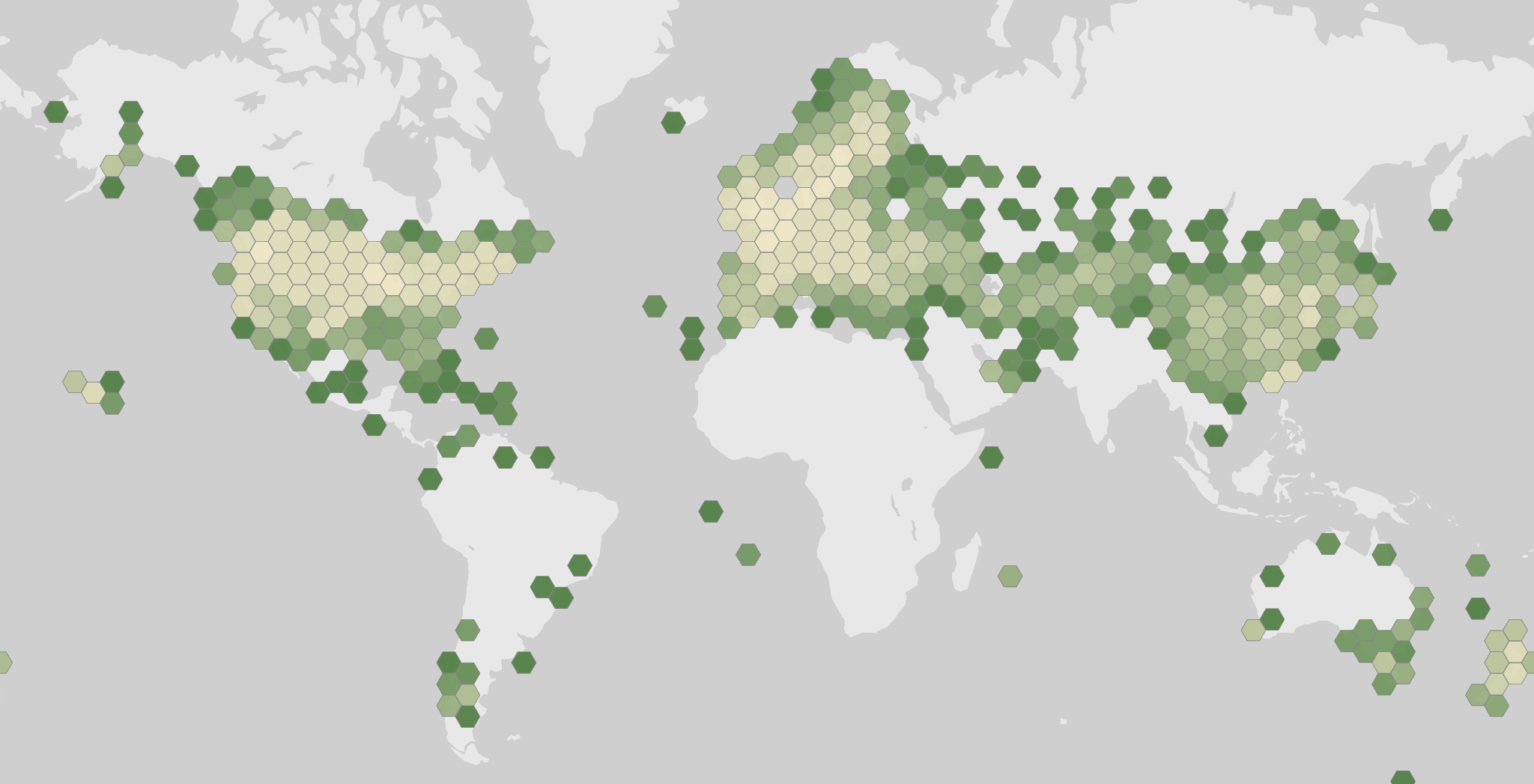
The common pheasant, also called the ring-necked or blue-headed pheasant, is a ground-dwelling bird of the order Galliformes. Native across a broad swath of Asia and parts of Europe, it has since been carried by people to farmland and grassland on nearly every continent. The IUCN lists it as Least Concern, reflecting a range and population size that remain large and secure.
Few birds have been so thoroughly reshaped by human hands, through selective breeding, hybridization between subspecies, and centuries of release for hunting. The result is a species whose wild appearance now varies enormously from bird to bird, even as its biology remains firmly tied to open farmland and grassy cover.
Identification and Appearance
The adult male is unmistakable at close range: a bottle-green head with a small crest, a bright red facial wattle, and two ear-tufts give it an alert, almost horned look, above a body barred in fiery copper-red, gold, and chestnut with an iridescent green and purple sheen.
Males of the nominate subspecies measure 60 to 89 centimeters long, nearly half of which is a long, brown, black-streaked tail. Body weight ranges from 0.5 to 3 kilograms, with males averaging around 1.2 kilograms and females about 0.9 kilograms; wingspan runs from 56 to 86 centimeters. The wing coverts are pale, white or cream, contrasting with black-barred tail feathers, and the rump is sometimes blue rather than the typical gold.
Females and juveniles are far plainer, mottled brown all over, and measure only 50 to 63 centimeters long with a shorter, roughly 20-centimeter tail. Young birds resemble females until about ten weeks of age, when males begin sprouting the bright feathers of adulthood on the breast, head, and back.
The similar green pheasant (P. versicolor) can be confused with hybrid common pheasants, though male green pheasants have shorter tails, uniformly dark bottle-green underparts, and never show a white neck ring. Because of extensive crossbreeding among subspecies and with green pheasants, wild common pheasants also turn up in melanistic (
Distribution and Habitat
Distribution and Habitat
Behavior and Lifestyle
Common pheasants spend most of their day on the ground, walking with a distinctive strutting gait and holding their long tail horizontal while feeding or at a 45-degree angle while running. They are strong, if reluctant, fliers: when startled they can burst almost vertically into the air with a whirring wingbeat, and males often let out a sharp croaking call during takeoff. Running is their preferred escape method, and they roost both on the ground and in sheltered trees at night.
Social structure shifts with the season. In autumn, pheasants gather into flocks that can number up to 50 birds, sometimes mixed-sex and sometimes single-sex, concentrating wherever food and cover are abundant. As breeding season approaches in early spring, these flocks break up gradually rather than all at once, with males departing first to establish crowing territories. During the breeding season a male typically keeps a harem of several females, while home ranges expand compared to the smaller, food-driven ranges used in winter. In Missouri, wintering hens have been tracked using roughly 64 hectares, while in Maryland the figure was about 50 hectares and in Iowa ranges of 76 to 96 hectares have been recorded, differences likely tied to weather, land cover, and local population density.
Most populations are sedentary, but birds in northern regions show migratory tendencies, shifting locations when cold weather limits food and cover. Territory size during the breeding season ranges from about 0.8 to 3.2 square kilometers. Pheasants also dust-bathe regularly, raking sand and dirt into their plumage with the bill, scratching the ground, and shaking their wings to strip away dead skin, excess oil, and worn feather sheaths.
Communication
The most recognizable signal is the male's crowing call, a loud, piercing double squawk rendered as ko-ork kok, ending in a sharp staccato note. This call carries up to a mile and is used both to establish and defend breeding territory and, in agricultural areas, is commonly heard at dawn and dusk during the mating season; its similarity to a rooster's crow makes it easy to recognize even at a distance.
Females communicate far less audibly, producing calls that are subtler and rarely carry as far as the male's crow. Visual signals also matter during territorial disputes and courtship, and the species relies on acoustic, visual, tactile, and chemical channels for perception and interaction more broadly.
Diet and Nutrition
Common pheasants are dietary generalists that will take almost anything edible they can find while scratching through undergrowth with their bill. Foraging peaks in the early morning and evening, when birds work the ground for grain, seeds, shoots, and berries alongside insects and other small invertebrates.
Agricultural crops make up a substantial part of the diet where available, including corn, wheat, barley, and flax. Wild seeds such as foxtail, ragweed, and sunflower are also taken, along with fruits like wild grape, apples, and blackberries. Animal prey rounds out the menu: grasshoppers, caterpillars, crickets, and snails are all regularly eaten.
This flexible, omnivorous strategy lets pheasants exploit farmland, scrub, and grassland alike, shifting toward whatever seeds, grain, or invertebrates are locally abundant at a given time of year.
Nesting and Breeding
Breeding begins in early spring, from mid-March to June, when males stake out crowing territories that are defined relative to rival males rather than by fixed boundaries. A male attracts and defends a harem of two to eighteen females through crowing and a wing-whirring display, sometimes preceded by an almost silent wing-flap. Rival males compete directly, flying at each other breast-to-breast, biting at wattles, or leaping and kicking toward an opponent's bill; males that stake out territory earliest in the season tend to dominate later arrivals.
Females choose mates based on dominance and specific traits: studies have found a preference for longer tails, larger ear tufts, and black points on the wattle, while overall plumage brightness appears to have no bearing on female choice. Courtship includes distinct displays, feeding rituals that draw females in and a lateral display, in which the male circles slowly in front of a female with his head lowered, near wing drooped, and wattle erect, that typically precedes mating. Later in the season a male may simply pursue and attempt to mount a female without formal display.
Nesting starts just before egg-laying, with the hen scraping a shallow depression in the ground under dense cover and lining it lightly with available plant material. She lays about one egg per day until a clutch of 7 to 15 eggs (averaging 10) is complete; larger clutches can result when two or more hens lay in the same nest. The hen incubates alone for roughly 23 to 25 days, leaving only briefly in early morning and evening to feed, and she alone cares for the chicks after hatching.
Chicks are precocial, hatching fully downy with eyes open and legs developed enough to walk and follow the hen almost immediately. They begin flying within 12 to 14 days and largely feed themselves from the start, resembling adults by about 15 weeks of age; young typically stay near the hen for 70 to 80 days before becoming fully independent. Nest parasitism is common in the species, since pheasants often nest near other ground-nesting birds with similar habitat needs, including grey partridges, prairie chickens, and various ducks, rails, and grouse; because pheasant eggs hatch sooner than those of many host species, the host may abandon her own remaining eggs, and pheasant chicks raised in foreign nests sometimes imprint on their host and adopt atypical mating behavior.
Population and Ecological Role
Common pheasants function as prey for larger carnivores and as insect predators, giving them a role in controlling invertebrate populations, and they may disperse some seeds through their foraging. In Britain roughly 47 million pheasants are released each year for game shooting, though most released birds survive less than a year in the wild, and captive breeding and repeated releases keep numbers in Great Britain fluctuating sharply between summer and late winter.
The species' spread has ecological costs for native game birds. Nest parasitism of prairie chickens and grey partridges is well documented, and because pheasant eggs hatch earlier than those of these hosts, embryo mortality and nest abandonment increase in parasitized nests; one Kansas study found the rate of parasitism of lesser prairie chickens rose as nest sites became scarcer. Pheasants also compete directly with bobwhites and partridges for food and habitat, can transmit diseases such as blackhead to more susceptible species like ruffed grouse, chukar, and grey partridge, and are aggressive toward other birds, winning 78% of documented encounters with prairie chickens in one 1979 study. In managed woodland in Britain, however, one study found a neutral to positive impact of pheasant presence on vegetation and bird communities, though this may reflect the habitat management applied to those estates rather than the pheasants themselves.
Conservation and Threats
The IUCN Red List classifies the common pheasant as Least Concern, reflecting its extremely wide distribution across native and introduced ranges alike; it also carries no special protective status under the US Migratory Bird Act, the US Federal List, CITES, or Michigan state law. Its global spread has been aided by how readily it breeds in captivity and naturalizes across a broad range of climates.
Within the United States, populations have nonetheless been declining over the past 30 years, primarily in agricultural regions. Changing farming practices are the main driver: crops such as barley that once supported pheasants are increasingly replaced by less beneficial plantings like nut trees, while pesticide use and habitat fragmentation reduce the herbaceous cover pheasants need for nesting. Reduced grassland cover also leaves nesting hens more exposed to predation.
In Britain, management efforts by organizations such as the Game & Wildlife Conservation Trust are researching ways to improve the breeding success of released and wild pheasants, aiming to reduce reliance on releasing large numbers of captive-bred birds each year.
Conservation status
- LC
- NT
- VU
- EN
- CR
Least Concern
Cultural Significance
The genus name Phasianus traces to the Ancient Greek phāsianós, meaning a bird of the Phasis River, now the Rioni River in Georgia, where the species was said to have first been observed by the Argonauts of classical mythology. Carl Linnaeus formally established the genus in the 10th edition of Systema Naturae in 1758, designating Phasianus colchicus as its type species based on shared traits such as long tails and ornate plumage.
Beyond its taxonomic history, the common pheasant's primary significance to people has been as an upland game bird. Pheasant farming is widespread and often intensive, supplying birds to hunting estates and restaurants as well as smaller numbers for home cooks, a practice that has shaped both rural economies and land management traditions for game shooting.
Fun Facts
- The genus name Phasianus comes from the Ancient Greek phāsianós, referring to a bird of the Phasis River (today's Rioni River in Georgia), where the Argonauts of Greek mythology reportedly first encountered the species.
- Carl Linnaeus used Phasianus colchicus as the type species when he formally established the genus Phasianus in 1758.
- The species is native to China but was introduced to the United States in the 1890s, one of the rare examples of a deliberately introduced bird succeeding widely in a new range.
- About 47 million pheasants are released annually on shooting estates in Britain alone, causing the country's population to swing from roughly 50 million birds in July down to under 5 million by the following June.
Ecology
Habitat
- Wetland
- Woodland
- Shrubland
- Grassland
Behavior
- Territorial
- Social
- Diurnal
- Migratory
Diet
- Omnivore
Photos
SourcesGBIFiNaturalistWikidataWikipediaEncyclopedia of LifeAnimal Diversity WebAnAge