Crepidotus mollis goes by several names, including the peeling oysterling, soft slipper, jelly crep, and flabby crepidotus, a sign of just how variable its soft, floppy cap can look. It belongs to the fungal kingdom, in the order Agaricales and family Crepidotaceae, within the class Agaricomycetes and phylum Basidiomycota.
This mushroom is regarded as inedible rather than dangerously toxic, but it is still worth knowing on sight since it often turns up in large numbers on dead wood.
Its many common names hint at the different faces this fungus shows depending on the weather and the age of the specimen, which makes careful identification more rewarding than it might first appear.
Fruiting Body and Identification
The most reliable identifying feature is the cap's texture: a stretchy, elastic upper skin covered in brown fibrils and scales that wear away with age, leaving a smooth surface underneath. The kidney-shaped cap measures roughly 1 to 5 centimeters wide, starting white when young and turning ochre as it matures. The flesh is white, flabby, and breaks easily.
The gills are pale brown and soft, and the spores are elliptical, smooth, and produce a brown spore print. A stalk is rudimentary or entirely absent, since the cap attaches directly to its wood substrate. In moist weather the whole fruiting body can curl inward, taking on a shape that resembles a globe.
Crepidotus mollis is notably large compared to most other species in its genus. Its cap is also vulnerable to the parasitic fungus Hypomyces tremellicola, which can visibly deform its shape.
Distribution and Habitat
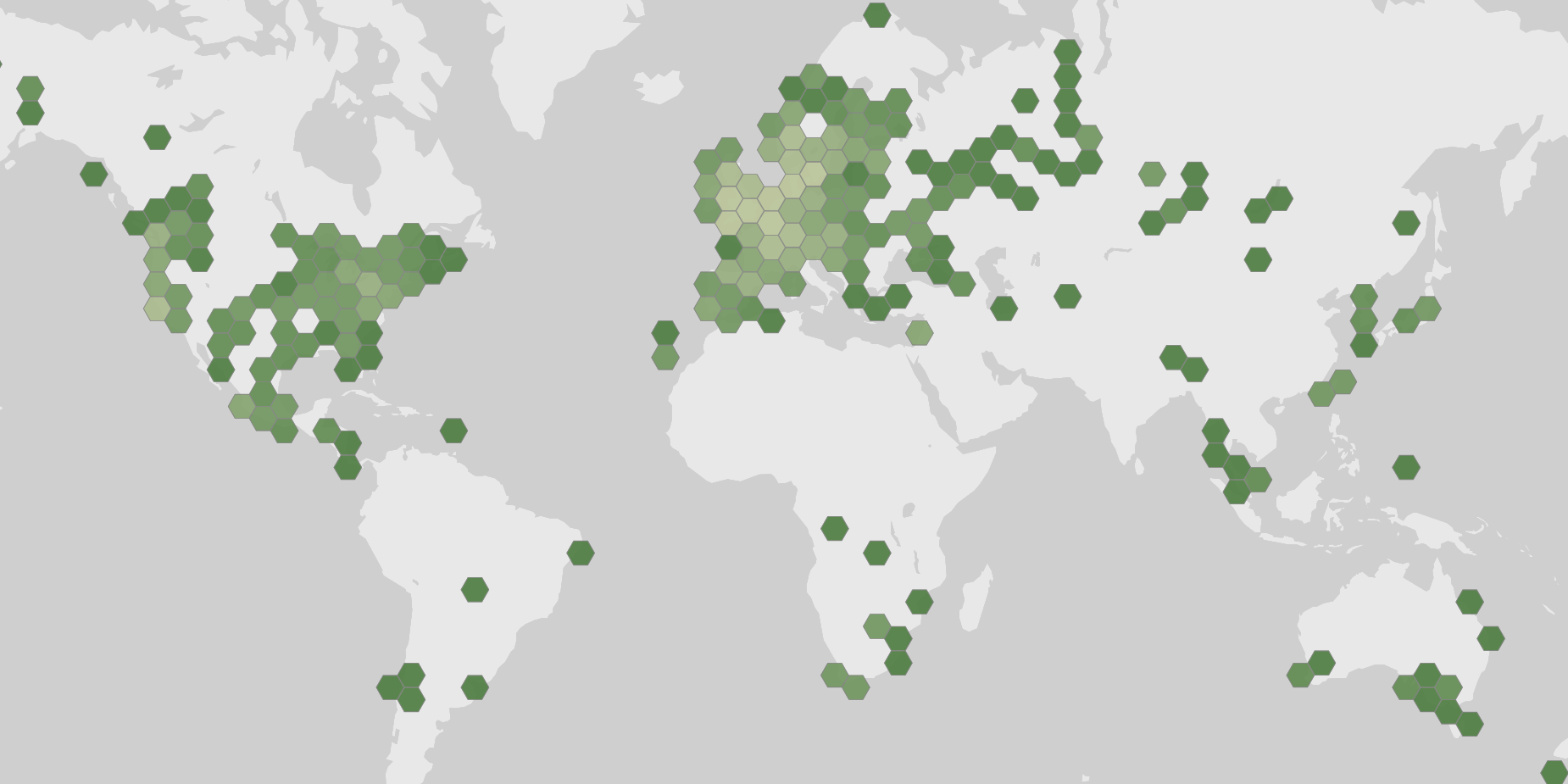
Crepidotus mollis is widely distributed and very common across the temperate zones of North America, South America, and Europe. It fruits from July to September in the northern hemisphere.
The fungus grows in groups or overlapping tiers directly on hardwood, including tree trunks, fallen branches, and sawdust piles, and only rarely appears on coniferous wood.
Monthly observation records show a sharp rise from summer into autumn, peaking around September and October before tapering off by December. Since these figures come from GBIF presence observations rather than abundance surveys, they should be read as evidence of seasonal detection rather than a measure of population size or a complete picture of its range.
Fun Facts
- Crepidotus mollis carries four common names in English: the peeling oysterling, soft slipper, jelly crep, and flabby crepidotus.
- In moist conditions, its cap can curl inward until the whole mushroom resembles a globe.
- It is noticeably larger than most other species in the genus Crepidotus.
- Its cap can be parasitized and deformed by another fungus, Hypomyces tremellicola.
- Its scaly cap surface wears smooth with age, which is why microscopy is sometimes needed to separate it from similar-looking species.
Ecology
Habitat
- Forest
- Woodland