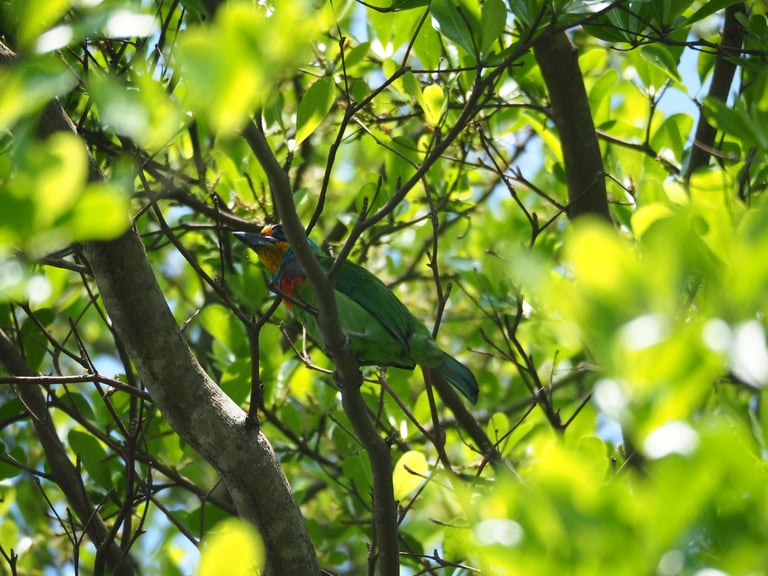
With its thick bill, speckled yellow-and-red face, and a call that can trill on for long periods, the crested barbet is hard to miss or mistake for another species.
This small bird belongs to the family Lybiidae, within the order Piciformes, and ranges across sub-Saharan Africa. The IUCN lists it as Least Concern. Its scientific name, Trachyphonus vaillantii, honors the French naturalist François Levaillant, but it is the bird's bold looks and loud voice that make it a memorable presence in gardens and woodlands alike.
Identification and Appearance
The crested barbet is unmistakable thanks to its thick bill and vividly colorful plumage. The face is speckled yellow and red, topped with a small black crest, while the belly carries yellow with red speckles. A broad black band crosses the neck, and the black wings are marked with white specks. Red markings appear toward the end of the body.
Weighing only about 0.0694 kilograms, this is a small bird whose coloration, despite its brightness, blends surprisingly well into bush surroundings. Its distinct trilling call is as much a field mark as its plumage, often giving away its presence before it is seen.
Distribution and Habitat
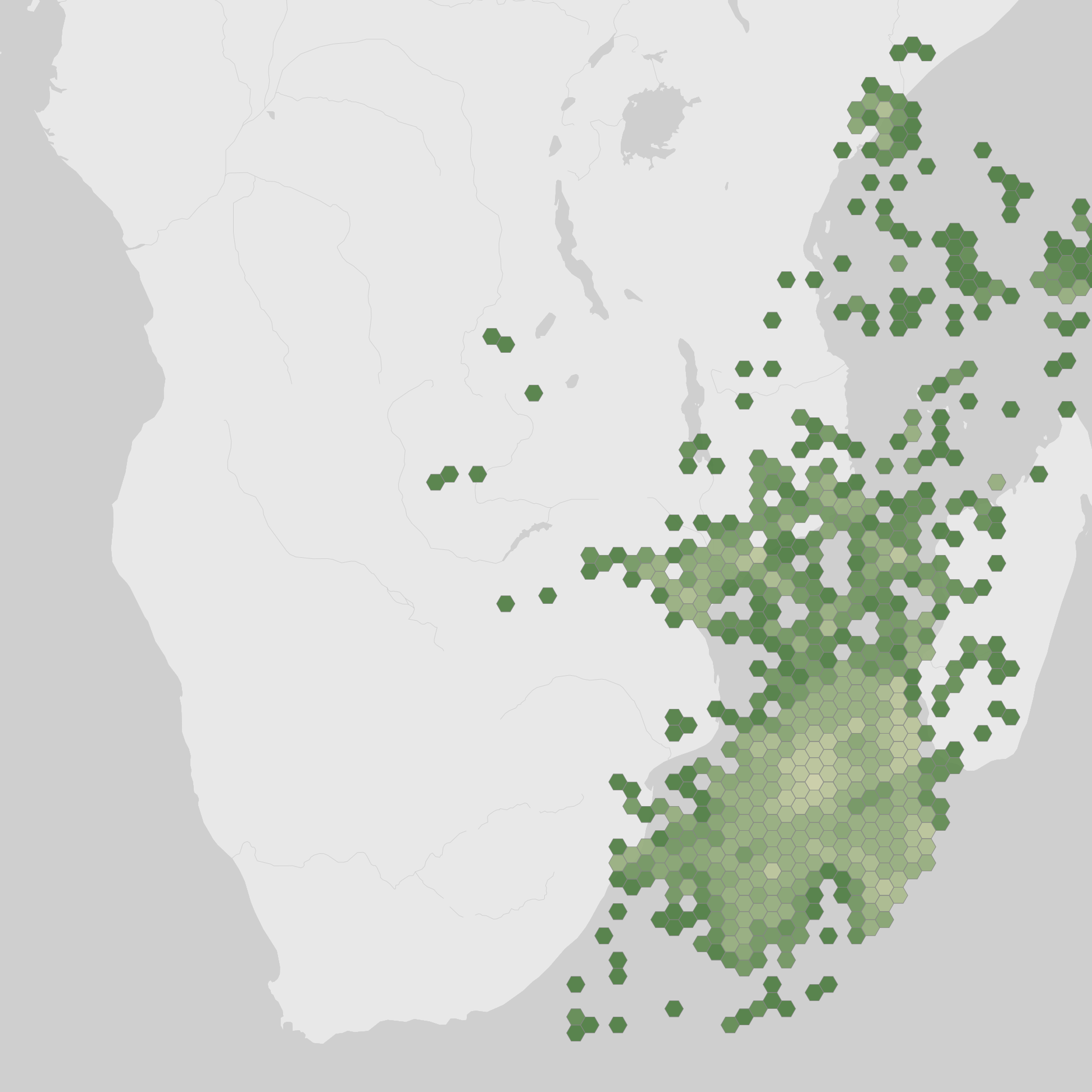
The crested barbet occupies a broad range across sub-Saharan Africa, found in Angola, Botswana, Burundi, the Democratic Republic of the Congo, Eswatini, Malawi, Mozambique, Namibia, Rwanda, South Africa, Tanzania, Uganda, Zambia, and Zimbabwe. Its range spans roughly 3,120,000 square kilometers.
It favors semi-open habitats, including forests, savanna, woodland thickets, watercourses, and suburban gardens, showing a notable tolerance for human-altered landscapes. This adaptability to both wild woodland and garden settings helps explain its wide distribution across the subcontinent.
Behavior and Lifestyle
The crested barbet is typically seen singly or in pairs, bouncing around on the ground as it searches for food before calling from an open branch. It is sedentary, not prone to migration, and is not a strong flier, covering only short distances when it does take wing. At night, it roosts in holes in trees.
Very vocal, it produces a long, continuing trill that carries across its territory. That territory is defended aggressively: crested barbets chase off other barbets competing for nest sites as well as unrelated birds like doves and thrushes.
Diet and Nutrition
The crested barbet is an omnivore with a varied diet that includes insects, other birds' eggs, fruits, and occasionally mice. This range of food sources, from invertebrates to small vertebrates and plant matter, reflects an opportunistic feeding style suited to the mix of woodland, savanna, and garden habitats it occupies.
Nesting and Breeding
Crested barbets are monogamous and defend a territory during the breeding season, with territory size varying according to habitat. They nest in a hole in a tree or a log, sometimes within a suburban garden.
Between September and December, the female lays one to five eggs at daily intervals. Incubation lasts 13 to 17 days, beginning with the second or third egg and carried out mainly by the female.
The young hatch naked and blind, and both parents feed them insects while regularly removing fecal material from the nest to keep it clean. Fledging occurs after about 31 days, and remarkably, a single pair can raise up to five broods in one breeding season.
Cultural Significance
In Zulu mythology, a giant bird figures in stories connected to the crested barbet, while in Xhosa folklore, a bird known as the indwe is regarded as a symbol of courage and leadership. More broadly in African folklore, the species' unusual call and striking plumage have inspired a variety of cultural interpretations.
Fun Facts
- The species was first described by Ranzani in 1821, referencing an earlier illustration in Levaillant's Histoire Naturelle des Promerops, et des Guêpiers.
- Its scientific name honors François Levaillant, the French naturalist whose work documented the bird long before its formal description.
Photos
Photographs from via iNaturalist, licensed under CC0 1.0., by Murray Yoko via iNaturalist, licensed under CC BY 4.0., by Timothy Whitehead via iNaturalist, licensed under CC BY 4.0., by Alan Manson via iNaturalist, licensed under CC BY 4.0., by Jean Jacques Godon via iNaturalist, licensed under CC BY 4.0., by Justin Ponder via iNaturalist, licensed under CC BY 4.0., by Jon Paul Rodríguez via iNaturalist, licensed under CC BY 4.0., by Mark Clarke via iNaturalist, licensed under CC BY 4.0., by Darren Obbard via iNaturalist, licensed under CC BY 4.0., by Lukas Zangl via iNaturalist, licensed under CC BY 4.0., by Barry Stewart via iNaturalist, licensed under CC BY 4.0., and by Presha Soogrim via iNaturalist, licensed under CC BY 4.0., credited on each photo.
Ecology and classification
Classification
- Phylum
- Chordata
- Class
- Aves
- Order
- Piciformes
- Family
- Lybiidae
- Genus
- Trachyphonus
- Species
- Trachyphonus vaillantii
Sources
- GBIF Species names and classification
- iNaturalist Photos
- Wikidata Common names and conservation status
- Wikipedia Summary extract
- AVONET Bird mass, habitat, migration, diet and range size