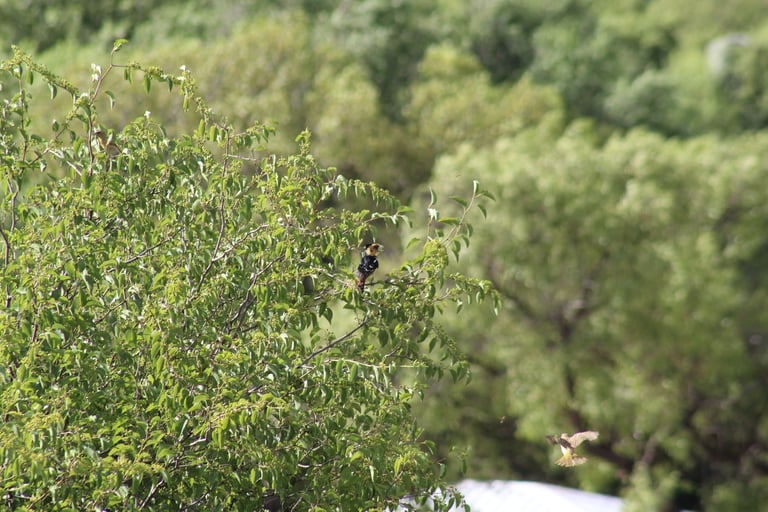
The Taiwan barbet, also called the embroidered barbet, is found nowhere else on Earth but Taiwan, where it lives in forests across the island.
This member of the Megalaimidae family belongs to the order Piciformes, sharing kinship with woodpeckers and toucans. The species carries a status of Least Concern, reflecting a population that is not currently considered at risk. Its vivid patchwork of colors and restricted range make it a distinctive symbol of Taiwan's forest bird life.
Identification and Appearance
The most useful field mark is the bird's embroidered look: a mostly green body set off by a red spot on the lore, blue ear-coverts and lower malar, and a mustard-yellow throat that together give it a patchwork, hand-stitched appearance.
The Taiwan barbet measures about 20 centimeters (7.9 inches) long and weighs roughly 0.0877 kilograms. Its build is stocky, with a thick, black beak suited to its forest diet.
Color details continue across the body: the forehead is yellow, with a black stripe running above the eye, while the breast shows both a blue band and a red band above a yellowish-green belly. The feet are greyish, rounding out the bird's muted lower half against its brighter head and chest.
Sexes look alike, so males and females cannot be told apart by plumage.
Distribution and Habitat
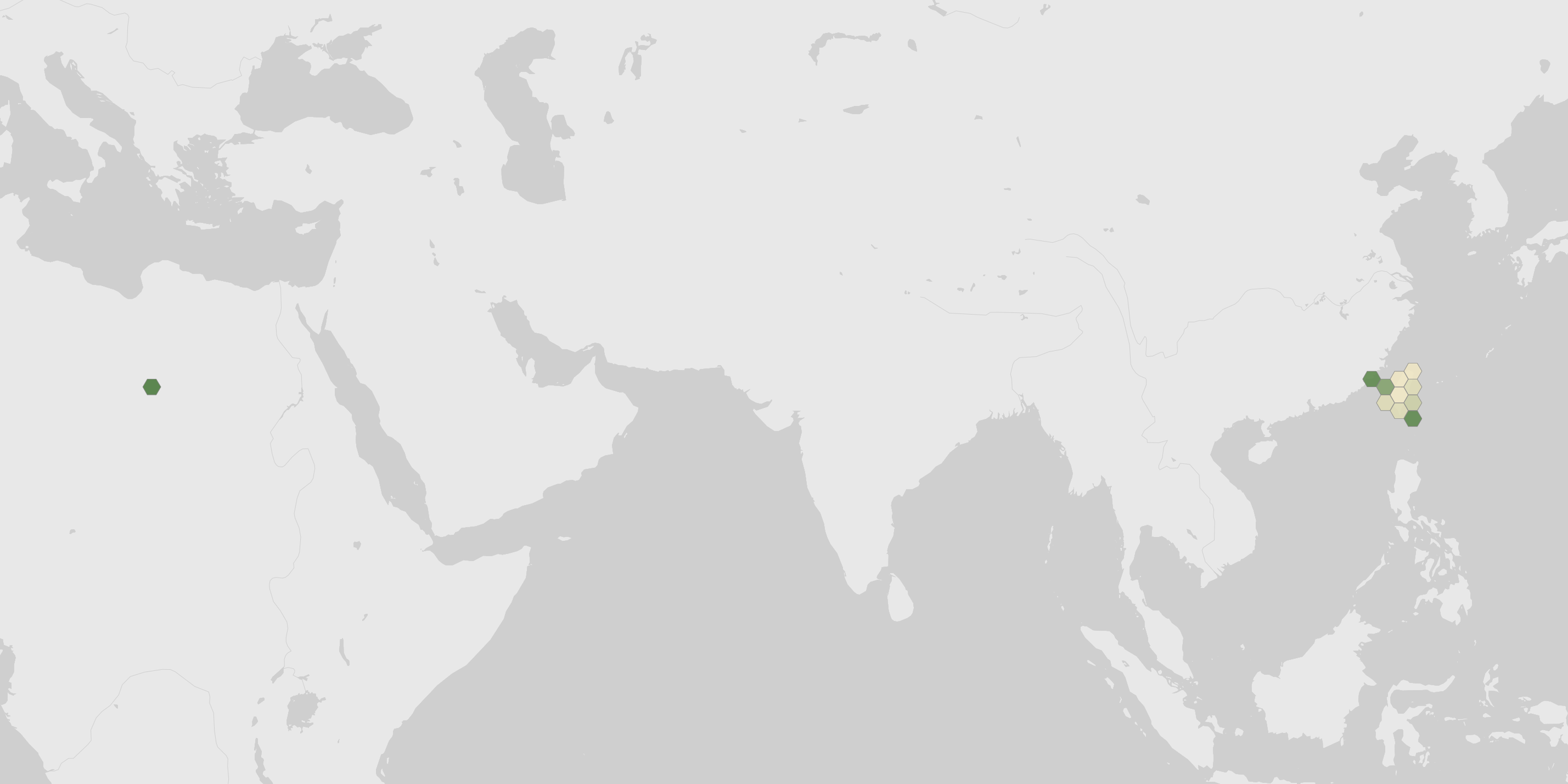
The Taiwan barbet occurs only within Taiwan, across a range estimated at about 19,800 square kilometers, making it a true island endemic.
It favors dense forest habitat, commonly found at elevations up to 2,800 meters (9,200 feet), which allows it to occupy a broad elevational band from lowland forest to high mountain woodland.
Observation records through the year show a sharp rise in records during spring months, peaking around April and May, which may reflect seasonal presence or increased detectability during the breeding season rather than a true change in abundance.
Fun Facts
- The Taiwan barbet's alternate name, the embroidered barbet, comes from its intricate, multicolored plumage pattern.
- It was first described by Gould in 1863, originally placed in the genus Megalaima as Megalaima nuchalis before being reclassified into Psilopogon.
- It nests in tree cavities, either using an existing hollow or excavating a new one itself, during a breeding season that runs from March to August.
Photos
Photographs from via iNaturalist, licensed under CC0 1.0., by Yu-Huang Wang via iNaturalist, licensed under CC BY 4.0., by 雲一百香果 via iNaturalist, licensed under CC BY 4.0., by MIMI via iNaturalist, licensed under CC BY 4.0., by Caroline Quinn via iNaturalist, licensed under CC BY 4.0., by 祐 via iNaturalist, licensed under CC BY 4.0., by Ben Costamagna via iNaturalist, licensed under CC BY 4.0., and by Nathan Ruser via iNaturalist, licensed under CC BY 4.0., credited on each photo.
Ecology and classification
Habitat
Diet
- Omnivore
Classification
- Phylum
- Chordata
- Class
- Aves
- Order
- Piciformes
- Family
- Megalaimidae
- Genus
- Psilopogon
- Species
- Psilopogon nuchalis
Sources
- GBIF Species names and classification
- iNaturalist Photos
- Wikidata Common names and conservation status
- Wikipedia Summary extract
- AVONET Bird mass, habitat, migration, diet and range size