The crested myna is a starling found from southeastern and central China to northern Indochina, where it lives in open country close to people. Also called the Chinese starling, it is a member of the family Sturnidae and weighs about .
The longest known life for the species is , a figure that comes mostly from captive birds. Its name comes from the tuft of feathers on its forehead, which looks like a crest.
Identification and Appearance
The crest is the easiest field mark. It is a tuft of feathers on the forehead that covers the nostrils. Otherwise the bird is mostly black with a slight green sheen. In flight, look for white patches under the wings, and white tips on the primaries and most tail feathers.
Adults have orange eyes, pale yellow bills and dull dark yellow legs. The bill is slender and very sharp. The under-tail coverts are black with a white tip. Males are slightly larger than females, and the female's crest is slightly less developed. Otherwise the sexes look alike.
Subspecies differ in detail. A. c. brevipennis has proportionally smaller wings and a smaller bill, with narrower crest feathers. A. c. formosanus is slightly smaller, with a greenish-yellow bill, white under-tail coverts and a more developed crest.
Hatchlings are naked except for short gray down. Within about 18 to 20 days, juveniles are fully covered with brown feathers, and the crest is usually poorly developed at this stage. Immatures have blue-gray eyes.
Distribution and Habitat
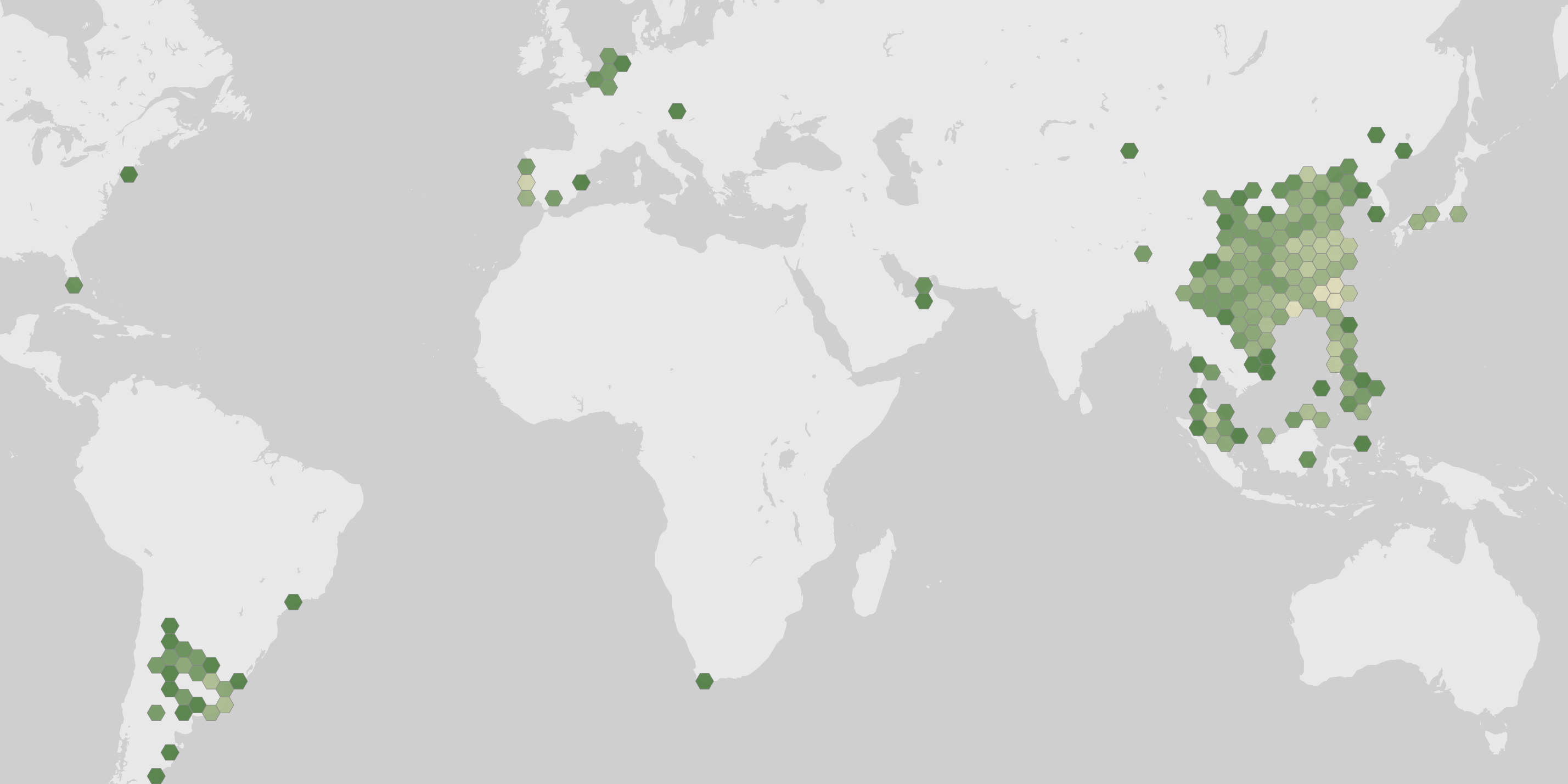
The range runs from southeastern and central China to northern Indochina, including the Yangtze valley and southeastern Jiangxi Province. The species also occurs in Burma, Taiwan and Hainan, and its range covers about . Observation records peak in April, but they show where birds are seen, not how many there are.
The crested myna is most at home in open landscapes. In cities it lives under building eaves, along roads and alleys, in parks and parking lots, under bridges and on roofs. In rural areas it uses farm fields, orchards, farmyards and manure piles, and it often feeds near cattle.
Its popularity as a cage bird has carried it beyond its range. It was found breeding around Lisbon, Portugal, in 1997 and is now established on both sides of the Tagus estuary and on the Setúbal Peninsula. It has also become established in Penang, Singapore, Manila, and parts of Japan and Argentina.
The European Union lists the species among invasive alien species of Union concern. It cannot be imported, bred, transported, commercialized or intentionally released in any member state.
Communication
The crested myna has a varied vocal repertoire, from whistles and warbles to chortles. Its alarm call is a raspy jaaay, and other calls include a series of chuffs or creeks.
It has been reported to mimic human voices and other yard birds. Captive birds, however, were not found to be good mimics.
Diet and Nutrition
The crested myna is an omnivore that eats mostly insects, but it also takes fruit, grain, meat, manure and garbage. On average, about 40% of an adult's diet is animal matter and 60% is plant matter.
The mix shifts with the seasons. In September the share of meat rises to around 50–60%, and nearly half of that is flies. In winter, when insects and fruit are scarcer, garbage makes up about 15% of the diet.
Juveniles eat proportionally more animal food, about 75% meat, and half of that is insects. Adults and juveniles both take more insects and fruit when these are abundant.
Nesting and Breeding
Nesting begins in April or May. In forests, crested mynas nest in holes made by woodpeckers or by decay. In towns they use chimneys, drains and crevices. Both sexes build the nest from grass, branches or whatever garbage they find.
The first clutch usually appears at the end of April or in May. Most pairs are double-brooded and lay a second clutch from June to mid-August. The eggs are light blue-green with a shape like robin eggs, and a clutch is typically around 4–6 eggs. One egg hatches each day.
The hatchlings are altricial. The eggs are incubated for 14 days, after which the young leave the nest for a nearby tree or shrub. The parents keep feeding them for about a week. The young stay with their parents in small family groups and join larger flocks for feeding and travel.
Conservation and Threats
The IUCN Red List has rated the crested myna Least Concern since 1998. Its range is larger than 20,000 km², so it does not meet the range size criterion for a threatened category. Its population trend has been stable over the last ten years or three generations.
The population is believed to exceed 10,000 mature individuals, so it does not meet the population size criterion either.
The European Union has judged its introduction to have significant negative impacts on ecosystems. Under EU rules it is listed as an invasive alien species of Union concern, which bars its import, breeding, transport, trade and intentional release.
Photos
Photographs from via iNaturalist, licensed under CC0 1.0., by Toby Y via iNaturalist, licensed under CC BY 4.0., by Vasco Henrique Oliveira Fonseca via iNaturalist, licensed under CC BY 4.0., by Yi CHEN via iNaturalist, licensed under CC BY 4.0., by Marcin Zuwała via iNaturalist, licensed under CC BY 4.0., by Jared Shorma via iNaturalist, licensed under CC BY 4.0., by Aaron Liston via iNaturalist, licensed under CC BY 4.0., by 大澤風季 ohsawa_Fuki via iNaturalist, licensed under CC BY 4.0., by RAP via iNaturalist, licensed under CC BY 4.0., and by 김재원 via iNaturalist, licensed under CC BY 4.0., credited on each photo.
Ecology and classification
Classification
- Phylum
- Chordata
- Class
- Aves
- Order
- Passeriformes
- Family
- Sturnidae
- Genus
- Acridotheres
- Species
- Acridotheres cristatellus