The sidewinder's sideways, S-curved gait leaves a trail of parallel, J-shaped marks across the dunes it calls home, a movement so distinctive it gave the snake its common name. This locomotion lets it cross loose, wind-blown sand that would bog down almost any other snake.
Crotalus cerastes is a pit viper in the family Viperidae, subfamily Crotalinae, native to the arid deserts of the southwestern United States and adjacent northwestern Mexico. The IUCN lists it as Least Concern, reflecting its wide range and stable population.
Beyond its odd gait, the species is worth a closer look for the raised "horns" over its eyes, a hunting style built on ambush and infrared detection, and a newborn behavior so unusual that biologists have compared it to warm-blooded animals.
Identification and Appearance
The clearest field mark is the pair of raised, horn-like supraocular scales above each eye, which give the species its alternate name, the horned rattlesnake. These scales are thought to shade the eyes or keep sand from drifting over them as the snake lies partly buried; because only downward pressure folds them, researchers suspect they also protect the eyes when the snake pushes into rodent burrows.
Adults are small, measuring roughly 43 to 80 cm (17 to 31.5 in) in total length and weighing around 211 grams. Unusually for a North American rattlesnake, females grow larger than males. The body is stout, with 21 rows of keeled dorsal scales at midbody and ventral scale counts of 141 or fewer in males and 144 or fewer in females.
Ground color ranges from cream, buff, and yellowish-brown to pink or ash gray, overlaid with 28 to 47 dark, subrhombic or subelliptical blotches down the back. The belly is white in the nominate subspecies, and adults typically show a brown proximal rattle lobe. Remarkably, the species can shift its shade somewhat with temperature, a process called metachrosis, so the same individual may look different from one day to the next.
Three subspecies are recognized, distinguished largely by geographic range and subtle pattern differences rather than dramatic external contrasts.
Distribution and Habitat
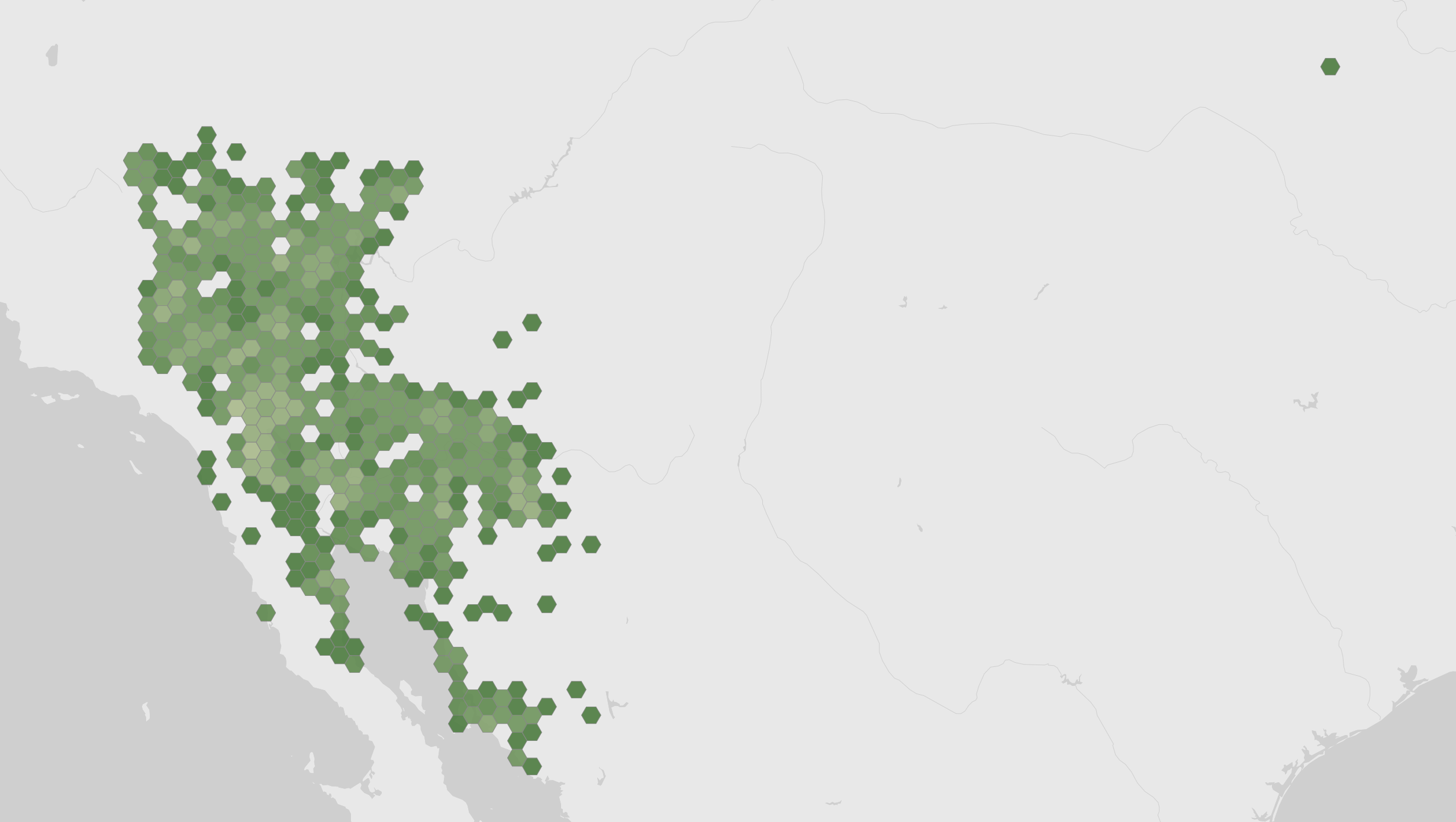
The sidewinder occupies desert country across the southwestern United States and adjacent northwestern Mexico, from southeastern California, southern Nevada, and southwestern Utah through western Arizona, and into western Sonora and eastern Baja California. Within this range it favors fine sand dune fields but is not restricted to them, also turning up on flat, rocky, or hard-pan terrain, especially where vegetation is sparse.
It tolerates a broad span of arid and semi-arid climates and occurs from below sea level up to about 1,830 m, though most populations stay under 1,200 m since mountainous terrain hinders its sideways locomotion. By day it shelters in mammal burrows, under shrubs, atop sand hummocks, or beneath large rocks in rocky zones, emerging to hunt as temperatures allow.
Monthly observation counts, which reflect presence rather than true abundance, rise sharply from a low in January and February to a pronounced peak in April and May before tapering through the summer and falling to a minimum in November and December. This pattern lines up with the snake's spring activity and breeding period, when both sexes move more and are more likely to be seen above ground, though it says nothing about actual population size.
Sidewinders concentrate near mammal burrows in sandy washes and thickly vegetated hummocks, particularly those topped with creosote, where kangaroo rats and other rodents, their main prey, are abundant.
Behavior and Lifestyle
Activity timing shifts with the seasons: sidewinders are strictly nocturnal during the hottest months and become diurnal or crepuscular during the cooler part of their activity period, roughly November to March. They must keep their body temperature near 30°C, basking when cool and retreating to shaded burrows or rock platforms when the sand grows dangerously hot, since overheating can kill them.
The snake's namesake sidewinding gait is a repeated, S-shaped throw of the body that keeps only a small patch of skin in contact with scorching sand at any instant, insulating the animal from heat while providing traction on loose surfaces. The same technique lets it climb sandy slopes up to the steepest angle the sand allows without slipping, and it can also use rectilinear motion or lateral undulation on firmer ground.
Sidewinders are solitary and non-gregarious outside of communal denning, but they are also territorial: a Mojave Desert study found home ranges averaging about 23 hectares, the largest recorded among rattlesnakes, with a range of 7.3 to 61 hectares and population densities of roughly 0.48 to 1.18 snakes per hectare, meaning territories can overlap. Males roam farther than females during the spring mating season, sometimes covering more than 1,200 m in a single night, while subadult males travel the farthest of any group on average.
Juveniles hunt lizards using "caudal luring," wiggling the tail in fast, fluttering movements that mimic a moth or slower motions resembling a caterpillar to draw prey close; adults abandon this trick as they shift toward rodents, birds, and other snakes. After a large meal snakes stay inactive for 5 to 10 days, and they go quiet again for 3 to 5 days before shedding.
Communication
Sidewinders rely most heavily on chemical cues, using tongue-flicks and a vomeronasal organ to identify prey and, notably, to detect chemical signals from kingsnakes and avoid confrontation with these known predators. Heat-sensing facial pits, an infrared channel unique to pit vipers, help them locate warm-bodied prey even in darkness, while vision plays a lesser supporting role.
Tactile sensing is essential to how the snake moves and interacts with its world: males use touch during mate-searching and courtship, and all sidewinders rely on feeling the substrate beneath them to coordinate sidewinding, rectilinear motion, and lateral undulation.
When threatened, a sidewinder shakes the rattle on its tail, a signal that works on multiple channels at once, functioning as an acoustic warning, a visual display, and a vibration detectable by nearby animals.
Hunting and Diet
Sidewinders hunt mainly by ambush, lying partly hidden in sand at dusk or dawn where their sandy coloration renders them nearly invisible to approaching prey. They locate targets primarily through chemical cues from the vomeronasal organ and heat signatures picked up by their facial pits, with eyesight used only secondarily.
Lizards make up over half of the diet, including glossy snakes, western ground snakes, western zebra-tailed lizards, western whiptails, and Colorado desert fringe-toed lizards, while mammals such as house mice, desert pocket mice, and Botta's pocket gophers account for more than 40 percent. Larger sidewinders also take birds, among them lark sparrows, house sparrows, and cactus wrens.
Diet composition tracks the snake's seasonal activity pattern: during late spring and summer, when sidewinders hunt mainly at night, mammals make up a greater share of the catch, while in the cooler early spring and fall, when daytime hunting becomes possible again, diurnal lizards are taken more often.
Reproduction and Life Cycle
Mating is polygynous and tied closely to warm weather, with the breeding season running from April through July. Because females are scattered across the landscape, males travel in straight lines over long distances to find mates and increase their food intake during this period to fuel the search; a male can mate up to three times in a year, while females depend on sufficiently warm temperatures to become reproductively active at all.
Courtship begins when a male follows a female's scent trail and crawls along her back, rubbing her with his chin; he then wraps his tail around hers and works to align their cloacae, a process that can take several hours and that the female permits by lifting her tail. Females may mate with several males in a season, and local competition for mates can lead to fights among females.
Gestation lasts roughly 4 to 5 months, during which females that fed heavily earlier in the cycle to build reserves for vitellogenesis often reduce their intake. Live young are born from late summer into early fall, in litters ranging from about 4 to 18, typically averaging around 10, each measuring 6 to 8 inches (about 15 to 20 cm) at birth and breaking free of a thin embryonic membrane within minutes.
Newborns remain at the natal burrow for 7 to 10 days until their first shed, during which the mother is thought to guard them, though some accounts describe her abandoning the brood within about three hours because guarding is energetically costly and can contribute to maternal death from exhaustion. After the first shed the young disperse permanently, with no further contact between mother and offspring. Both sexes reach sexual maturity at 2 to 3 years old, and females may skip breeding in years when food is scarce.
Population and Ecological Role
Sidewinders sit in their desert food web as both predator and prey, taking a heavy toll on lizards and small rodents such as kangaroo rats and pocket mice while themselves falling to a range of desert predators. Population density can reach up to about one snake per hectare, though individuals mostly avoid each other outside the mating season.
The species also carries several parasites, including blood parasites of the genera Haemogregarina and Hepatozoon and a nematode, Thubunaea cnemidophorus, found in the esophagus, stomach, and intestines, underscoring its role as host within a wider community of desert organisms.
Conservation and Threats
The IUCN Red List classifies the sidewinder as Least Concern, a status given to species with a wide distribution, a presumed large population, and no evidence of decline fast enough to justify listing in a more threatened category; a 2007 assessment found the population trend stable. No special protections apply under the U.S. Federal List, CITES, or state-level lists, and no targeted conservation programs currently exist for the species.
Its persistence owes much to the fact that large parts of its range fall within protected desert landscapes, including Death Valley National Park, Joshua Tree National Park, Mojave National Preserve, Sequoia National Park, Desert National Wildlife Refuge, Kofa National Wildlife Range, Organ Pipe Cactus National Monument, and the Gila River Indian Reservation.
Conservation status
- LC
- NT
- VU
- EN
- CR
Least Concern
Cultural Significance
The word "horned" in the sidewinder's alternate name echoes an older legend tied to the genus name Cerastes, a mythological horned serpent whose traits likely derive from the habits of the Old World horned viper. In various traditions this horned-serpent image became a symbol of power, protection, and fertility, and it has also fed into a broader Western association of horned, forked-tongued snakes with sinister or devilish imagery.
Beyond folklore, the sidewinder's biology left a mark on modern technology: the AIM-9 Sidewinder air-to-air missile takes its name from the snake because both track targets using infrared, or heat, emanations. No positive economic or practical use of the species by people is documented.
Fun Facts
- The sidewinder's namesake gait leaves a trail of parallel, J-shaped marks in the sand, distinct from the tracks of any other locomotion style.
- Females grow larger than males, an arrangement unique among rattlesnakes native to the United States.
- The snake can shift its skin tone somewhat with temperature, a color-changing trait called metachrosis.
- Newborns cluster together at the burrow entrance during their first week of life, their collective movements creating a stable, warm microclimate reminiscent of a warm-blooded animal.
- Juvenile sidewinders lure lizards close by wiggling their tails in motions that mimic a fluttering moth or a slow-crawling caterpillar.
- The AIM-9 Sidewinder missile was named for this snake because both rely on infrared heat detection to find their targets.
Ecology
Diet
- Carnivore
Behavior
- Nocturnal
- Predator
- Solitary
- Territorial
Habitat
- Shrubland
- Desert
Photos
SourcesGBIFiNaturalistWikidataWikipediaEncyclopedia of LifeAnimal Diversity WebAnAge