The poplar mushroom grows in dense tufts directly from the bark and wounds of poplar trees, forming clusters that can look almost like a small shelf of fungal growth on the trunk. Known scientifically as Cyclocybe cylindracea and also called Agrocybe aegerita or Pholiota aegerita, it belongs to the fungal genus Cyclocybe within the family Tubariaceae.
It is a mushroom worth knowing both for its distinctive growth habit on living and dead wood and for the long culinary tradition built around it in several parts of the world.
Fruiting Body and Identification
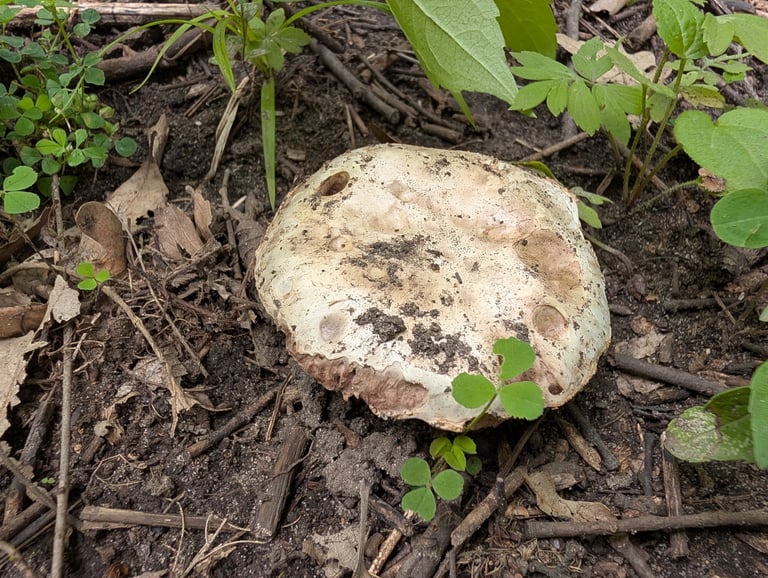
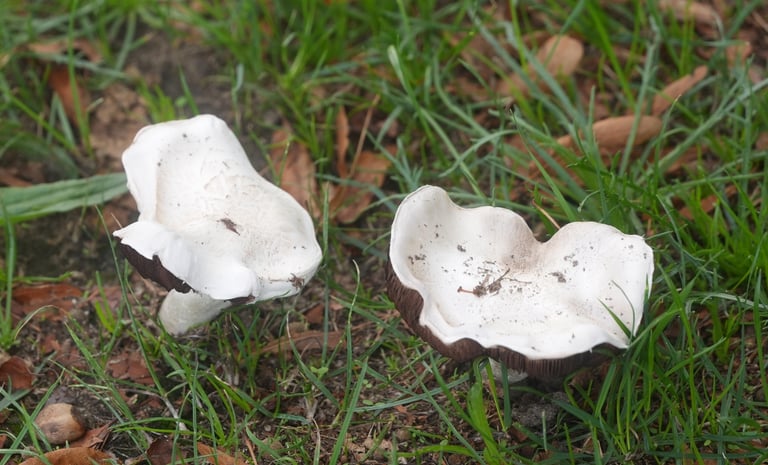
The most reliable identifying feature of Cyclocybe cylindracea is its growth pattern: a medium-sized agaric with an open, almost flat convex cap measuring 3 to 10 centimeters across, emerging in tufts from poplar wood. The cap's color shifts noticeably with age, starting reddish-brown when young and fading to a lighter, more ochre tone toward the center, with a whiter margin.
Beneath the cap, numerous whitish radial gills are attached to the stem; these darken over time to a brownish-grey as the mushroom matures. The spores themselves are light-colored and elliptic, measuring 8 to 11 by 5 to 7 micrometers.
The stem is white, fibrous, and generally curved, bearing a membranous ring in its upper portion. This ring quickly turns tobacco-brown as falling spores coat it, a useful clue when the mushroom is fresh.
Distribution and Habitat
Cyclocybe cylindracea is a white rot fungus that grows in tufts on logs and in wounds or cavities of poplar trees, as well as other large-leaved trees. This wood-decaying habit ties it closely to broadleaf woodland and forest settings where such host trees grow.
Observation records collected through the year show a clear seasonal pattern, with counts rising sharply from late summer into autumn and peaking around September and October before tapering off through the winter months. This pattern suggests the species fruits mainly in late summer and autumn, though these figures reflect presence observations rather than actual abundance or a complete picture of its range.

Uses and Cultural History
Cyclocybe cylindracea has a long history as a food mushroom, serving as a typical ingredient in both Southern European and Chinese cuisine. Its culinary popularity has led to active cultivation in Korea, Japan, China, and Australia, making it one of the more widely farmed specialty mushrooms in East Asia and beyond.
Beyond the kitchen, the species has a place in traditional Chinese medicine, where it is used as a diuretic. It has also been studied alongside Mycetinis alliaceus and Chondrostereum purpureum for its suitability in counteracting the toxicity of olive-mill wastewater, an industrial byproduct of olive oil production.
Fun Facts
- The mushroom carries several regional names, including poplar fieldcap, poplar mushroom, velvet pioppini, and Yanagi-matsutake in Japan.
- It has been explored for a role in treating olive-mill wastewater, an industrial pollutant from olive oil production, alongside two other fungal species.
Photos
Photographs from via iNaturalist, licensed under CC0 1.0., by Andrejus Gaidamavičius via iNaturalist, licensed under CC BY 4.0., by axtothemax via iNaturalist, licensed under CC BY 4.0., by Atsushi Nakajima via iNaturalist, licensed under CC BY 4.0., by Samuele Papeschi via iNaturalist, licensed under CC BY 4.0., by Isaac Guard via iNaturalist, licensed under CC BY 4.0., and by Adrien Cozannet via iNaturalist, licensed under CC BY 4.0., credited on each photo.
Ecology and classification
Classification
- Phylum
- Basidiomycota
- Class
- Agaricomycetes
- Order
- Agaricales
- Family
- Tubariaceae
- Genus
- Cyclocybe
- Species
- Cyclocybe cylindracea
Sources
- GBIF Species names and classification
- iNaturalist Photos
- Wikidata Common names and conservation status
- Wikipedia Summary extract