Ivy-leaved toadflax has a flower stalk that hunts for light, then reverses direction the moment it is fertilized, pushing its own seed capsules into dark crevices where they are more likely to germinate.
This low, spreading, trailing plant with small purple flowers is native to rocky habitats in southern Europe, and belongs to the plantain family, Plantaginaceae. It has since become naturalized across many temperate parts of the world, trailing from the same kind of stone and rock surfaces that gave it common names like Oxford ivy, Kenilworth ivy, and wandering sailor.
Identification and Appearance
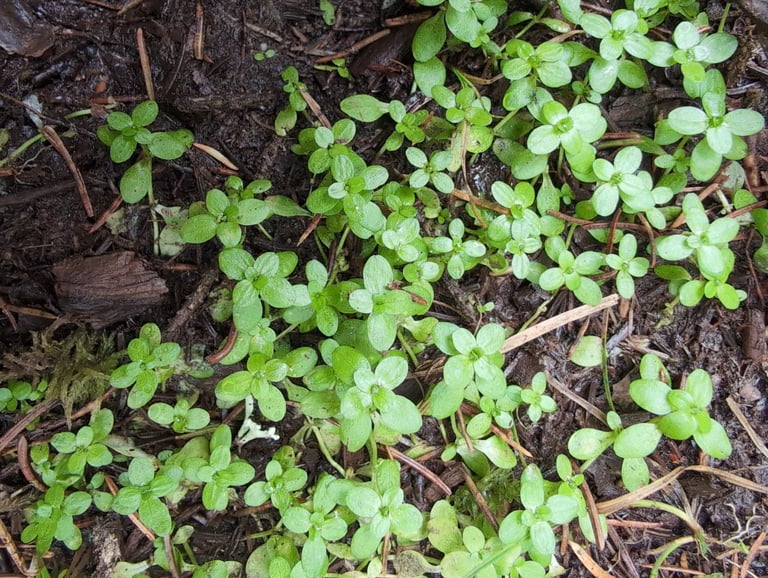
The most useful field mark is the combination of small, rounded to kidney-shaped leaves with three to seven lobes (most often five) and tiny snapdragon-like flowers that are mostly lilac with a yellow throat marked by darker lines. The leaves, 5–40 mm long and 6–60 mm wide, alternate along thin, usually purple petioles 10–22 mm long, and are often blushed with purple on their undersides.
The plant grows 10–80 cm tall as a biennial or short-lived perennial, spreading quickly from thin, fibrous roots suited to reaching into cracks. Flowers resemble a snapdragon in structure: sharply pointed sepal lobes 1.5–3 mm long, a closed petal tube 3–5 mm long, and an inflated lower lip that blocks the tube's mouth, with two yellow-spotted cushion-shaped lobes beneath it. The upper lobes stand upright with rounded ends 2–3 mm long, while the lower lobes spread outward; a short spur, about a third of the flower's total length, projects from the rear. Flowers are rarely all or nearly all white.
Two subspecies are distinguished by leaf texture: subsp. muralis has leaves that are smooth or bear scattered hairs, while subsp. visianii has pubescent, villous leaves. A similar species, Cymbalaria aequitriloba, has smaller plants and flowers and lacks the prominent yellow throat coloration seen in C. muralis.
Distribution and Habitat
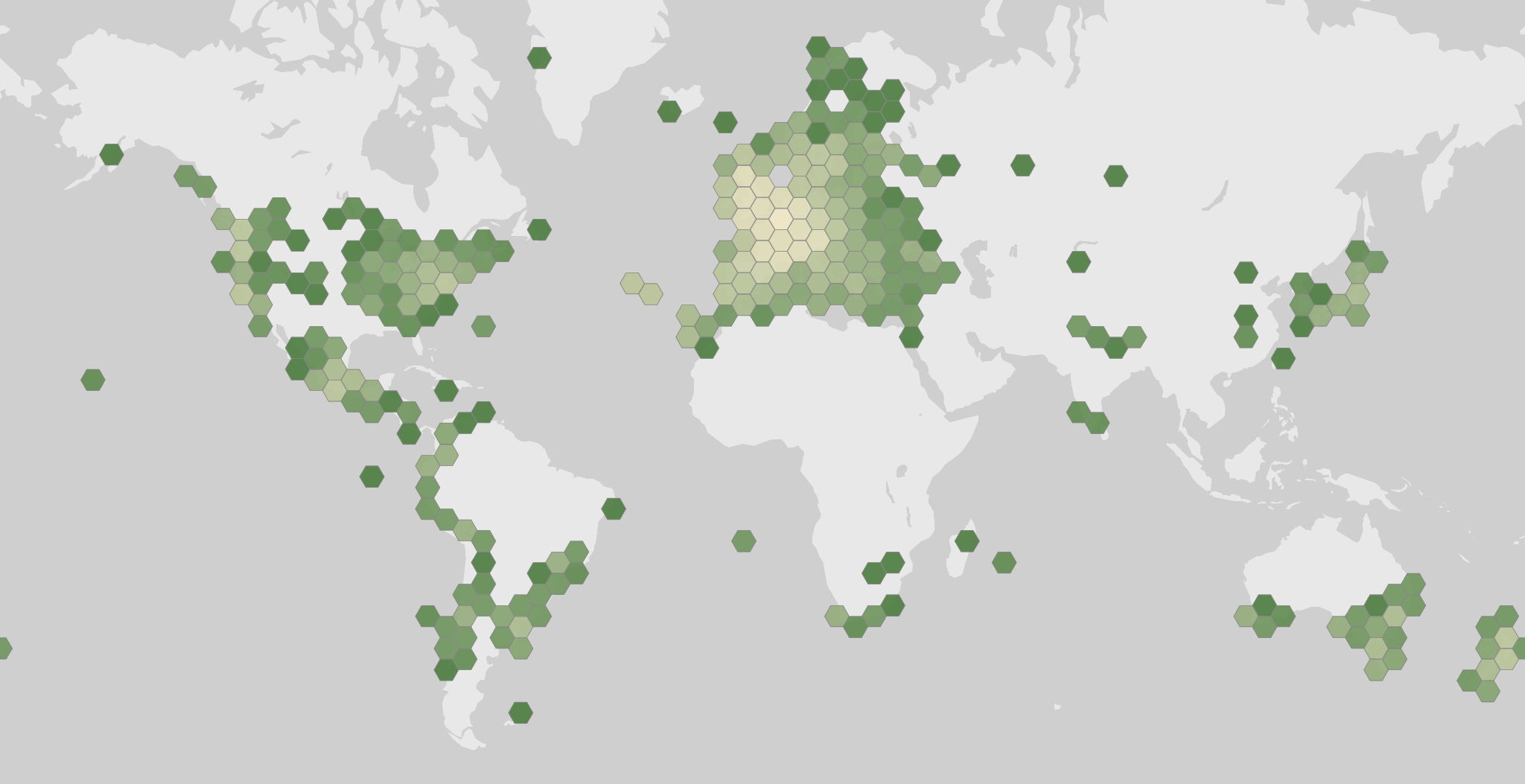
Ivy-leaved toadflax's original habitat was narrow niches in rock faces and cliffs, and it still favors cracks in stone walls and rocky slopes today. Its native range is limited to southern Europe, spanning Austria, France, Italy, Switzerland, and the former Yugoslavia, with related records extending to Slovenia, Croatia, Bosnia and Herzegovina, Serbia, Kosovo, San Marino, and Atlantic islands including the Azores, Madeira, the Canary Islands, and the Cape Verde Islands.
From this southern European core the species has spread very widely, whether by accident or through cultivation as an ornamental. It was grown in English gardens by 1617 and recorded outside cultivation in Great Britain by 1640, later becoming a popular 19th-century garden plant there. It is now found from Ireland and Portugal eastward to Ukraine, Poland, and Sweden, and reportedly as far as the Baltic States, northwestern Russia, and the North Caucasus.
Beyond Europe it grows in Morocco, Algeria, and Tunisia in North Africa, in South Africa's Cape and Northern Provinces, and across parts of Asia including Turkey, Jordan, the Koreas, and the eastern Himalayas. In North America it ranges through much of the U.S. Midwest, northeast, and New England, the West Coast states, and scattered interior states, as well as five or more Canadian provinces. It has also reached South America (Colombia, Ecuador, Peru, Brazil, Uruguay, Bolivia, and Argentina), Chile, and oceanic islands such as Hawaii, New Zealand, Bermuda, Mauritius, and St. Helena, plus six Australian states.
Monthly observation records peak in the spring and early summer months, suggesting this is when the plant is most visibly in flower or most often noticed, though these counts reflect observation effort rather than population size.
Growth and Form
Ivy-leaved toadflax grows as a subshrub, forming a low, fast-spreading trailing mat rather than an upright plant. As a biennial or short-lived perennial, it establishes itself in crevices and cracks through thin, fibrous roots suited to gripping narrow spaces, allowing it to persist and spread across stone and rock surfaces year after year.
Ecology and Relationships
Ivy-leaved toadflax is a generalist that attracts a wide range of pollinators, including bees, flies, and butterflies, though a flower visit alone does not prove pollination occurs. Among its recorded flower visitors, bumblebees such as Bombus pratorum, Bombus pascuorum, and Bombus terrestris stand out, alongside solitary bees like Anthidium manicatum and mason bees of the genus Osmia.
Its roots form partnerships with arbuscular mycorrhizal fungi, which help the plant draw nutrients from the thin soils of rock crevices. The plant also hosts several specialist insects: at least three aphid species, Myzus ornatus, Myzus persicae, and Myzus cymbalariae, commonly feed on it, with the last named for its association with this plant. It additionally serves as a host for tomato ringspot virus.
A range of birds are recorded feeding on ivy-leaved toadflax, including finches such as Acanthis flammea and Chloris chloris, along with species like the skylark (Alauda arvensis), rock partridge (Alectoris graeca), and pigeons of the genus Columba.
Uses and Human Relationships
In Southern Europe, ivy-leaved toadflax is sometimes eaten as a salad green, with a taste described as like raw garden peas or bitter with a sharp numbing sensation.
Historically, 17th-century Italian apothecaries used it as a substitute for navelwort (Umbilicus rupestris), an unrelated plant, in certain medicinal applications, a connection that gave rise to the common name "bastard" or "false" navelwort. In gardens, it is valued as groundcover for rocky slopes and wall cracks, where once established it reproduces on its own from both seed and rooting stems; it is winter hardy in USDA zones 5 to 9 and has been noted as deer resistant by garden author Carolyn Singer.
Fun Facts
- The plant was already being grown in gardens by 1617, decades before it was first recorded growing wild in Britain in 1640.
- Two subspecies are recognized, subsp. muralis and subsp. visianii, distinguished mainly by leaf hairiness.
- Its close relative Cymbalaria aequitriloba looks similar but has smaller flowers that lack the bright yellow throat markings of C. muralis.
Photos
Photographs from by Jose Gutierrez Higa via iNaturalist, licensed under CC BY 4.0., via iNaturalist, licensed under CC0 1.0., by Shaun via iNaturalist, licensed under CC BY 4.0., by Piotr Panek via iNaturalist, licensed under CC BY 4.0., by Marc Riera via iNaturalist, licensed under CC BY 4.0., by zebedeugalinha via iNaturalist, licensed under CC BY 4.0., by Michiel de Groot via iNaturalist, licensed under CC BY 4.0., by jamie-aa via iNaturalist, licensed under CC BY 4.0., by Andrejus Gaidamavičius via iNaturalist, licensed under CC BY 4.0., by Brenda Black via iNaturalist, licensed under CC BY 4.0., by Holly Hodges via iNaturalist, licensed under CC BY 4.0., and by Daniel Cahen via iNaturalist, licensed under CC BY 4.0., credited on each photo.
Ecology and classification
Classification
- Phylum
- Tracheophyta
- Class
- Magnoliopsida
- Order
- Lamiales
- Family
- Plantaginaceae
- Genus
- Cymbalaria
- Species
- Cymbalaria muralis
Sources
- GBIF Species names and classification
- iNaturalist Photos
- Wikidata Common names and conservation status
- Wikipedia Summary extract
- Plants of the World Online Native range, life form and climate (WCVP)
- GloBI What it eats, what eats it, parasites and pollinators
- trophiCH
- DoPI
- Guzman et al. 2022
- EuPPollNet