Dermacentor variabilis, better known as the American dog tick or wood tick, can spread Rocky Mountain spotted fever and tularemia to the animals and people it bites — and because symptoms in the host may not appear for several days, the connection to a tick bite is easy to miss.
This tick belongs to Ixodida, the order of hard ticks, within the class Arachnida alongside spiders, mites and scorpions. It occupies wooded, brushy and grassy habitat across North America and carries no special conservation status, rated Not Evaluated by the IUCN — it is neither rare nor protected.
What makes it worth reading about is not its biology alone but what rides along with it: as one of the best-known hard ticks on the continent, it matters most to anyone who spends time on trails, in tall grass, or with a dog that goes there too.
Identification and Appearance
Dermacentor variabilis is identified first as a hard tick, a member of the family Ixodidae, set apart from soft ticks by a rigid dorsal shield rather than a leathery, unarmored body. Beyond this family-level placement, no detailed measurements of body length, color pattern, or differences between males and females are documented here.
What is clear is its familiarity: the species is described as one of the best-known hard ticks, encountered often enough on pets and clothing that most of its recognition in practice comes from context and experience rather than fine anatomical detail.
Distribution and Habitat
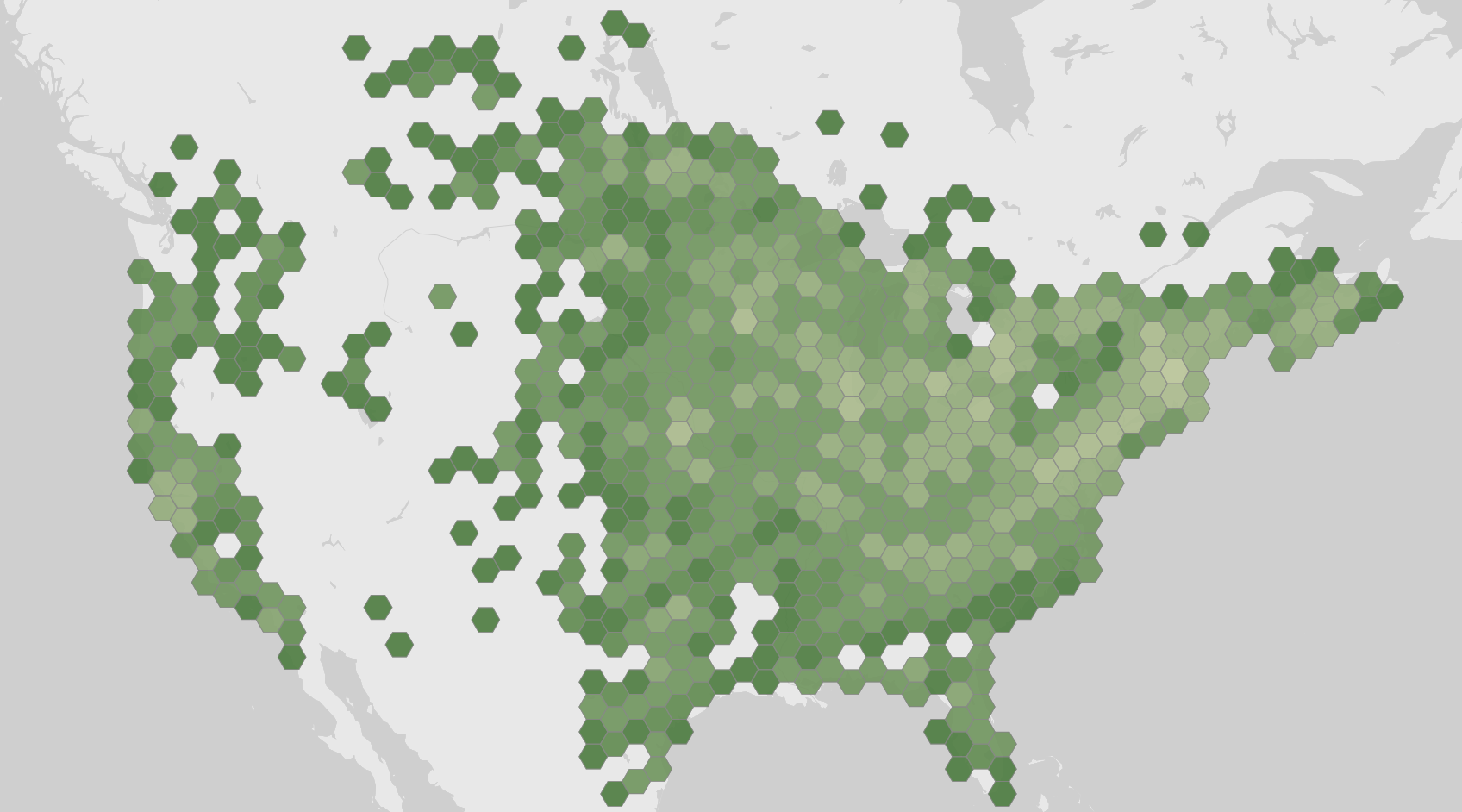
The American dog tick's core range lies in the eastern half of North America, with scattered reports extending as far west as California. It favors forests, densely wooded areas, and grasslands, but is just as often found along roadsides, hiking trails, highway rest stops, and in suburban, agricultural, and riparian settings wherever mammal hosts pass regularly.
Activity timing shifts with latitude. At the northern edge of its range, in Nova Scotia and Massachusetts, adults are active from April to August, peaking in May and June. In coastal Virginia the season runs April through September or October, with peaks in both May and July. Ohio ticks are active from late April to September, peaking in May–June and again, more modestly, in August–September. In Georgia, activity spans late March to August with three peaks — early May, late May, and late June — while in Florida, high summer heat and low winter humidity compress activity into April through July.
Monthly observation counts follow a similar arc, climbing sharply from low winter numbers to a pronounced peak in May, with April and June also elevated before a steep decline through the late summer and fall. These are presence records rather than a measure of abundance or the tick's full range, but the pattern lines up with the regional activity peaks described above, reinforcing spring as the season of greatest encounter risk.
Behavior and Lifestyle
American dog ticks are solitary parasites that move between hosts across their life stages rather than living permanently on one animal. Between blood meals, they wait at the edges of trails and in grassy or wooded areas well traveled by mammals, a behavior called questing that appears to be triggered by odors left behind by potential hosts.
A questing tick climbs a blade of grass or low plant, anchors itself with its third pair of legs, and extends its front legs to grab onto a passing host. Once attached, it inserts a toothed, jaw-like mouthpart called the hypostome and secretes a cement-like substance that locks it in place for the duration of feeding; when feeding ends, a second secretion dissolves this bond and the tick drops off.
While attached, its effective home range is limited to whatever territory its host covers. Between hosts, it wanders in search of a new one, though how far it travels during this search is not documented.
Communication
Much of this tick's sensory world runs on chemical cues rather than sound or sight. Males locate females by sensing pheromones the females release, and questing ticks appear to orient toward paths that hosts have marked with their own odors.
A key tool in this process is Haller's organ, a sensory structure on the first pair of legs found in all ticks of the suborder Ixodida. It carries sensilla tuned to carbon dioxide and infrared radiation, letting the tick detect a host's breath and body heat even before physical contact, supplemented by tactile and vibrational cues once a host is near.
Diet and Nutrition
Dermacentor variabilis feeds exclusively on blood, making it an obligate sanguivore at every stage of its life. A single feeding bout lasts three to eleven days, and between meals the tick can survive extended periods without feeding at all, whether it is a larva, nymph, or adult.
Host choice shifts with life stage: adults take larger blood meals and favor bigger hosts, while earlier stages target smaller animals. Documented hosts include dogs, humans, rabbits, raccoons, rats, mice, porcupines, squirrels, and voles, reflecting a diet built around whatever mammal happens to brush past its questing perch.
Reproduction and Life Cycle
American dog ticks breed once a year, typically in mid-April as adults emerge from overwintering in the soil, in a polygynous system where one male may mate with several females. Courtship begins on the host: a female partially engorges herself with blood, then releases pheromones that draw males off their own hosts and toward her.
After a male locates a female, he mounts her, finds her genital opening, and uses his mouthparts to insert a spermatophore — mating takes place entirely on the shared host. The female then resumes feeding to complete her engorgement before dropping off, which happens five to fourteen days after mating.
Four to ten days after dropping off, once egg development is finished, she lays as many as 6,500 eggs; the exact number rises with warmer temperatures and a larger final blood meal, up to a point above 35°C or beyond roughly 665 milligrams of blood. Egg-laying is her final act — females die once it is complete, making the species semelparous with only one reproductive event per lifetime.
Eggs receive no protection beyond the female's presence before her death, and males contribute nothing after mating. Once hatched, larvae must find their own first host unassisted. Both sexes reach reproductive maturity anywhere from one to seventeen months of age, averaging around three months.
Population and Ecological Role
No population estimate or trend figure is available for this species, but its ecological role is well defined: it is an obligate ectoparasite at every life stage, with larvae and nymphs targeting small mammals such as mice and other rodents while adults move on to larger hosts like dogs, raccoons, cattle, and humans.
Abundance patterns differ depending on whether ticks have fed. Engorged tick numbers track host age, since younger hosts more easily support a heavier tick load, while non-engorged tick numbers respond more to season and site — wooded or grassy areas in spring typically hold the highest counts of ticks that have not yet fed.
Beyond its role as a parasite, the species functions as a disease bridge between wildlife and domestic animals, carrying Rickettsia rickettsii, Francisella tularensis, and the protozoan Cytauxzoon felis, the last of which it can pass from wild cats to domestic cats.
Conservation and Threats
Dermacentor variabilis carries no special conservation status: the IUCN lists it as Not Evaluated, and it holds no protections or restrictions under the US federal list, CITES, or state-level lists such as Michigan's. In conservation terms, it is neither threatened nor in need of protection.
The concern this species raises runs in the opposite direction from most conservation subjects. Rather than facing threats itself, it acts as a significant vector for Rickettsia rickettsii, the bacterium behind Rocky Mountain spotted fever, and for Francisella tularensis, which causes tularemia — making it a public health consideration rather than a species in need of safeguarding.
Cultural Significance
Dermacentor variabilis carries no documented economic benefit to people, and no folklore, symbolism, or artistic tradition is recorded around it. Its relationship with humans is defined almost entirely by disease transmission rather than any cultural or practical use.
Fun Facts
- It is regarded as one of the best-known hard ticks in North America.
- It is a significant vector for Rickettsia rickettsii, the bacterium responsible for Rocky Mountain spotted fever.
- It was long thought absent from the Rocky Mountain region, where the related Dermacentor andersoni (Rocky Mountain wood tick) is found instead, though reports of the two species overlapping date back to 1939.
- A female lays eggs only once in her life — up to 6,500 of them — before dying.
- Its Haller's organ, located on its front legs, can detect both carbon dioxide and infrared radiation, letting it sense an approaching host before ever touching it.
Ecology
Diet
- Carnivore
Habitat
- Forest
- Woodland
- Grassland
- Urban
Behavior
- Solitary
- Hibernating