The eastern gray squirrel is described as the most prodigious natural forest regenerator in eastern North America. It is a tree squirrel of the family Sciuridae, native to the eastern and midwestern United States and the southern parts of central Canada.
An adult weighs about and has a body length of about . Its longest known life is , most often in captivity. Outside its native range it has been introduced to several places, and in Europe it is regarded as an invasive species.
Identification and Appearance
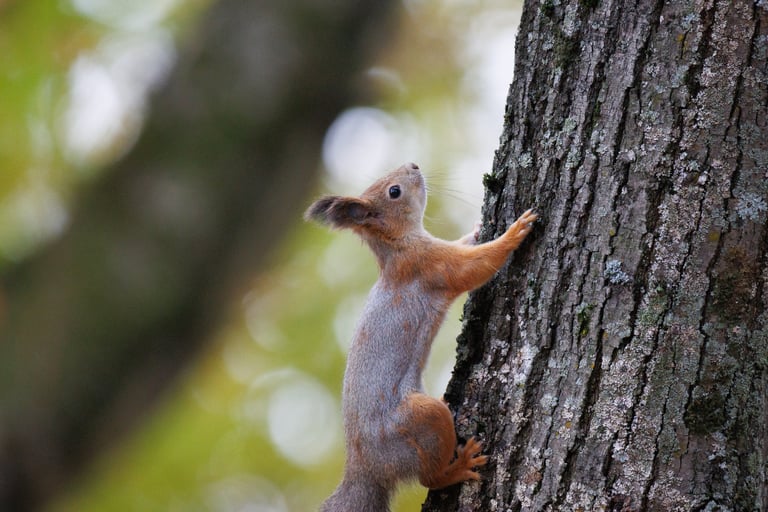
The eastern gray squirrel is mostly gray, with brown spots and streaks on its back and a white underside. A large bushy tail is its most noticeable feature.
Adults weigh between 400 and 600 g, and the average adult weighs about . Head and body length runs from 23 to 30 cm, and the tail measures 19 to 25 cm. Males and females look alike and are the same size.
Black individuals are common in some populations, especially in urban areas and in southeastern Canada, where the almost entirely black melanistic form predominates. Melanistic squirrels tolerate cold better than the gray form.
It is easy to confuse with the fox squirrel. The gray squirrel has a white underside, while the fox squirrel has a brownish-orange underside. Its tracks have four toes on the front feet and five on the hind feet.
Distribution and Habitat
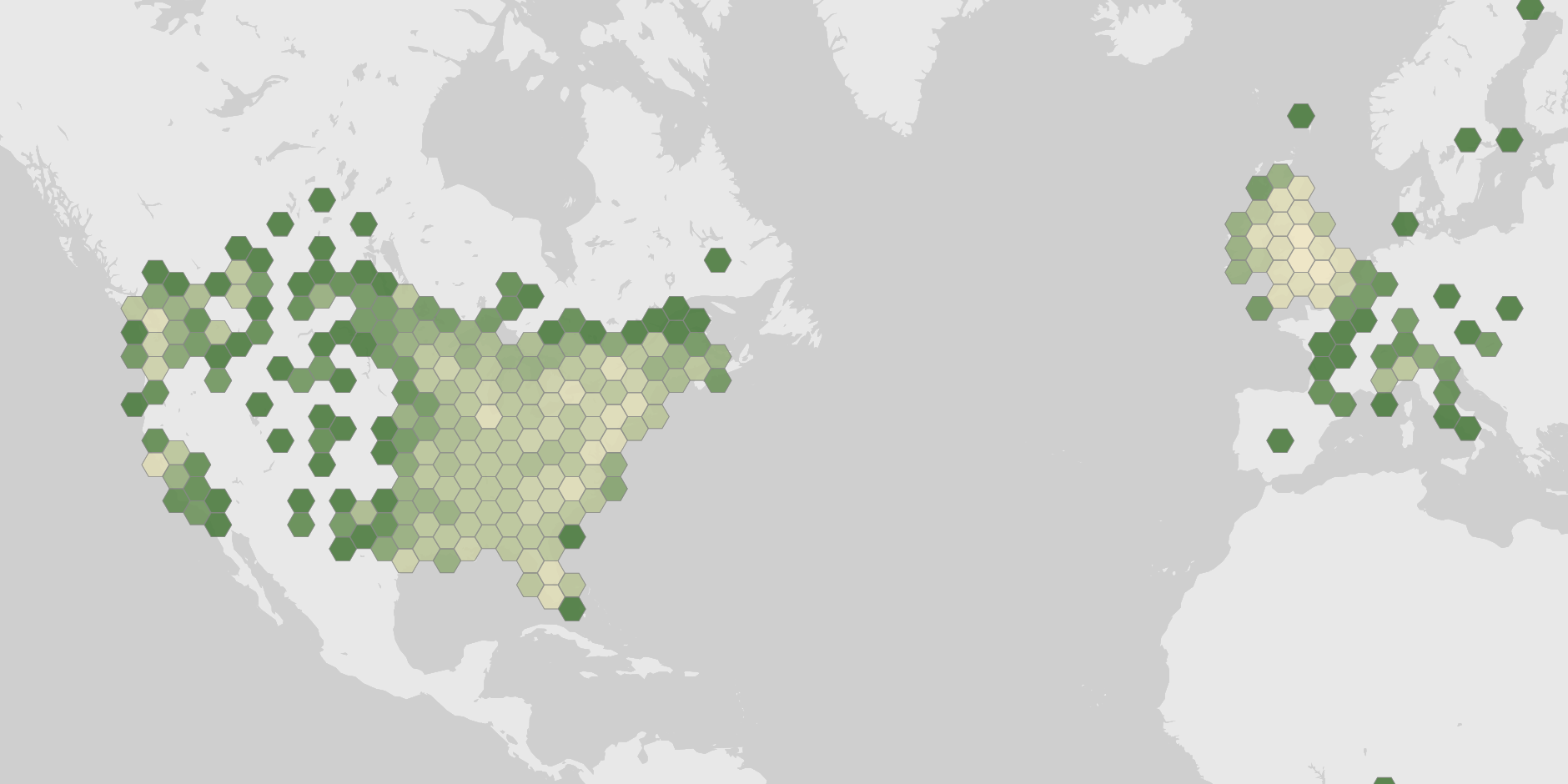
The eastern gray squirrel is native to the eastern and midwestern United States and to the southern parts of central Canada. Its native range runs from New Brunswick through southern Ontario and south to East Texas and Florida.
It prefers mature broadleaved woodlands with a rich understory, and it generally needs continuous woodland of more than 40 hectares (100 acres). Densities are highest in forests with oaks and walnuts, whose nuts keep through winter storage. It also lives in conifer woodland, parks, gardens and cities where mature trees grow.
In the mid-1800s its population in the midwestern United States was described as truly astonishing. Human hunting and deforestation later reduced it sharply, and it was almost absent from Illinois by 1900.
The species has been introduced far from its native range. On Vancouver Island in western Canada it has been released since 1966, and it has been introduced to Britain, Ireland, Italy, South Africa and Australia, where it was extirpated by 1973.
Behavior and Lifestyle
The eastern gray squirrel is active during the day. In spring, summer and autumn its peak activity comes about 2 hours after sunrise and again 2 to 5 hours before sunset, which lets it avoid the midday heat. In winter, activity peaks just 2 to 4 hours before sunset.
It lives mostly in trees and is one of very few mammals that can descend a tree head-first. It turns its hind feet so the claws point backward and grip the bark. It does not hibernate.
It builds a drey, a roughly spherical nest of dry leaves and twigs about 30 to 60 cm across, in the forks of trees. Squirrels may also use permanent tree dens, and they sometimes nest in attics or house walls. Squirrels tend to claim two or three dens at the same time.
Males form dominance hierarchies during the breeding season. Home ranges average and are larger in summer. Lactating females are especially aggressive and may shrink their ranges by as much as 50 percent.
Hawks, owls and snakes are its main predators. Raccoons, weasels, foxes and domestic cats also take squirrels, and its speed makes capture difficult.
Communication
Eastern gray squirrels communicate through vocalizations, posture and scent. Their vocal range includes a mouse-like squeak, a low-pitched noise, a chatter and a raspy "mehr mehr mehr". They also flick their tails and use facial expressions.
The "kuk" or "quaa" call and tail flicking warn other squirrels about predators, and they also signal when a predator has left. Mothers and young use a soft coo-purring sound, called the "muk-muk" sound, as a contact call. Males use it when courting females during the breeding season.
Channel use depends on the setting. Squirrels in big cities rely more on visual signals because the noise is loud and open ground gives clear sightlines. In heavily wooded areas, where the canopy blocks sight, they rely more on sound.
Diet and Nutrition
The eastern gray squirrel is an omnivore whose diet is almost entirely plant material. Most of its food is nuts, flowers and buds from oaks, hickories, pecans, walnuts and beeches. Maples, elms, wild cherries and hawthorns also provide fruits, seeds and flowers.
Conifer seeds and catkins from cedars, pines and spruces are another food source, along with herbaceous plants and fungi. In winter it also eats crops such as corn and wheat.
Insects become more important in summer, and they matter most for young squirrels. Squirrels also eat bird eggs, nestlings and frogs, and they sometimes eat carrion.
In autumn it buries food in winter caches, a method called scatter hoarding. It finds these caches by memory and smell.
Reproduction and Raising Young
Breeding takes place in December to February and again in May to June, and it starts a few weeks later in more northern areas. Males follow a female for up to five days before she comes into estrus, sometimes from 500 meters away. Several males may mate with one female, forming a dominance hierarchy among them.
Gestation lasts about . Most females produce in a year, with first litters arriving in February or March and second litters in June or July. Typical litters hold 2 to 4 young, and up to 8 is possible. The average litter size is .
Newborns are naked apart from their whiskers and weigh 13 to 18 g. Weaning starts in the seventh week and is complete at about . Young leave the nest after about 12 weeks, and autumn-born young often stay with their mother through winter.
Most females begin breeding at about 1.25 years of age, and males are usually sexually mature by about 11 months. Females may breed for more than 8 years.
Population and Ecological Role
Only one in four young squirrels survives to its first year. Mortality is around 55 percent in the following year, then falls to about 30 percent in later years until it rises sharply at eight years of age.
It is a major seed predator and seed disperser in forests. Its seed caching helps spread tree seeds, and it may also spread truffle spores when it eats truffles.
Bobcats, fishers and coyotes are the main predators of the squirrel, and snakes and weasels take it less often. Fleas and sucking lice are its main parasites, and ticks, mites and roundworms also infest it.
Conservation and Threats
The eastern gray squirrel is rated Least Concern on the IUCN Red List and is not threatened. It has no special status under US federal law or CITES.
In Europe it is a serious concern because it has displaced native red squirrels. In Britain it has largely replaced the red squirrel, and in Ireland it competes with the Eurasian red squirrel. Its spread also threatens the native American red squirrel on Vancouver Island.
In the United States, it is harvested for food and sport in some states, and it supports wildlife viewing.
Cultural Significance
Eastern gray squirrels provided food for Native Americans and colonists, and some people still eat them today. In some states they have economic importance. In Mississippi about 2.5 million are harvested each year, with an economic impact of 12.5 million dollars.
Among nature watchers, squirrels rank second to birds in value.
The species also supports ecotourism, and it is a visible animal for people who watch wildlife.
Photos
Photographs from via iNaturalist, licensed under CC0 1.0. and by Liem Malarney via iNaturalist, licensed under CC BY 4.0., credited on each photo.
Ecology and classification
Classification
- Phylum
- Chordata
- Class
- Mammalia
- Order
- Rodentia
- Family
- Sciuridae
- Genus
- Sciurus
- Species
- Sciurus carolinensis
Sources
- GBIF Species names and classification
- iNaturalist Photos
- Wikidata Common names and conservation status
- Wikipedia Summary extract
- Encyclopedia of Life Habitat, diet and behavior traits
- Animal Diversity Web Animal habitat, behavior and diet
- AnAge Longevity
- COMBINE Mammal size, lifespan, breeding, diet and activity
- GloBI What it eats, what eats it, parasites and pollinators
- Wardeh et al. 2015 (EID2)
- MammalBase
- SquamataBase
- HWML Parasite Collection
- CarniDIET