A large male eastern grey kangaroo can weigh up to 69 kg (152 lb) and stretch well over 2 meters from nose to tail, making it one of the biggest marsupials on Earth.
It belongs to the family Macropodidae within the order Diprotodontia, and it lives across the eastern third of Australia, from coastal woodlands to inland grasslands. The IUCN lists the species as Least Concern, and its population is estimated in the millions.
Despite its bulk, the eastern grey is one of the most familiar large marsupials to ordinary Australians, since it thrives in the same fertile, well-watered country where most of the country's people live.
Identification and Appearance
The eastern grey kangaroo's soft grey coat is its most reliable field mark, setting it apart from the reddish or grey-blue red kangaroo, whose face carries bold black-and-white markings around the muzzle that the eastern grey lacks. Its eyes appear large and wide open, and a light grey to brownish-grey body contrasts with a paler, sometimes near-white, belly.
Adult males commonly weigh 50 to 66 kg (110 to 146 lb), while females are considerably smaller at 17 to 40 kg (37 to 88 lb). A powerful tail exceeding 1 meter (3 ft 3 in) helps balance the body and props the animal up when it rears back to fight or feed. The largest recorded specimen weighed 91 kg (201 lb) and measured 2.92 m (9 ft 7 in) along the curves of its body, with a flat skin length of 2.49 m (8 ft 2 in).
Where its range overlaps with the western grey kangaroo, the two can be hard to tell apart. Both share a similar body and facial structure with fully furred muzzles, but the western grey is a darker, dustier brown with sharper contrast around the head, while the eastern grey stays lighter and grayer overall.
Distribution and Habitat
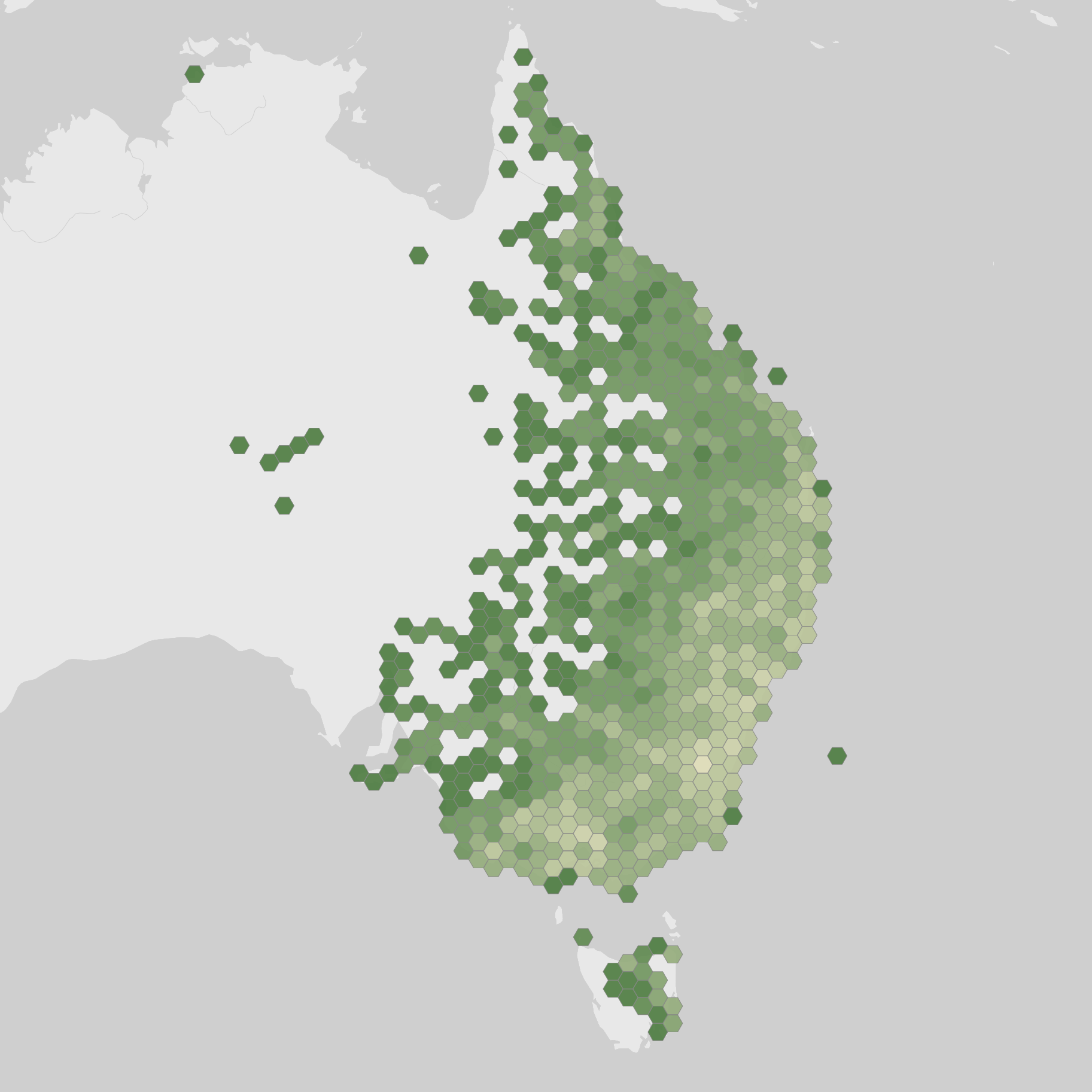
The eastern grey kangaroo occupies the eastern third of Australia, favoring open grassland broken up by patches of bush for daytime shelter. It uses a wide range of habitats, from open woodlands and grasslands to mountain forests, and it generally prefers wetter, more fertile country than the red kangaroo, though it can extend into semi-arid areas as well.
It also turns up in coastal areas, sub-tropical forests, and inland scrub, and its tolerance for disturbed and near-urban landscapes means it is often found in bushland pockets just outside the major cities along the southern and eastern coasts, where most Australians live.
Monthly GBIF observation counts show a rise from around 11,000 sightings in January to a peak near 28,000 in April, before tapering through the year to about 14,000 in December. Since these figures record presence rather than true abundance, they should be read cautiously, but the pattern hints at greater visibility of the species in Australia's autumn months.
Behavior and Lifestyle
Eastern grey kangaroos are gregarious animals that gather in open-membership groups often called mobs, typically averaging around three individuals but sometimes merging into larger gatherings to graze preferred pasture or rest together in the heat of the day. Groups follow a dominance hierarchy, with dominant animals gaining first access to good food and shade, though the species is not territorial in the strict sense.
Activity is mainly nocturnal and crepuscular: kangaroos rest in the cover of woodland through the middle of the day, then move out into open grassland at dusk to graze through the night and into early morning. Locomotion is by hopping, typically covering about 9 meters per bound, with a leg structure that becomes more energy-efficient at higher speeds, allowing bursts up to roughly 30 mph.
Home ranges average about 42.9 hectares, varying by roughly 29.2 hectares in either direction depending on the density of animals and the availability of food and water. Vigilance against predators is highest among reproductive females, animals on the edge of the group, and those grazing far from cover, and while individual watchfulness does not fall much as groups grow larger, the open membership of mobs still gives more animals a buffer against danger.
Communication
Clucking calls are the main everyday signal, used by both males and females to keep in contact with each other and with their young. When alarmed, an eastern grey kangaroo can switch to a guttural cough, the same sound males use when confronting rivals, fighting, or asserting dominance.
Physical signals matter too: any grey kangaroo that senses danger will stamp its hind legs sharply against the ground. Combined with the guttural cough, this stamping carries over a considerable distance, warning the rest of the mob well before a threat gets close.
Diet and Nutrition
Grass is the eastern grey kangaroo's staple food, and the species grazes on a wide variety of grasses and forbs across the open plains it favors. Its diet is broader than that of some relatives, such as the red kangaroo, which supplements grazing with a larger share of shrubs.
In the wild, foliage such as leaves and the occasional seeds, grains, or nuts round out its plant-based intake, but fruit is rarely part of the natural diet. Animals kept in captivity, however, may also be fed fruit, a food source the wild population does not normally encounter.
Reproduction and Raising Young
Breeding is polygynous and seasonal, concentrated in spring and early summer, with most births occurring in the Australian summer. Dominant males secure most matings, and courtship is brief: a male approaches a female in estrus, sniffs her pouch and urogenital area, clucks, and paws at her head and tail before copulation, after which he guards her from rival males for roughly an hour in total.
Gestation lasts only about 34.8 to 38 days, remarkably short even though the estrous cycle itself runs closer to 46 days. Females typically give birth to a single joey, though twins occur occasionally, and the newborn is tiny and undeveloped, making its own way into the pouch to continue growing while attached to a teat.
The joey remains in the pouch for about 11 months, nursing throughout, before beginning to emerge and become progressively more independent; full weaning can extend out to around 550 days in some cases. Females are able to hold a fertilized embryo in suspended development, a process called embryonic diapause, until the current joey has left the pouch, and during drought or poor food conditions this pause can last much longer, with males even ceasing sperm production until enough rain brings on fresh green growth.
Sexual maturity comes at around 17 months for females and roughly 20 to 25 months for males, though females with joeys nearing independence often forage alone, likely to reduce the risk of predation to themselves and their young.
Population and Ecological Role
Population figures vary by source and date, ranging from close to 2 million to an Australia-wide estimate near 11.4 million as of 2010, reflecting how widespread and locally abundant the species has become across its range. As a grazer, the eastern grey kangaroo helps control the growth and spread of grasses and other low vegetation.
Heavy, unchecked grazing pressure can contribute to soil drying in the way many large grazers do, but the species' numbers are not considered great enough to pose a serious ecological hazard on their own.
Conservation and Threats
The eastern grey kangaroo is classified as Least Concern by the IUCN, reflecting a population that is not considered at immediate risk of extinction. The species did suffer a sharp decline in the late 1990s, particularly in Tasmania, but legal protection across most of Australia and the fact that much of its range now falls on private property have allowed numbers to recover and grow.
The main pressure it faces today comes from conflict with agriculture, since the eastern grey favors the same fertile districts now given over to crops and introduced pasture grasses, which it readily eats; in some areas this has led to localized culling. A large, government-regulated kangaroo industry harvests animals under strict annual quotas, and despite this commercial take, the species remains common and widespread, still occupying the full range it held when Europeans arrived in 1788.
Conservation status
- LC
- NT
- VU
- EN
- CR
Least Concern
Cultural Significance
For millennia, First Nations people across eastern Australia have hunted the eastern grey kangaroo for its meat and fur, and it holds standing as a totem animal of deep cultural and spiritual significance, much of which remains privately held knowledge within Aboriginal communities rather than public record.
That long relationship continues in a different form today through Australia's regulated kangaroo industry, which draws on the species for food and for body parts valued as material, continuing a use of the animal that stretches back long before European settlement.
Fun Facts
- The eastern grey kangaroo tolerates fluoroacetate, a toxic compound found in certain Australian plants, even though it does not typically encounter those plants in its usual habitat.
- It is a totem animal of deep spiritual significance in Australian Aboriginal cultures, though many of the specific meanings attached to it are kept as private, internal knowledge rather than shared publicly.
- First Nations peoples across eastern Australia have hunted the species for its meat and fur for thousands of years, a practice that predates European settlement by millennia.
Ecology
Behavior
- Nocturnal
- Social
- Crepuscular
Habitat
- Forest
- Woodland
- Mountain
- Grassland
Diet
- Herbivore
Photos
SourcesGBIFiNaturalistWikidataWikipediaAnimal Diversity WebAnAge