Echinacea purpurea's spiky, cone-shaped flower heads, ringed by drooping pink-purple petals, make it one of the most recognizable native wildflowers of eastern North America. It is a herbaceous perennial in the daisy family, Asteraceae, native to the eastern, southeastern, and midwestern United States as well as Ontario, Canada, where it grows most abundantly in the Ozarks, the Mississippi Valley, and the Ohio Valley.
The species favors dry open woods, prairies, and barrens, habitats shaped by periodic disturbance and full sun. Beyond its wild range, it has become one of the most widely cultivated native perennials in temperate gardens, valued for its long bloom period and its appeal to pollinators.
Identification and Appearance
The domed, bristly central cone is the plant's most distinctive feature, formed by dozens of small yellow tubular florets packed into a raised protuberance that gives the genus its name. Surrounding this cone is a ring of pink to purple, strap-shaped ligulate florets, which are sterile, while the tubular florets at the center are hermaphroditic, bearing both male and female organs.
A mature plant reaches up to 120 centimeters (47 inches) tall and about 25 centimeters (10 inches) wide, with an upright habit. The full flower head, cone and petals together, spans 7 to 15 centimeters (3 to 6 inches) across. Leaves are arranged alternately along the stem on petioles up to 17 centimeters (7 inches) long, and are oval to lance-shaped, measuring 5 to 30 centimeters (2 to 12 inches) in length and 5 to 12 centimeters (2 to 5 inches) in width, with edges that range from nearly smooth to toothed.
While purple is the typical color in wild populations, flower head color can vary. The narrow, linear to lance-shaped involucral bracts beneath the flower head add to its bristly, hedgehog-like appearance. Bloom timing runs through summer into autumn, and after flowering the plant produces small, hard achene fruits that persist on the dried cone.
Distribution and Habitat
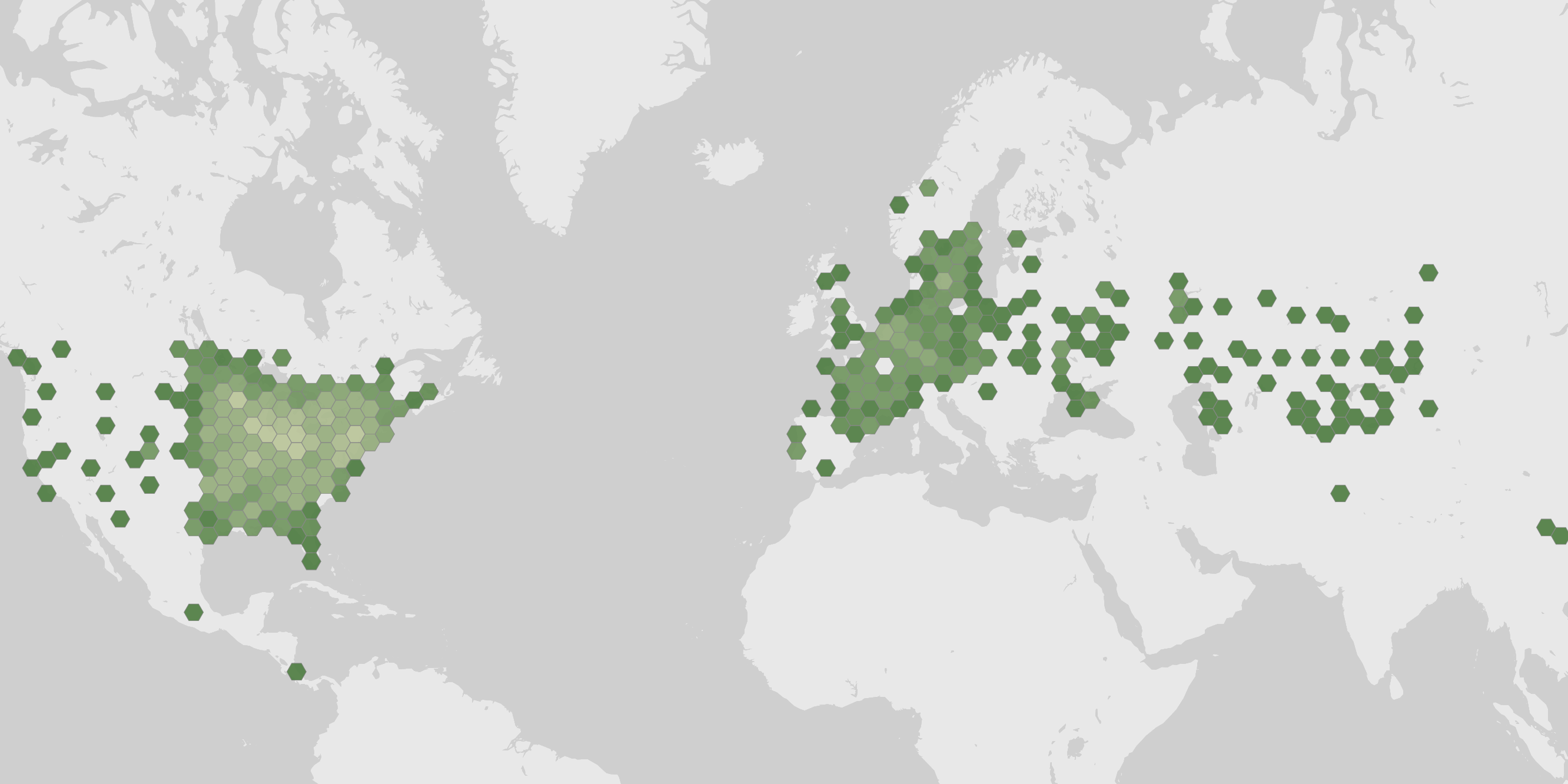
Echinacea purpurea occurs across much of the eastern, southeastern, and midwestern United States and into Ontario, Canada, with its strongholds in the Ozarks, the Mississippi Valley, and the Ohio Valley. Within this range it grows in dry open woods, prairies, and barrens, habitats that share well-drained soils and ample sunlight.
Monthly observation records show a sharp seasonal pattern: counts stay low from November through March, climb rapidly in May and June, and peak in July at 6,755 recorded sightings before tapering off through autumn. This pattern most likely tracks the plant's summer flowering period, when its showy cone-shaped heads make it far easier for observers to notice and identify, rather than reflecting any true seasonal migration or shift in abundance.
As a presence-only dataset, these observation counts do not measure population size or mark the complete boundaries of the species' native range; they simply show where and when people have recorded seeing it.
Ecology and Relationships
Echinacea purpurea draws a wide range of pollinators to its flower heads, including bumblebees, sweat bees, honey bees, the sunflower leafcutter bee, and the specialist mining bee Andrena helianthiformis. Butterflies are frequent visitors too, among them monarchs, swallowtails, and sulphur butterflies, drawn to the nectar-rich ring of ligulate florets surrounding the central cone.
After flowering, the plant's achene fruits become a food source for birds, particularly finches, which eat the seeds and disperse them through their droppings, helping the species colonize new ground.
The plant also faces pressure from herbivores at different life stages. Slugs and rabbits target young foliage, especially soon after the plants emerge in spring, while gophers can damage and consume the roots underground.
Uses and Human Relationships
Echinacea purpurea has long been used in traditional medicine by Native American peoples to treat a wide range of ailments. Among Western tribes such as the Ute, the plant carries a specific association with elk and is known as "elk root," tied to a belief that wounded elk sought it out as a natural remedy.
The species also carries a place in Greek mythology, where it was said that the god Jupiter created the coneflower to catch the attention of a mortal woman named Echinacea, with the flower symbolizing his devotion to her.
Today the plant is grown widely as an ornamental in temperate gardens, suited to borders, walkways, and beds, and its flowers are used in fresh bouquets. Breeders have developed numerous cultivars for flower quality and plant form, including 'Ruby Giant' and 'Elbrook,' both recipients of the Royal Horticultural Society's Award of Garden Merit. Growers propagate it either from seed, aided by stratification or daily temperature fluctuation to break dormancy, or vegetatively through division, root cuttings, or basal cuttings treated with rooting hormone.
Fun Facts
- The genus name Echinacea comes from the Greek word echinos, meaning hedgehog or sea urchin, a reference to the bristly, spiny appearance of the dried seed head.
- In Greek mythology, Jupiter was said to have created the coneflower to win the attention of a mortal woman named Echinacea, making the flower a symbol of his devotion.
- Among Native American groups, the Plains Nations used Echinacea more than any other herb, and Echinacea purpurea is considered the easiest species in the genus to grow and the most commonly used today.
- Western tribes such as the Ute called the plant "elk root," linked to a belief that wounded elk would seek it out.
Ecology
Habitat
- Woodland
- Grassland
Growth habit
- Herb