The plains zebra is the most common and widely distributed zebra species alive today, with a fragmented range that still stretches across much of southern and eastern Africa south of the Sahara. It belongs to the family Equidae, the same lineage as horses and donkeys, and is currently listed as Near Threatened by the IUCN.
What makes this species compelling is not just its abundance but the story woven into its populations: one extinct form, the quagga, has become a symbol of colonial-era overhunting, while the living plains zebra continues to adapt its social and migratory habits to a changing African landscape.
Identification and Appearance
The single most useful field mark is the stripe pattern itself: no two plains zebras share exactly the same arrangement, and the stripes run vertically on the front half of the body before curving toward horizontal bands across the hindquarters. Adults stand 127–140 cm (50–55 in) at the shoulder, with a head-body length of 217–246 cm (85–97 in) and a tail measuring 47–56.5 cm (18.5–22.2 in). Males are heavier and more thickly necked than females, weighing 220–322 kg (485–710 lb) compared to 175–250 kg (386–551 lb) for mares.
The body is stocky with relatively short legs, a convex forehead, and a slightly concave nose profile. Upright, rounded ears are shorter than those of the mountain zebra and narrower than those of Grévy's zebra, helping separate the plains zebra from its close relatives at a glance. Northern populations show narrow, sharply defined stripes, while southern populations carry broader, more variable striping with faint brown "shadow" stripes between the black and white bands—a feature largely absent farther north.
Foals are born with a brown-and-white coat that darkens to full black over time. Coat abnormalities occur occasionally: melanistic individuals carry dense dark striping on the torso but little on the legs, "spotted" zebras show interrupted stripe patterns, and albino zebras with blonde stripes instead of black have been recorded in forests around Mount Kenya. The extinct quagga, once considered a separate species, differed most obviously by having brown and white stripes confined to the head and neck, plain brown upper parts, and an unstriped white belly, tail, and legs.
Distribution and Habitat
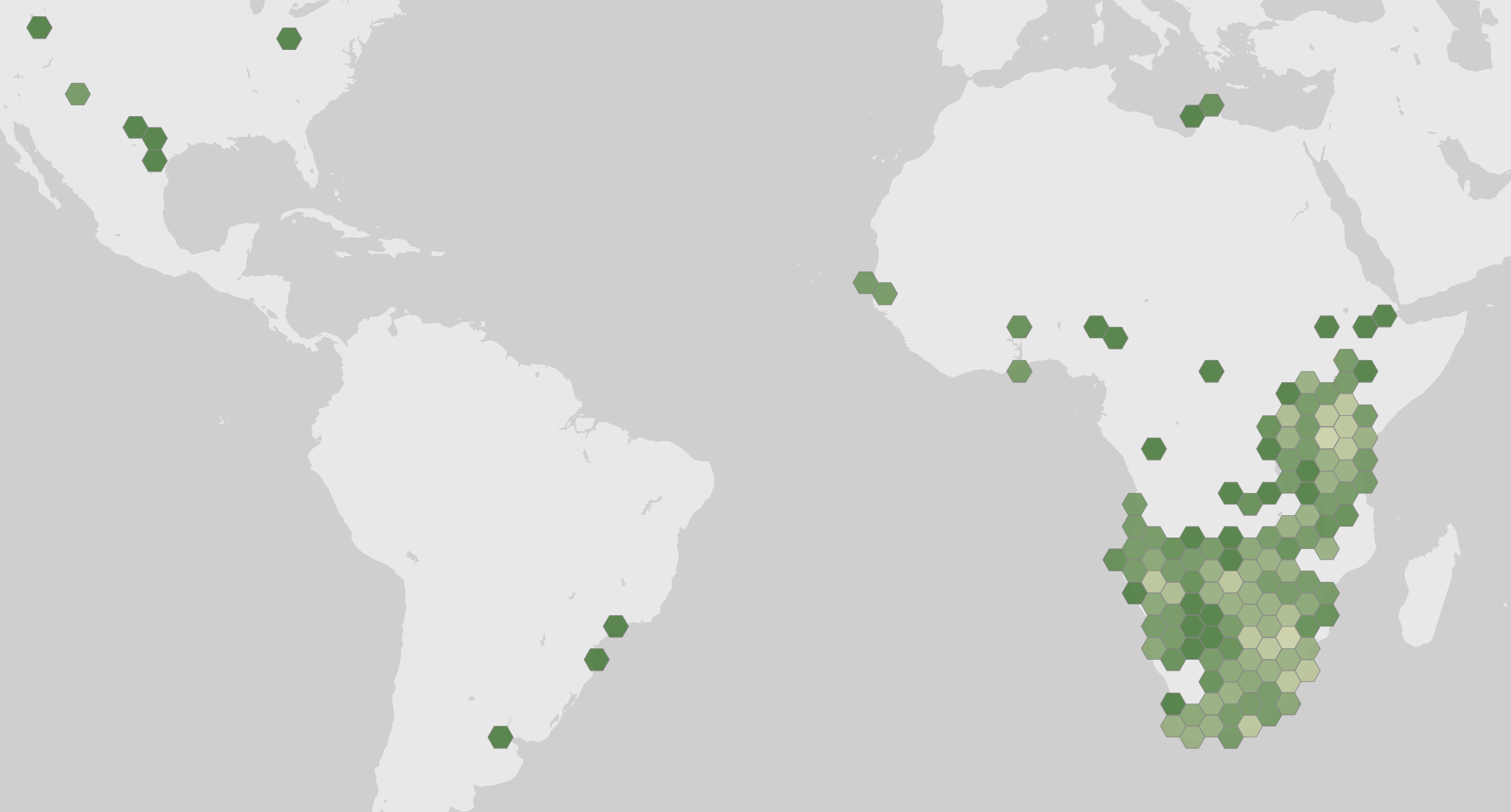
The plains zebra's range runs from South Sudan and southern Ethiopia south through eastern Africa into Zambia, Mozambique, and Malawi, then spreads across most of southern Africa, stopping short of the Sahara to the north. The species favors treeless grasslands and savanna woodlands, generally preferring Acacieae woodland over Commiphora scrub, and can be found from sea level up to about 1,300 m (4,300 ft) on Mount Kenya. It avoids true deserts, dense rainforest, and permanent wetlands.
Water dependency shapes much of its distribution: plains zebras rarely range more than 10–12 km (6.2–7.5 mi) from a water source, and populations occupy more mesic habitats than other African wild equids. Some herds are sedentary with small, dense home ranges, while others are migratory, moving between distinct wet- and dry-season ranges and seemingly drawing on memory of past foraging conditions to anticipate where grass will be best months in advance.
Monthly observation counts show more sightings from July through November, peaking around November, and fewer from December through April, though these figures reflect presence records rather than true abundance or a complete range map. Woody plant encroachment on open grasslands is a growing concern, as it raises predation risk in habitat the species otherwise favors.
Behavior and Lifestyle
Plains zebras are diurnal and nomadic, spending most of daylight hours feeding while remaining alert to predators after dark, when at least one member of a resting group stays standing on guard. Their basic social unit is the harem: a single stallion with several mares and their recent offspring, an arrangement that typically holds stable for months or years. Young males instead form loose "bachelor" groups of up to fifteen individuals, organized by an age-based hierarchy and occupied largely with play-fighting and greeting rituals until they are ready to acquire mares of their own.
Multiple harems and bachelor groups merge into much larger herds of hundreds of animals, especially during migrations—an unusual trait among harem-forming mammals, shared otherwise mainly with primates like the gelada and hamadryas baboon. Home ranges vary enormously with lifestyle, from as little as 30 km² (12 sq mi) in resource-rich areas to 600 km² (230 sq mi) for migratory populations.
Stallions build harems by abducting young mares in their first oestrus from their natal family groups, triggering repeated contests among rival males until the mare finally conceives and settles permanently with one stallion. Fights over mares can turn violent, with rivals biting at the neck, head, or legs and wrestling each other to the ground, though a healthy harem stallion is rarely challenged once established. Mares maintain their own hierarchy within a harem, with the highest-ranking female mating first and leading the group, while newcomers are met with hostility until the stallion's presence eases tensions.
Daily hygiene rituals reinforce these bonds: individuals stand side by side nipping at each other's neck, mane, and back to remove parasites, a service also performed by oxpecker birds riding on their backs.
Communication
Plains zebras rely on at least six distinct vocalizations. A high-pitched contact call—rendered as "a-ha, a-ha, a-ha" or "kwa-ha"—keeps herd members in touch, and the species name quagga itself derives from the Khoikhoi word for zebra, an imitation of this bark. A sharp two-syllable call signals a spotted predator, a loud snort warns of danger while moving through cover, and a longer, softer snort expresses contentment; injured males give a short squeal, and distressed foals wail.
Facial signals complement the calls. In greeting, the ears point up and forward with lips pulled back in a chewing motion; the same lip movement paired with lowered ears signals a threat instead. Mutual grooming—nipping and scraping along the neck, withers, and back, most often between mothers and foals—reinforces social bonds, eases tension after aggressive encounters, and visibly reflects an individual's standing within the harem.
Diet and Nutrition
Plains zebras are grazers, feeding primarily on grasses across the savannas and grasslands they inhabit. They often move into stands of tall grass or wetter pastures ahead of other grazers, giving them early access to vegetation before it is depleted. This head start puts them in frequent competition with wildebeest, which are typically far more numerous in the same landscapes and graze many of the same areas.
Reproduction and Raising Young
Breeding follows a polygynous system in which a single stallion mates with all the mares in his harem. A male tests a female's readiness through the flehmen response, curling his upper lip to detect her scent, while a receptive mare signals willingness by straddling her legs and raising her tail. Fillies begin advertising oestrus with a distinctive posture between one and two years of age, and it can take about a year of repeated contests among rival stallions before a young mare finally conceives and settles with one male for good.
Gestation lasts around a year, and mares typically produce a single foal, sometimes at intervals of about twelve months. Births show a marked seasonal peak in early December and January, coinciding with the rains in East Africa, and a mare gives birth lying on her side near the rest of her group. Newborn foals weigh 30–35 kg (66–77 lb) and can stand almost immediately, beginning to eat grass within a week.
Mothers initially keep every other zebra, including the harem stallion, away from a new foal, though bonds with the wider group form later. Stallions are generally intolerant of foals that are not their own, and infanticide has been recorded. Foals are usually weaned around eleven months but may continue to suckle longer, and mortality in the first year is high, driven mainly by predation despite the protection a herd affords.
Females reach sexual maturity before age three, males only after five or six years. As a mother's attention shifts to a new sibling, young males drift away from their natal harem to join a bachelor group, while young females typically remain until abducted into a new harem by another stallion. Mares in good condition can reproduce roughly every two years, with a first foal typically arriving between three and 3.5 years of age.
Conservation and Threats
The plains zebra was classified as Near Threatened by the IUCN in 2016, when the total population was estimated at around 500,000 individuals. The species remains widespread and common across much of its range, but numbers are declining in ten of the seventeen countries where it occurs, including Botswana, the Democratic Republic of the Congo, Kenya, Rwanda, Somalia, South Sudan, Tanzania, Uganda, Zambia, and Zimbabwe. Populations are considered stable in Ethiopia, Malawi, and South Africa, and stable or increasing in Mozambique, Namibia, and Eswatini, while the species has already disappeared from Burundi, Lesotho, and possibly Somalia.
The main pressures are hunting for hide and meat, habitat loss from farming, competition with livestock for forage, and fencing that blocks traditional migration routes; civil conflict in parts of its range has compounded these declines. The quagga, a distinctively marked form of this same species, illustrates how severe the consequences can be: hunted heavily by Dutch and later Afrikaner settlers for meat and skins, it was reduced to extinction, with the last wild individual likely killed around 1878 and the last captive animal dying in an Amsterdam zoo on 12 August 1883.
Protected areas across the range—including Serengeti National Park in Tanzania, Tsavo and Masai Mara in Kenya, Hwange National Park in Zimbabwe, Etosha National Park in Namibia, and Kruger National Park in South Africa—support many of the species' more stable populations, alongside some groups persisting in unprotected land. In 1984 the quagga became the first extinct animal to have its DNA analyzed, a discovery that revealed it was in fact a form of the plains zebra rather than a separate species.
Conservation status
- LC
- NT
- VU
- EN
- CR
Near Threatened
Cultural Significance
Zebras have appeared in Southern African rock art for 20,000 to 28,000 years, though less frequently than antelope species such as eland, and their stripes have inspired folk tales explaining how the pattern came to be, including stories involving scorching by fire. The San people linked the zebra's dazzling stripes to water, rain, and lightning, while for the Shona people of Zimbabwe the zebra is a totem animal alongside the eland, buffalo, lion, and monkey; the Shona name "madhuve," meaning "woman of the zebra totem," remains a given name for girls in Zimbabwe today. At the ruins of Great Zimbabwe, zebra stripes decorate structures associated with a premarital initiation school for women, symbolizing the union of male and female.
The quagga in particular became a stark symbol of overhunting and extinction during the colonial era, hunted for meat and for skins that were traded and used locally as grain bags. Its loss went on to shape museum collections and conservation narratives, and later taught scientists a great deal about coat variation and genetics across zebra populations.
In Western culture, zebras have often stood in as a more exotic alternative to the horse, appearing as mounts and characters in works ranging from comic books to animated films such as Dumbo, The Lion King, Khumba, and the Madagascar series, and even inspiring the half-zebra centaurs of Fantasia.
Fun Facts
- The species name quagga comes from the Khoikhoi word for zebra, an onomatopoeic rendering of its distinctive "kwa-ha" bark call.
- In 1984, the extinct quagga became the first extinct animal ever to have its DNA analyzed, launching a new field of genetic research into vanished species.
- A free-roaming population of about 129 plains zebras lives near San Simeon, California, descended from animals once kept in William Randolph Hearst's private zoo in the early twentieth century.
- Albino zebras with pale blonde stripes instead of black have been recorded in forests around Mount Kenya.
- Rival stallions competing for mares can fight violently, biting at the neck, head, and legs and wrestling each other to the ground.
- Oxpecker birds often ride on zebras' backs, feeding on parasites as part of the animals' daily grooming routine.
Ecology
Habitat
- Woodland
- Mountain
- Grassland
- Savanna
Behavior
- Social
- Diurnal
- Migratory
Diet
- Herbivore
Photos
SourcesGBIFiNaturalistWikidataWikipediaAnimal Diversity WebAnAge