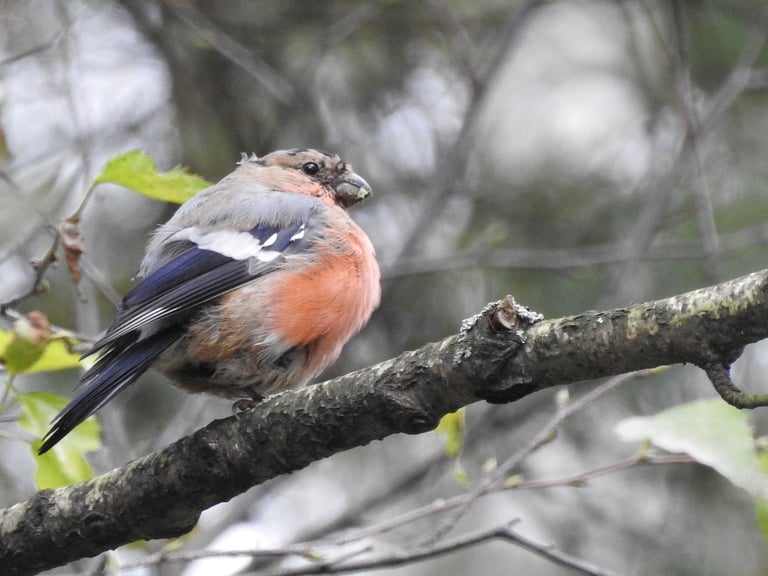
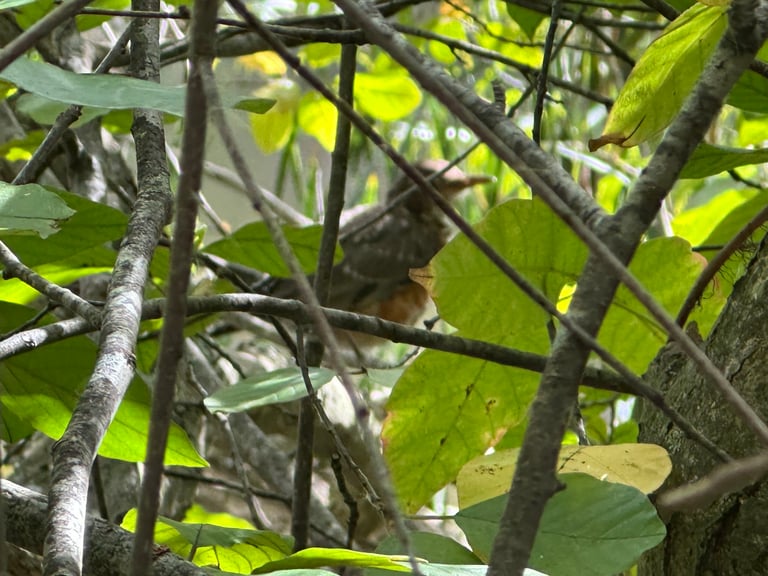
A male Eurasian Chaffinch announces his presence with a loud, cascading song delivered from an exposed perch, a habit that has fascinated birdwatchers and scientists alike. Both sexes share a pair of bold white wing bars and white-edged tails, but only the male carries the species' signature blue-grey cap and rust-red breast, while the female wears duller grey-brown tones.
The chaffinch is a small passerine in the finch family, Fringillidae, and one of the most common and widespread birds across Europe and temperate Asia. It is assessed as Least Concern by the IUCN, reflecting its enormous range and stable numbers.
Beyond its bright plumage, the species offers insight into how birdsong is learned and passed down, a subject studied closely through its many regional song dialects.
Identification and Appearance
The clearest field mark on an adult male is the combination of a black forehead and blue-grey crown against a rust-red face and breast, a pattern no similar European finch shares. The bird measures about 14.5 cm long, with a wingspan of 24.5 to 28.5 cm and a weight between 18 and 29 g, making it a compact, sparrow-sized finch.
The rump is light olive-green, and the lower mantle and scapulars form a brown saddle across the back. The throat and breast are a dull rust-red that fades to pale creamy-pink on the belly. The tail is mostly black with a dark grey central pair of feathers, but the outer feathers on each side carry bright white wedges, and each wing shows a contrasting white covert panel plus a buff-white bar on the secondaries.
Plumage looks different depending on the season. After the autumn moult, buff fringes on the new feathers add a brownish cast, but these tips wear away over winter so that by the spring breeding season the brighter underlying colors show through. The bill mirrors this cycle too, turning from pale grey in winter to a bluish-grey with a small black tip by spring.
Females are far duller than males, with grey-brown heads and upperparts and paler underparts, though they share the same wing and tail pattern. Juveniles resemble the female. The British and Irish subspecies, F. c. gengleri, looks much like the nominate form but has a slightly darker mantle and underparts.
Distribution and Habitat
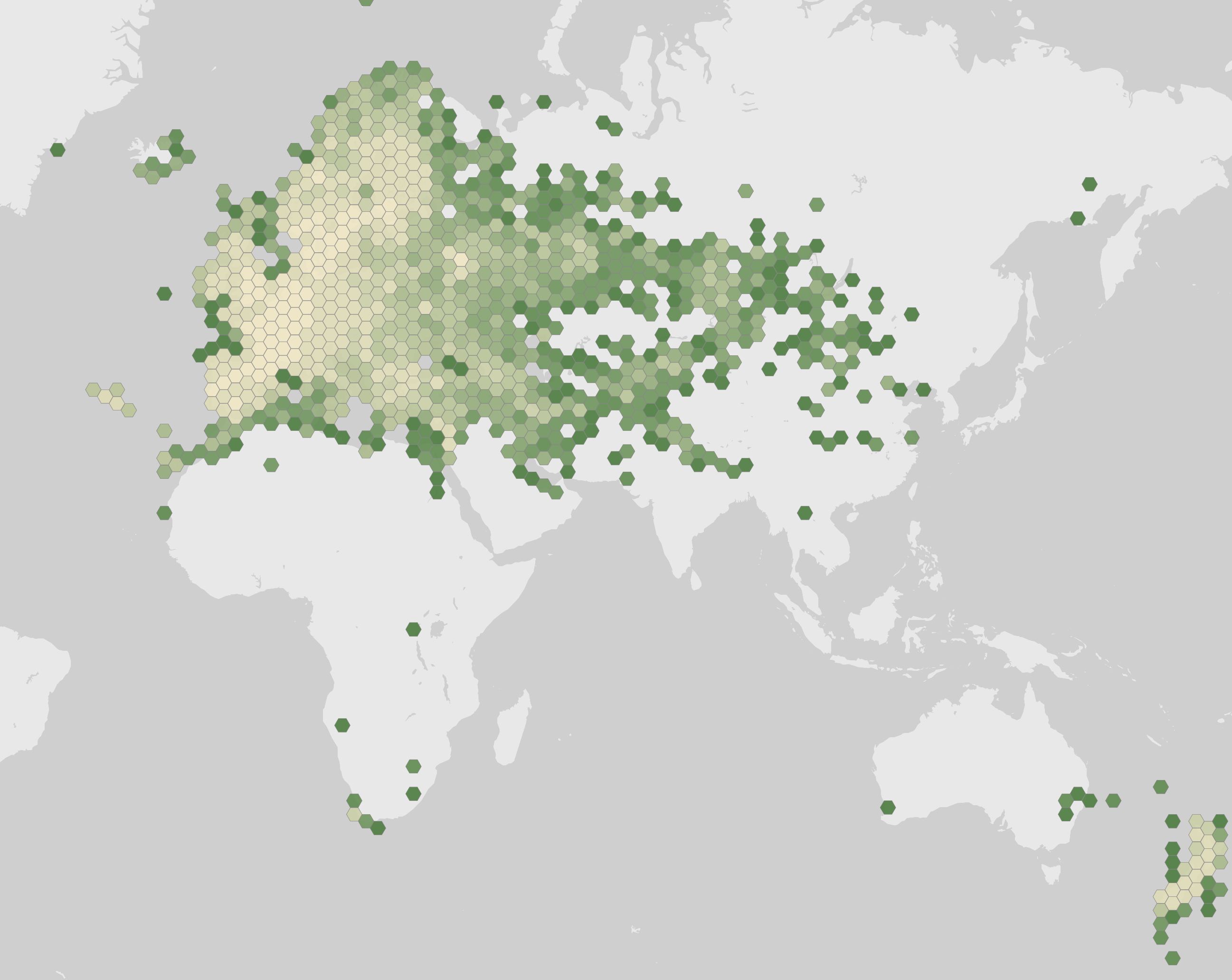
The Eurasian Chaffinch breeds across most of Europe and eastward through temperate Asia as far as the Angara River and the southern end of Lake Baikal in Siberia, generally confined to wooded areas where the July temperature averages between 12 and 30 °C. It favors woodland, but also breeds readily in gardens and parks close to people.
British colonists introduced the species to several overseas territories in the second half of the 19th century. In New Zealand it had colonized both the North and South Islands by 1900 and is now one of the most widespread and common passerines in the country. A much smaller introduced population survives around Constantia, Hout Bay, Pinelands, and Camps Bay in Cape Town, South Africa.
The chaffinch is not migratory across the milder parts of its range, but it vacates colder regions in winter and forms loose flocks, sometimes mixing with bramblings. It occasionally turns up as a vagrant in eastern North America, though some of these sightings may involve escaped cage birds rather than genuine wanderers.
Monthly observation counts peak sharply in April and May, coinciding with the breeding season when birds are most visible and vocal, and drop through the summer and autumn months before rising again toward winter. These figures reflect where and when the species is recorded, not its total abundance or full range.
Communication
Male chaffinches typically sing two or three distinct song types, and these songs vary by region into recognizable dialects. The British ethologist William Thorpe used the species to show that young birds must hear an adult male's song during a critical period after hatching or they will never learn to sing it properly. Thorpe also found that castration silences an adult male's song entirely, while injecting testosterone can make a castrated bird sing even in November, well outside its normal singing season.
Chaffinches also use between two and eight distinct calls, some shared by both sexes year-round and others restricted to the breeding season. The flight call (tupe) and the separation-alarm call (chink) are heard throughout the year, while the seep call is used only by females and the kseep and tchirp calls only by males during breeding. A harsh zzz call accompanies attacks on intruders near the nest, and seee and uh-weet calls signal the presence of predators.
The uh-weet call was once thought to predict rain, but more recent observations link it more closely to predators near calling males, particularly when females are nearby, than to weather.
Diet and Nutrition
Outside the breeding season, chaffinches feed mainly on seeds and other plant material gathered on the ground, often in large flocks in open country. They rarely take food directly from plants and almost never use their feet to hold or manipulate food.
During the breeding season the diet shifts sharply toward invertebrates, especially defoliating caterpillars. Birds forage up in trees at this time and occasionally make short sallies into the air to snatch flying insects.
Nestlings eat nothing but invertebrates, a mix of caterpillars, aphids, earwigs, spiders, and beetle grubs, reflecting the high protein demands of rapid chick growth.
Nesting and Breeding
Chaffinches breed for the first time at one year old and are mainly monogamous, with pair bonds in resident populations such as F. c. gengleri sometimes carrying over from one year to the next. Timing depends on spring temperature, running earlier in southwest Europe and later in the northeast; in Great Britain most clutches are laid between late April and mid-June. A male attracts a female into his territory through song.
The female alone builds the nest, usually in the fork of a bush or tree several meters above ground. It has a deep cup lined with fine roots and feathers, an inner layer of moss and grass, and an outer coating of lichen bound with spider silk.
Eggs are laid at daily intervals in early morning until the clutch of typically 4 to 5 eggs is complete. They vary widely in color, from pale blueish-green to light red with purple-brown blotches or streaks, averaging 19 by 15 mm and weighing about 2.2 g. The female incubates alone for 10 to 16 days.
Chicks hatch nearly naked with closed eyes and are brooded by the female for about six days while both parents feed them, mainly on caterpillars. Young fledge 11 to 18 days after hatching and disperse, but both parents continue feeding them for roughly three more weeks. Second broods are rare and, when they occur, always use a freshly built nest.
Population and Ecological Role
Nest predation is a constant pressure on chaffinches: crows, red and grey squirrels, domestic cats, and probably stoats and weasels all take eggs and nestlings. Clutches started later in spring suffer less predation, likely because thicker vegetation makes nests harder to find by then. Unlike its close relative the brambling, the chaffinch is never parasitized by the common cuckoo.
The species has also played an unwitting role in spreading disease. The protozoal parasite Trichomonas gallinae, long known in pigeons and raptors, began turning up in dead European greenfinches and chaffinches in Great Britain in 2005. It reached Norway, Sweden, and Finland by 2008 and Germany a year later, likely carried by chaffinches that breed in northern Europe and winter in Britain. Greenfinch numbers fell noticeably after the outbreak, but chaffinch populations showed no significant decline despite carrying the parasite.
A separate condition, caused by the Fringilla coelebs papillomavirus, produces tumors ranging from small nodules to large growths on the feet and legs. It remains uncommon: a 1973 Dutch study found papillomas in only 330 of roughly 25,000 chaffinches screened.
Conservation and Threats
The Eurasian Chaffinch is classified as Least Concern by the IUCN, a status supported by an extensive breeding range of about 7 million square kilometers and a very large population. Europe alone holds an estimated 130 to 240 million breeding pairs, and once Asian populations are included, the total may run between 530 and 1,400 million individuals.
There is no evidence of any serious overall decline across this range, which is the main reason the species avoids a higher threat category despite localized disease outbreaks affecting related finches.
Conservation status
- LC
- NT
- VU
- EN
- CR
Least Concern
Cultural Significance
In Finnish and Estonian mythology, the chaffinch appears as the soul-bird, believed to carry the soul of the deceased up through the firmament toward the Polar star into the underworld, placing it alongside figures such as the giant eagle Kokko and the swans of Tuonela.
In England, the chaffinch was once a popular caged songbird, trapped and sold in such numbers that by the late 19th century the practice had depleted populations in London's parks. Samuel Orchart Beeton's 1882 guide to caged birds even recommended one as a cure for a sulky boy, and competitions were held betting on how many times a caged bird would repeat its song. Some birds were cruelly blinded with a hot needle in the mistaken belief this improved their singing, a practice condemned in Thomas Hardy's poem
Fun Facts
- The chaffinch's song is not instinctive but learned: William Thorpe's research in the 1950s showed that young birds pick up their song pattern by listening to others, making it one of the clearest early examples of culturally transmitted behavior in birds.
- Populations separated by roughly 1,000 kilometers can develop distinct regional song dialects, a pattern researchers describe as macrogeographical variation in the chaffinch's vocal culture.
- Males and females look strikingly different: the male wears a blue-grey cap and rust-red underparts, while the female has much more subdued, muted tones.
- Despite their different coloring, both sexes share the same field marks: two contrasting white bars on each wing and white edges along the sides of the tail.
- The male's song is delivered from exposed perches with a notably strong voice, a display used to attract a mate during the breeding season.
Ecology
Habitat
- Woodland
- Urban
Behavior
- Territorial
- Social
- Migratory
Diet
- Omnivore
Photos
SourcesGBIFiNaturalistWikidataWikipediaEncyclopedia of LifeAnAge