The European hedgehog is a spiny insect eater that many people know from their own gardens. It lives across Europe, from Iberia and Italy north into Scandinavia and west into Ireland, and it copes with many kinds of habitat. Its IUCN status is Near Threatened, even though the species remains widespread.
An adult averages about and measures about in body length. Its body is covered in spines, and it curls into a tight ball when threatened. Its lifespan can reach at most.
Identification and Appearance
The most useful field mark is the coat of spines. Up to about 6,000 brown and white spines cover most of the body, which gives the animal a brownish look from a distance.
Adults are large for a hedgehog. Head and body length reaches 260 mm (about 10 inches) or more in large adults, while the tail is almost absent, at only 20 to 30 mm. Weight changes sharply with the seasons. Animals are heaviest in autumn, when they build fat reserves, and they are lightest after hibernation. Males are slightly larger than females, but the seasonal change in weight is far greater than the difference between the sexes.
Where it lives alongside the northern white-breasted hedgehog, the two species are hard to tell apart in the field. The northern species has a white patch on its chest, which the European hedgehog lacks.
Pale 'blonde' individuals with black eyes and creamy spines occur now and then. They are rare, except on North Ronaldsay and Alderney, where about a quarter of the population is thought to be blonde.
Distribution and Habitat
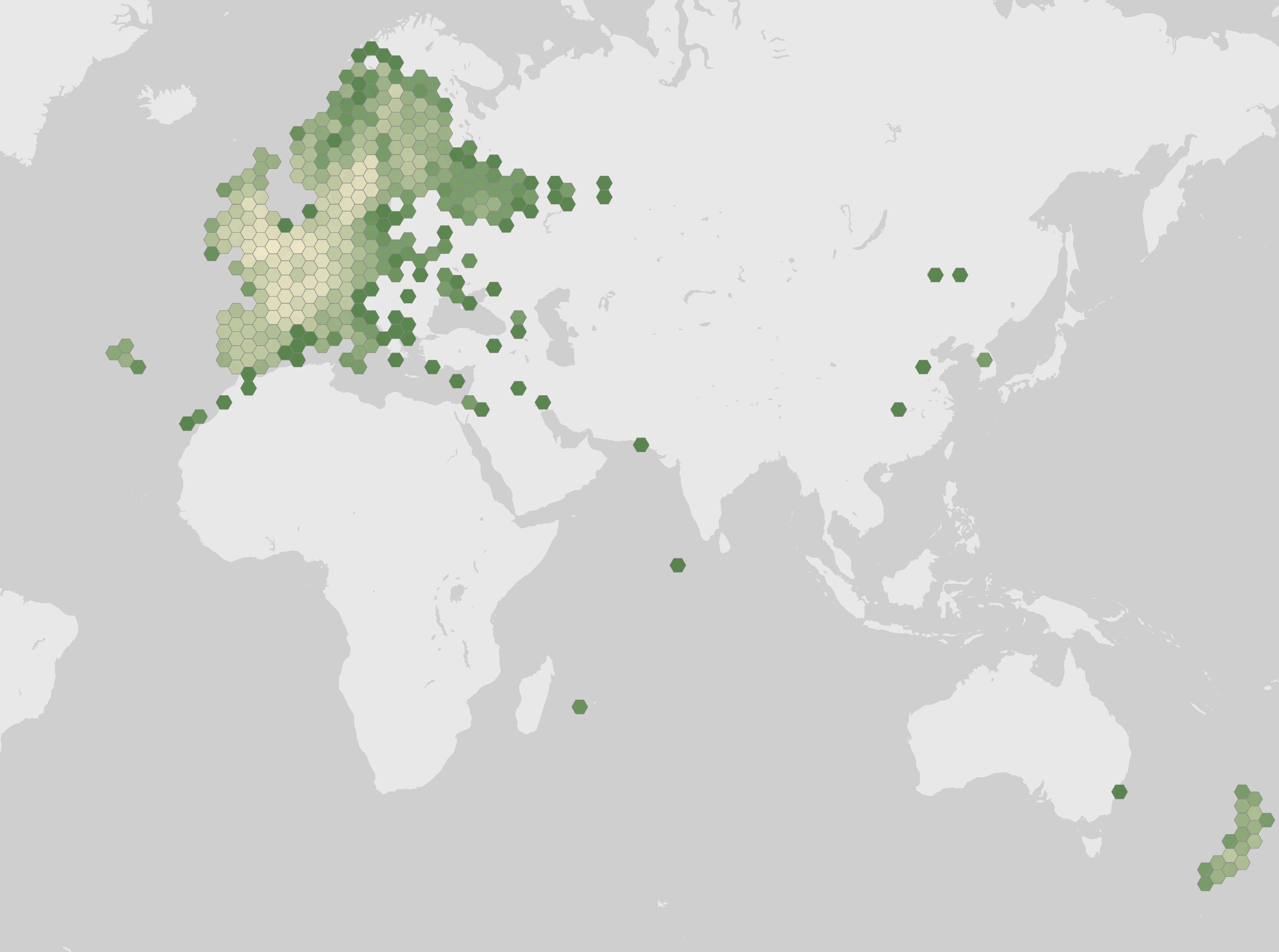
The European hedgehog is native to Europe. Its range runs from Ireland and the Iberian Peninsula east through much of western and central Europe, and from southern Fennoscandia and the northern Baltic to north-west Russia. It also lives on Mediterranean islands such as Corsica, Sardinia, Elba and Sicily, and on many Atlantic and British islands.
It occupies a broad range of lowland habitats that offer enough cover for nesting. These include woodland edges, meadows, pasture, arable land, orchards and vineyards, and it is common in parks, farmland and gardens. It prefers lowlands and hills up to about 600 m, and it is found locally on mountains, reaching as high as 2,000 m in the Alps and Pyrenees.
Hedgehogs are most abundant in gardens, parks and other green spaces close to human settlements. They are scarce in marshes and moorland, where suitable sites and materials for winter nests are lacking.
Observations peak in August, though this reflects where and when people see hedgehogs rather than how many live there.
Behavior and Lifestyle
The European hedgehog is nocturnal. It spends the day resting in a shallow nest of leaves, grass, twigs or pine needles, and it leaves the nest after dark to forage. Its gait is hesitant, and it often stops to sniff the air.
It is mostly solitary and does not defend a territory. Home ranges are large and hard to defend, so animals roam widely at night. The average home range is about . Males cover up to twice the area of females. Where food is plentiful, as in gardens, the ranges can be much smaller. Several animals may use the same nest, though never at the same time, and they may share urine sites. Aggressive encounters between individuals have not been seen.
In colder areas, hedgehogs begin looking for insulated nests as days shorten, and they usually hibernate from October to April. Warmer areas see hibernation only in the harshest winters. Animals store fat to keep warm and to fuel periodic waking. These breaks occur every one to two weeks and last one to two days, when the animal feeds and urinates. Captive hedgehogs with enough food may not hibernate at all.
When threatened, a hedgehog curls into a ball that exposes its spines and protects its face and belly. It is also a capable swimmer and climber, and it can squeeze through narrow gaps.
Communication
European hedgehogs are not especially noisy. They mostly make grunts, snorts and hoarse squeaks. Adults vocalize during mating, while feeding, and sometimes when they are handled. Young squeak and whistle while they are in the nest.
Because the animal is active at night, it relies heavily on smell and hearing. It has a well-developed sense of smell and a Jacobson's organ in the roof of its mouth, which may play a role in social behavior. Both sexes have several kinds of scent glands, and they communicate through pheromones and scent marks.
Studies of the related long-eared hedgehog show that it can hear sounds up to 45 kHz. The hearing of the European hedgehog itself has not been well studied.
Diet and Nutrition
The European hedgehog is omnivorous, but insects make up most of its food. It favors beetles, ants, bees, wasps, earwigs, moths and butterflies. Crickets, grasshoppers, cockroaches, snails, earthworms and eggs also appear in its diet. Small animals such as lizards, snakes, frogs and small rodents are eaten less often, and it also takes carrion. About four-fifths of its food is invertebrates and about one-fifth vertebrates. Plant material is a small part of the diet, including seeds, grains, nuts and fruit.
Its prey includes rodents, passerine birds, lizards and snakes, frogs, and other hedgehogs. These are taken when they are available, while insects remain the staple. Because it eats slugs and snails, many gardeners welcome it.
Reproduction and Raising Young
Mating begins in late spring, usually April or May, when hedgehogs leave hibernation. Males wake three to four weeks before females and enlarge their home ranges to find mates.
Courtship is slow. A male circles a female while she lowers her head and makes snorts, grunts and hisses. He may circle for several hours and make several attempts to mount. If she refuses him repeatedly, he leaves. If she accepts, she flattens her spines and lowers herself to the ground. The male climbs onto her back and holds her shoulder with his teeth. Males and females both mate with several partners in a season, and the male does not take part in raising the young.
Gestation lasts about . A litter usually has four to six young, and the range runs from two to ten. Females average about per litter and about per year, with a second litter born later in the year. The later litter has a poorer chance of surviving winter.
The female raises the young alone. Newborns are blind and have soft spines hidden under a fluid-filled skin, which is absorbed within a day. The spines are soon visible, and by about 11 days the young can roll into a ball. Their eyes open at about three to four weeks, and they are weaned at about . Young become independent after weaning and can breed by about of age.
Population and Ecological Role
Britain holds an estimated 1,550,000 hedgehogs, with about 1,100,000 in England, 310,000 in Scotland and 140,000 in Wales. This estimate is uncertain, since it rests on limited density data for different habitats.
In the wider ecosystem, hedgehogs feed on many invertebrates, and they may help control insect pests in some areas. They are also hosts to nematodes, trematodes, acanthocephalans, ticks and fleas. Badgers are the main predator in Britain and compete with hedgehogs for some of the same food. Foxes, wolves, polecats, genets and pine martens also prey on them, along with large owls.
Conservation and Threats
The IUCN classifies the European hedgehog as Near Threatened and its population as stable overall. Local populations are declining fast in Britain, where the species was added to the Biodiversity Action Plan in 2007. A survey of road casualties found an annual drop of about 7% between 2001 and 2004. An assessment of British monitoring data estimated that 25% of the population was lost in a decade, and rural populations are thought to have fallen by at least half since 2000.
Road deaths are a common threat, and dogs hunt hedgehogs in some areas, such as Sardinia. Loss of suitable nesting and hibernation sites also limits numbers. In Britain, the reasons for the decline are not fully clear.
In Denmark and Poland the species is protected by law, and it is illegal to capture or harm it. Rehabilitation of sick hedgehogs is allowed. It is protected in all European countries that have signed the Berne Convention on the Conservation of European Wildlife and Natural Habitats.
Outside Europe, the species is a serious pest. In the Western Isles of Scotland, introduced hedgehogs eat the eggs of ground-nesting waders, and in New Zealand they prey on native insects, snails, lizards and ground-nesting birds.
Cultural Significance
Hedgehogs are often kept as pets elsewhere, but the European hedgehog is banned as a pet in Europe. Their broad diet makes them useful for controlling insect pests. They have also been used in research on several diseases, including foot and mouth disease, yellow fever and influenza. Their hair and spines are used to monitor pollutants such as arsenic, lead and cadmium.
Ancient Romans raised hedgehogs for meat and used their spiny coats in training work animals. Traditional remedies and rituals involving hedgehogs were also common in the past.
From the early 1950s until the 1980s, the hedgehog was an unofficial symbol of NATO in many countries, where it stood for a peaceful animal that bristles when defended.
Photos
Photographs from via iNaturalist, licensed under CC0 1.0., by Vasco Henrique Oliveira Fonseca via iNaturalist, licensed under CC BY 4.0., by Geoffroy Couasnet via iNaturalist, licensed under CC BY 4.0., by Lauren Gore via iNaturalist, licensed under CC BY 4.0., by Leon Haag-Fank via iNaturalist, licensed under CC BY 4.0., by Florin Feneru via iNaturalist, licensed under CC BY 4.0., by Avery Kendra via iNaturalist, licensed under CC BY 4.0., by Buckelkopfcichlide via iNaturalist, licensed under CC BY 4.0., and by Valentin Moser via iNaturalist, licensed under CC BY 4.0., credited on each photo.
Ecology and classification
Classification
- Phylum
- Chordata
- Class
- Mammalia
- Order
- Erinaceomorpha
- Family
- Erinaceidae
- Genus
- Erinaceus
- Species
- Erinaceus europaeus
Sources
- GBIF Species names and classification
- iNaturalist Photos
- Wikidata Common names and conservation status
- Wikipedia Summary extract
- Encyclopedia of Life Habitat, diet and behavior traits
- Animal Diversity Web Animal habitat, behavior and diet
- AnAge Longevity
- COMBINE Mammal size, lifespan, breeding, diet and activity
- GloBI What it eats, what eats it, parasites and pollinators
- trophiCH
- Wardeh et al. 2015 (EID2)
- HWML Parasite Collection
- CarniDIET
- TETRA-EU