Few mammals spend their lives as completely hidden as the European mole. It digs extensive tunnel networks through soil, and its burrow systems can stretch up to half a kilometer.
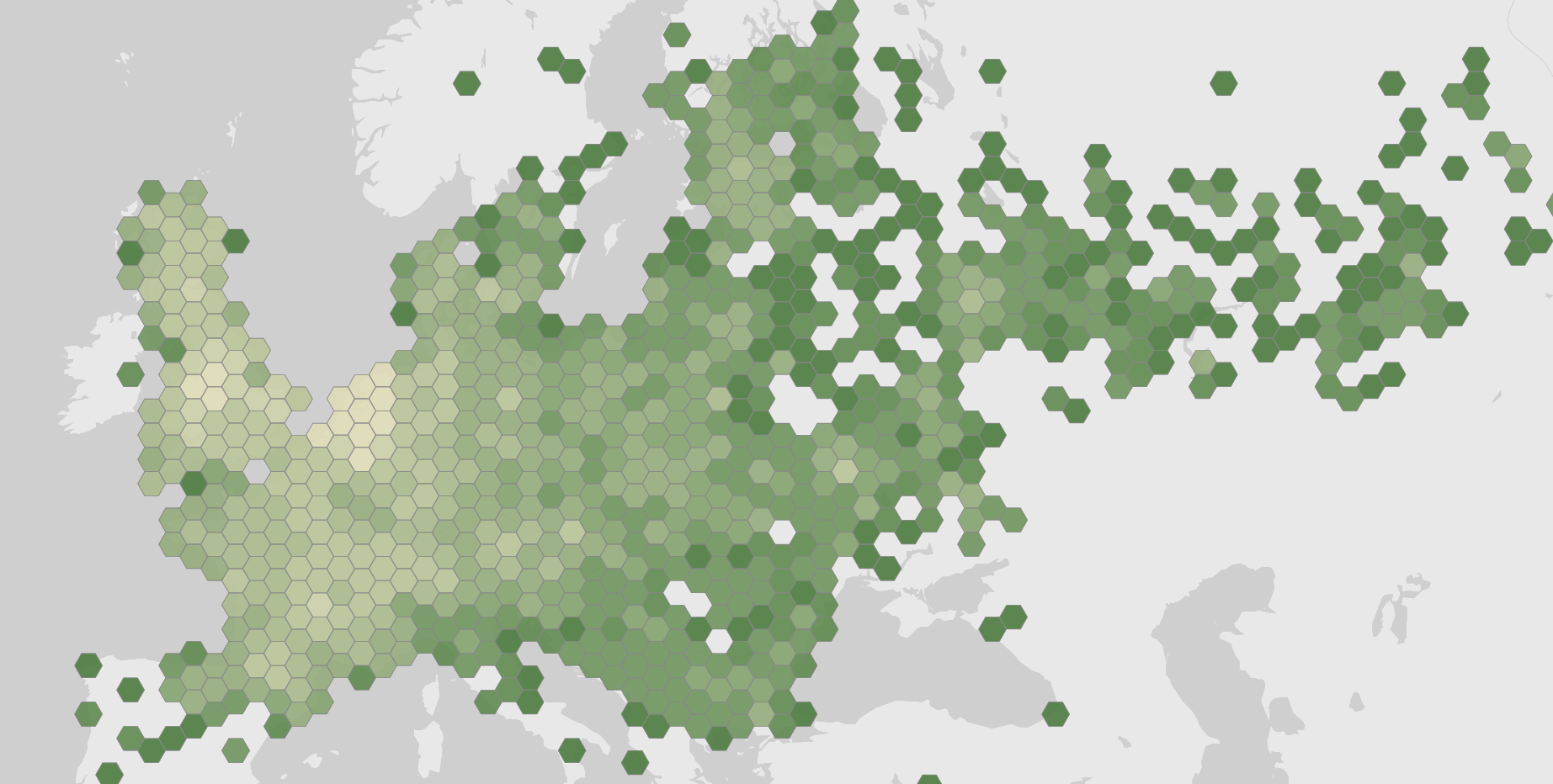
The European mole is a small insectivorous mammal of the family Talpidae. It is found across much of Europe and into westernmost Asia, from the United Kingdom and southern Scandinavia south to northern Greece and east to western Siberia. It lives in soils deep enough for tunneling, and its conservation status is Least Concern.
The species is worth reading about for its specialized underground life: its tunnels are reused for generations, and its digging helps aerate the soil it lives in.
Identification and Appearance
The most useful field mark is the body itself: a cylindrical, velvety-furred animal with broad, paddle-like front feet. Its eyes are so small they are hidden behind fur, and its ears are little more than ridges in the skin.
An adult measures about 11 to 16 cm in length and weighs about 70 to 130 g. Females are typically smaller than males.
The fur is usually dark grey, but colors vary widely. White, light grey, tan, taupe and black moles have all been seen, because fur color gives little disadvantage to an animal that lives underground.
Distribution and Habitat
The European mole occurs across a broad range of Europe and westernmost Asia. In most of this range it is the only mole species present.
It lives in habitats with soil deep enough for tunneling, including arable fields, deciduous woodland and permanent pasture. It rarely occurs in coniferous forests, sand dunes or moorland, where invertebrate prey is scarce.
In sandy soils and newly cultivated land, it makes shallow, temporary surface tunnels. In stable soils it builds permanent networks at varying depths, and the deepest tunnels are used most in drought and cold weather.
The Loire River in France was once thought to separate it from the Aquitanian mole. The boundary is not strict, since members of both species have been found on opposite sides, so the two may live side by side in places. In suitable urban greenspace, about 10 hectares are needed for a population to persist.
Behavior and Lifestyle
The European mole is adapted for a fossorial life. Its front limbs are strongly modified for digging, and it spends most of its time in burrows used for feeding, food storage and nesting.
It is mainly active at night, with about three periods of rest and three periods of activity in each 24 hours. It searches for food both in its tunnels and near the surface, and it moves to deeper, warmer soil as the weather turns cold.
Moles live alone except during the breeding season, and they defend their territory. Their home ranges are about 300 to 3,000 square meters. Males and females build tunnels differently: females make irregular networks, while males dig long, straight tunnels with branches.
Moles build structured mounds called fortresses, which at times contain more than 750 kg of soil. Inside them are one or more nest chambers lined with dry grass or dead leaves. Two moles that meet outside the breeding season usually fight, but such meetings are rare, so neighbors seldom come into conflict.
Communication
Moles communicate mainly through scent. They mark their territory with urine, and both sexes have a pair of scent glands beneath the skin.
The glands are slightly larger in males, but they grow in both sexes during the breeding season. This growth points to scent as an important way of finding a mate.
Moles also sense their surroundings through touch and vibration, and chemical cues play a role in how they perceive the world.
Diet and Nutrition
European moles are insectivores that feed on invertebrates. They find food in three ways: digging through soil, moving through their burrow systems, and searching the ground surface. The mix depends on soil conditions and the experience of the individual.
Earthworms are the main food where they make up most of the soil animal biomass. Where worms are scarcer, insects become the main food, and moles eat both larval and adult insects.
Most of their active time goes into searching for food. Millipedes and other annelid worms are among the other main prey groups, while centipedes, spiders and snails are taken less often.
Reproduction and Raising Young
Mating takes place in a short spring breeding season, usually from March to May. Females become easier to identify during this time, and the internal sex organs of both sexes grow considerably. Males travel farther than usual in search of mates, moving through existing tunnels or digging new ones.
Females usually give birth to a single litter a year, and most births come in mid to late April. The gestation period is about . Each litter has two to seven young, born blind and hairless.
The mother nurses her young for about . Fur begins to grow at about 14 days, and the eyes open at about 22 days. The young leave the nest at about 33 days and disperse above ground around five or six weeks after birth, which is when they are most exposed to predators.
Moles reach sexual maturity in the spring after their birth, and they can live up to .
Population and Ecological Role
Moles are common across their range. An estimated 35 to 40 million moles live in the United Kingdom alone.
Moles shape their ecosystem by digging. Their tunnels aerate the soil, and they feed on insects and earthworms. Their abundance in a given area depends mainly on how many earthworms are present.
Moles also form part of the food web. Foxes, wolves, jackals, weasels, martens and several bird groups, including herons, storks and birds of prey, take them as prey. They also host fleas, ticks and other parasites.
Conservation and Threats
The European mole is assessed as Least Concern on the IUCN Red List. This means it is common and widespread throughout its range and is not considered at risk at present.
It has no special status under US federal law, under CITES, or on the State of Michigan list. Its large range and common presence give it a stable outlook.
Its populations are not described as under pressure from a particular threat, so the species needs no specific protection at present.
Cultural Significance
Moles help people in farming and gardening. They control some kinds of injurious insects, and their digging may improve soil fertility by aerating it.
Moles appear in fiction, often as talking characters. The Little Mole is a fictional example, and Mole is one of the main characters in The Wind in the Willows.
Photos
Photographs from by Shane Austin via iNaturalist, licensed under CC BY 4.0., via iNaturalist, licensed under CC0 1.0., by Алексей Логинов via iNaturalist, licensed under CC BY 4.0., by Николай Соболев via iNaturalist, licensed under CC BY 4.0., by CaracalShan via iNaturalist, licensed under CC BY 4.0., by Kai Löhr via iNaturalist, licensed under CC BY 4.0., by Maryna Burlaka via iNaturalist, licensed under CC BY 4.0., by Ondřej Křivan via iNaturalist, licensed under CC BY 4.0., by Paulius Rupšas via iNaturalist, licensed under CC BY 4.0., by Jose Gutierrez Higa via iNaturalist, licensed under CC BY 4.0., and by Julia Palmer via iNaturalist, licensed under CC BY 4.0., credited on each photo.
Ecology and classification
Behavior
- Nocturnal
- Burrowing
- Solitary
- Territorial
Diet
- Insectivore
Classification
- Phylum
- Chordata
- Class
- Mammalia
- Order
- Soricomorpha
- Family
- Talpidae
- Genus
- Talpa
- Species
- Talpa europaea
Sources
- GBIF Species names and classification
- iNaturalist Photos
- Wikidata Common names and conservation status
- Wikipedia Summary extract
- Encyclopedia of Life Habitat, diet and behavior traits
- Animal Diversity Web Animal habitat, behavior and diet
- AnAge Longevity
- COMBINE Mammal size, lifespan, breeding, diet and activity
- GloBI What it eats, what eats it, parasites and pollinators
- trophiCH
- MammalBase
- HWML Parasite Collection
- CarniDIET
- TETRA-EU