The European robin is a small songbird that sings through the winter, and in Britain and Ireland it is a familiar bird of gardens. Its orange breast and face mark it out across a range that stretches from North Africa to Western Siberia.
The European robin, Erithacus rubecula, is a small insectivorous passerine in the Old World flycatcher family Muscicapidae. Birds in the west and south of its range stay put, while those in the north and east migrate where winters are harsher. The International Union for Conservation of Nature rates the species Least Concern.
Identification and Appearance
The orange breast and face are the robin's most useful field mark. Adults measure 12.5–14.0 cm, with a wingspan of 20–22 cm, and a typical adult weighs about .
Both sexes look alike. The orange is bordered by bluish grey on the sides of the neck and chest, the upperparts are brown or olive-tinged in British birds, and the belly is whitish. The bill and eyes are black and the legs and feet are brown. The British subspecies E. r. melophilus has a more strongly colored breast.
Juveniles are spotted brown and white, and patches of orange appear gradually. Migrants from Scandinavia and Russia can be told apart by the greyer tone of their upperparts and a duller orange breast.
Distribution and Habitat
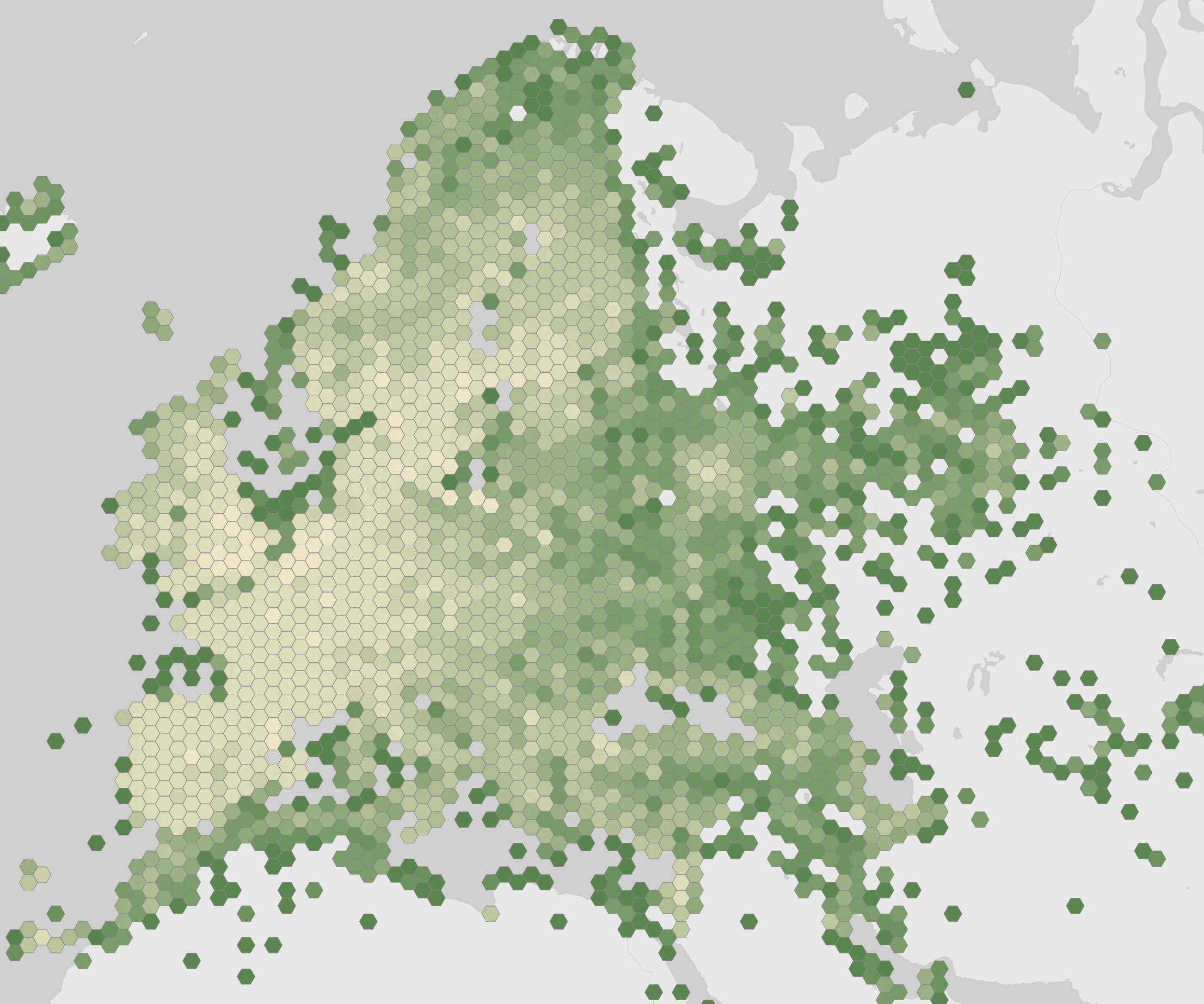
The European robin occurs across Eurasia, from Western Siberia in the east to Algeria in the south. In the southeast its range reaches Iran and the Caucasus mountains, and on the Atlantic it extends to the Central Group of the Azores and to Madeira. It is a vagrant in Iceland.
In Britain and Ireland most robins stay year-round, though a small share, usually females, migrate to southern Europe in winter, with some going as far as Spain. Birds from Scandinavia and Russia move west to Britain and western Europe to escape harsh winters. Continental winter migrants favor spruce woods in northern Europe, while in Great Britain the species prefers parks and gardens.
In southern Iberia, resident and migrant robins occupy separate habitats, and resident birds remain in the same woodlands where they bred. The habitats named for the species include forest, parks and gardens.
Attempts to introduce the robin to Australia and New Zealand in the late 19th century failed. Birds released near Melbourne, Auckland, Christchurch, Wellington and Dunedin did not become established. Releases on Long Island, New York (1852), in Oregon (1889–1892) and on the Saanich Peninsula in British Columbia (1908–1910) also failed to produce lasting populations. Presence observations peak in April.
Behavior and Lifestyle
The robin is diurnal, although it is known to hunt insects on moonlit nights or near artificial light. In Britain and Ireland it is relatively unafraid of people and follows gardeners who dig, looking for earthworms and other food freshly turned up. Robins also approach large wild animals such as wild boar, which disturb the ground and bring food to the surface.
In continental Europe, robins were hunted and killed like most small birds, so they are far more wary there. In Britain and Ireland they were long regarded as a gardener's friend and were never harmed, partly because of the traditional link between the red of their breasts and the blood of Christ.
Males are highly territorial and fiercely attack other males and competitors that enter their territory. They sometimes attack other small birds for no apparent reason, and they will even attack their own reflection. Territorial disputes can be fatal and account for up to 10% of adult robin deaths in some areas.
Robins have a high mortality in their first year, and the average life expectancy is 1.1 years. Once past that first year, survival improves, and the longest known life for the species is about , a figure that often comes from captive birds. A spell of very low winter temperatures can raise mortality. The avian magnetic compass of the robin uses vision-based magnetoreception, in which the bird's sense of the Earth's magnetic field is affected by the light entering its eye.
Communication
Robins sing a fluting, warbling song during the breeding season. Both males and females sing throughout the year, including in winter, when they hold separate territories. The winter song is more plaintive than the summer version.
In the breeding season, males usually begin their morning song about an hour before civil sunrise and usually stop around thirty minutes after sunset. Urban robins in artificially lit areas may also sing at night, and some sing after dark to avoid daytime noise.
The male keeps the same territory all year, while the female moves a short distance from her summer nesting territory to an area better suited to winter feeding.
Recordings
song · France · Lionel Triboulin · Public domain
nocturnal flight call · France · Philippe Grange · Public domain
aberrant, song, atypique · France · Philippe Grange · Public domain
dawn song, chant d'automne · France · Philippe Grange · Public domain
song · France · Philippe Grange · Public domain
Diet and Nutrition
Terrestrial invertebrates form the core of the robin's diet. Its main prey includes flies, such as hoverflies and long-legged flies, along with spiders and worms. Lizards are also a main food group among its vertebrate prey.
In autumn and winter, robins add berries, fruit and seeds to their insect diet. They also eat seed mixtures and suet placed on bird tables, as well as scraps left by people.
The robin is an omnivore and is known to take small vertebrates, including fish, and carrion. Its diet varies with the season, shifting toward plant foods when insects are scarce.
Nesting and Breeding
Robins nest in many places. They will use any spot that offers shelter, such as a hollow or a crevice, and they also nest in sheltered banks, machinery, barbecues, bicycle handlebars, upturned brooms, discarded kettles, watering cans, flower pots and hats. Nest boxes with an open front, placed in a sheltered spot up to 2 metres (6 ft 7 in) above the ground, are also used. Nests are built from moss, leaves and grass and lined with fine grass, hair and feathers.
In Britain and Ireland the breeding season begins in March. Robins lay two or three clutches of five or six eggs over the season. The eggs are cream, buff or white, speckled or blotched with reddish-brown, often more heavily at the larger end.
Juveniles leave the nest with entirely mottled brown plumage. After two to three months, the young bird grows orange feathers under its chin, and the patch spreads over a similar period until the adult red-orange breast is complete.
Population and Ecological Role
The European robin is abundant across its range, with a population in the hundreds of millions. Its numbers appear to be increasing, and it is a common food for predators. Carnivorous mammals such as the least weasel, the wildcat and martens take robins, as do birds of prey such as the Eurasian kestrel, and the robin is also eaten by the jay and the nutcracker.
The robin also hosts parasites. Arachnids are its main parasite group, including a mite named Trouessartia rubecula.
As an insect eater, the robin helps control populations of flies and other invertebrates in its woodlands, gardens and parks.
Conservation and Threats
The IUCN rates the European robin as Least Concern. Its range covers about , and its population numbers in the hundreds of millions.
The species does not approach the vulnerable thresholds of a population decline greater than 30% over ten years or three generations. Its population appears to be increasing.
Mortality is highest in the first year of life. Very cold winter spells raise death rates, and territorial fights account for up to 10% of adult deaths in some areas.
Photos
Photographs from by Andrea via iNaturalist, licensed under CC BY 4.0., by Lars Willighagen via iNaturalist, licensed under CC BY 4.0., by Ross McCallum via iNaturalist, licensed under CC BY 4.0., by Justin Philbois via iNaturalist, licensed under CC BY 4.0., by Karen Offereins via iNaturalist, licensed under CC BY 4.0., by Coralie via iNaturalist, licensed under CC BY 4.0., by Nikhil R R via iNaturalist, licensed under CC BY 4.0., by Richard Nuttall via iNaturalist, licensed under CC BY 4.0., by Alexander Bach via iNaturalist, licensed under CC BY 4.0., by Leonardo Rapisarda via iNaturalist, licensed under CC BY 4.0., by Jess Hughes via iNaturalist, licensed under CC BY 4.0., by William Stephens via iNaturalist, licensed under CC BY 4.0., and by Andrew Bazdyrev via iNaturalist, licensed under CC BY 4.0., credited on each photo.
Ecology and classification
Classification
- Phylum
- Chordata
- Class
- Aves
- Order
- Passeriformes
- Family
- Muscicapidae
- Genus
- Erithacus
- Species
- Erithacus rubecula
Sources
- GBIF Species names and classification
- iNaturalist Photos
- Wikidata Common names and conservation status
- Wikipedia Summary extract
- Xeno-canto Audio recordings
- AnAge Longevity
- AVONET Bird mass, habitat, migration, diet and range size
- GloBI What it eats, what eats it, parasites and pollinators
- trophiCH
- Wardeh et al. 2015 (EID2)
- DoPI
- TETRA-EU