A colony of European yellow-tailed scorpions has clung to the walls of Sheerness Dockyard in Kent for close to two centuries, making it the northernmost wild scorpion population outside the Americas.
Euscorpius flavicaudis is a small, dark scorpion native to Southern Europe and Northwest Africa, where it shelters in dry cracks and crevices away from human disturbance. It carries no special conservation status, but its unlikely foothold in the United Kingdom makes it one of the more improbable success stories among Europe's arachnids.
What makes this species worth a closer look is not size or venom, but persistence: a Mediterranean crevice-dweller that has quietly endured English winters inside dockyard mortar for generations.
Identification and Appearance
The clearest field mark is the color contrast between a black body and yellow-brown legs and tail, which gives the species its common name. Adults measure about 35–45 mm long, a genuinely small size for a scorpion, and the body carries this two-tone pattern consistently.
The pedipalps, or claws, are relatively large and strong for an animal this size, while the metasoma (tail) is notably short and thin rather than thick and curled. This combination of heavy claws and a slight tail hints at how the species subdues prey: through grip rather than sting.
Fine sensory hairs cover much of the body, particularly the pedipalps, and function as the scorpion's early-warning system for detecting movement nearby. No consistent differences between males and females in color or size are described, though occasional developmental anomalies occur: at least one juvenile female has been recorded with a double metasoma, an unusual duplication of the tail segment.
Because Euscorpius flavicaudis shares its general scorpion body plan with many relatives, its small size and yellow-tailed coloring are the most reliable ways to distinguish it where its range is known.
Distribution and Habitat
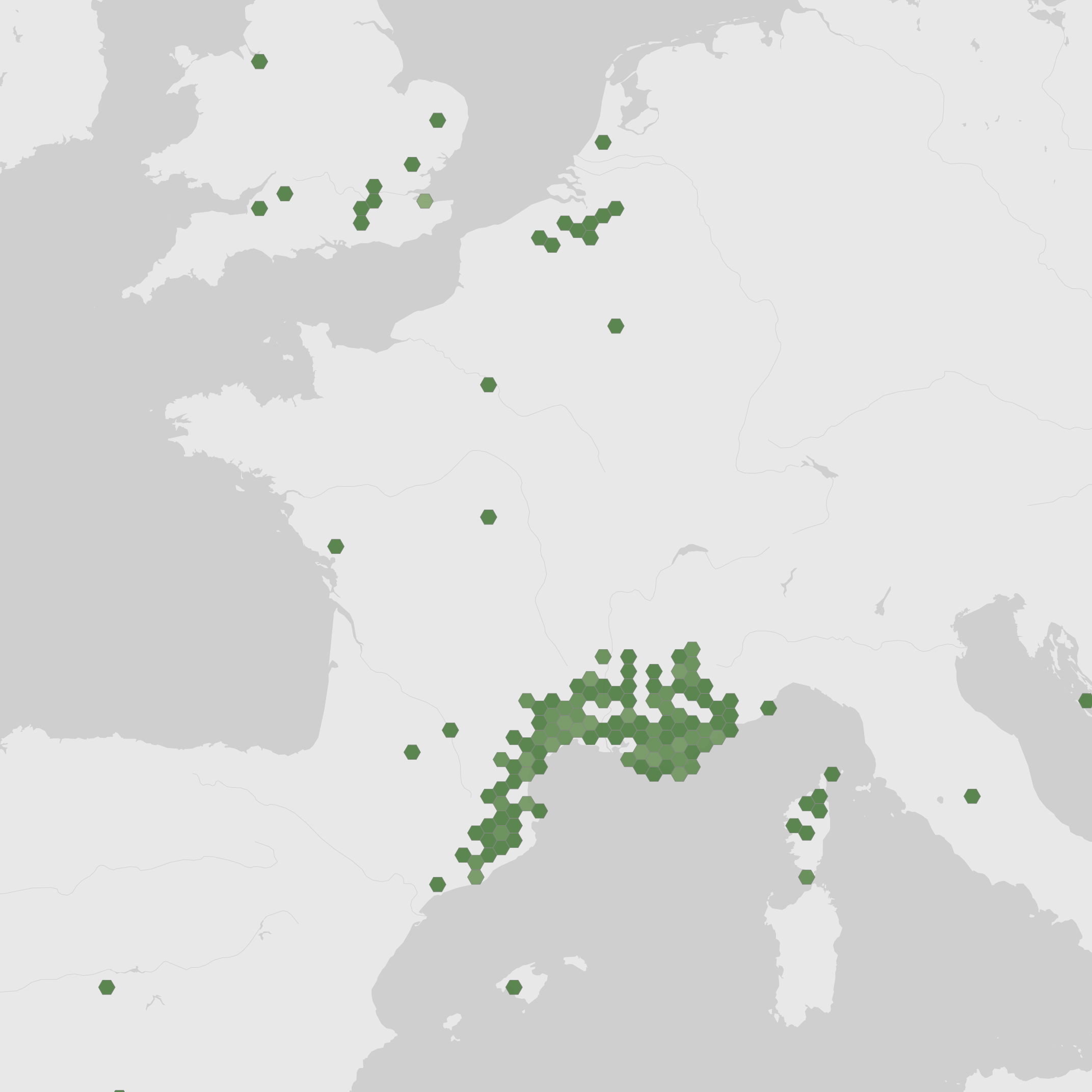
The species is native to Southern Europe and Northwest Africa, but a well-known introduced population survives far outside that range in the United Kingdom, centered on Sheerness Dockyard on the Isle of Sheppey in Kent, with additional records from parts of east London. The introduction is thought to date to the early 19th century, arriving accidentally in a shipment of Italian masonry.
Across its range, Euscorpius flavicaudis favors cracks and crevices, gaps in stonework, and other dark, dry spaces, generally at elevations below 500 meters. It tolerates, and even seems to favor, low levels of human activity, turning up in urban, suburban, and agricultural settings as readily as in more natural habitat. In the UK specifically, it occupies gaps left where mortar pointing has crumbled from old walls.
Monthly observation records show a clear rise in spring, peaking in May, with a secondary increase in August before numbers taper off through autumn and winter. Because these are presence observations rather than counts of actual population size, the pattern most likely reflects when the scorpions are active near the surface and easiest to detect, rather than true seasonal abundance.
Behavior and Lifestyle
Activity follows a strict nocturnal rhythm: the scorpion stays deep in its crack through daylight hours, relaxed and unalert, then moves toward the entrance as dusk falls, becoming visibly more alert with pedipalps extended, claws open, and body raised. Peak activity comes soon after dark. Researchers have described three distinct behavioral states in the species: moving, alert but immobile, and completely unalert, each recognizable by posture.
These scorpions rarely leave the shelter of their crack at all, doing so mainly to feed or to mate, and their willingness to venture out shifts strongly with the seasons. Males become steadily more active as temperatures rise, with activity peaking just before the mating season. Females follow a similar pattern initially but change dramatically after mating, becoming far less active even in warm weather, aside from brief surges right after giving birth and again once their brood is old enough to leave her back.
Hunting behavior is entirely ambush-based: the scorpion positions itself at the mouth of its crevice and waits for prey to wander within reach, usually managing only a single meal per night even though it emerges to hunt every evening. If no prey turns up before dawn, it withdraws empty-handed, a setback the species can apparently absorb thanks to an ability to survive long stretches without food.
Hunting and Diet
As an ambush predator, Euscorpius flavicaudis does not chase down its food; it waits motionless at the entrance to its crevice and relies on sensory hairs covering its pedipalps to detect prey moving nearby. The moment something suitable comes within range, the scorpion strikes quickly, seizing the target with its claws.
Woodlice make up the bulk of its diet, though it will take most small insects that pass close enough. Prey is subdued and killed using the claws rather than the sting; the venomous sting is used only in more intense encounters, such as fights with rivals or prolonged pursuits, and is otherwise held in reserve. Once prey is dead, the scorpion retreats into its crack and eats it head first.
Cannibalism has been documented within colonies of the species: when two scorpions come into conflict, the larger individual invariably wins and eats the smaller one. Feeding opportunities are limited even though the species hunts every night, and it can go for extended periods without a meal when prey fails to appear, usually managing at most one successful catch per night.
Reproduction and Life Cycle
Mating takes place during the warmest months of the year, June through August, with the length of the season tied directly to how long warm weather persists. At the season's start, the female population splits into two groups: females still carrying young from a previous mating and those that failed to mate the year before. Because populations are small and scattered, males that encounter a receptive female tend to guard her closely, even staying in her crack to fend off rival males if she is not yet ready to mate.
Courtship begins with the pair grasping each other's pedipalps and circling together in what is often called the scorpion dance. The male then deposits a spermatophore on the ground and maneuvers the female over it so she can take it up. The mating system is promiscuous, with males often mating multiple times in a season, generally the larger individuals, while females mate at most once per season and sometimes not at all.
Fertilization is internal, and development is ovoviviparous: the female retains the fertilized eggs inside her body for a gestation period of roughly 10 to 14 months, depending on food availability and climate, before finding a secluded, humid spot to give birth. A litter can range from a few young to about 30, born white, soft, and swollen, which climb onto the mother's back immediately after birth.
The young remain riding on the mother until their first molt, at around six days old, after which they begin exploring nearby but stay close to the shelter for several more days. Males take no part in raising the young, leaving soon after mating, while females continue carrying and protecting the brood until it grows too large to fit on her back, generally past two months of age. Young scorpions do not reach adulthood for one to two years.
Conservation and Threats
Euscorpius flavicaudis carries no special conservation status under the IUCN Red List, the US Federal List, or CITES. Rather than reflecting security, this likely reflects how little formal attention the species has received: it occurs in extremely small numbers across its range, and its low density and secretive habits in cracks and crevices make it inherently difficult to survey.
No specific threats or population trend are documented for the species, and no dedicated conservation programs are described either in its native Mediterranean range or in its introduced UK colony at Sheerness, which has instead persisted quietly in dockyard walls since its accidental arrival roughly two centuries ago.
Cultural Significance
Euscorpius flavicaudis has no known economic importance to humans, and it has not developed a documented role in folklore, art, or trade. Its main point of cultural interest lies simply in its unusual presence as a scorpion living wild in Britain, an association tied more to novelty than to symbolism.
Physically, the species shares its basic form, four pairs of banded legs, sensory hairs, and grasping claws, with virtually every other scorpion, and its main distinction noted in available descriptions is simply how small it is compared to its relatives.
Fun Facts
- A juvenile female of this species has been recorded with a double metasoma, an extra tail segment also documented in other scorpions such as Hottentota alticola.
- The UK's Sheerness colony is believed to have arrived hidden in shipments of Italian masonry during the Georgian era, settling directly into the dockyard's stone walls.
- Despite being venomous, this scorpion rarely stings, preferring to subdue prey and rivals with its claws instead.
- Newborn young, sometimes numbering close to 30 in a single litter, ride on their mother's back until they outgrow the space.
- The species can survive long stretches without food, useful given it may hunt every night yet only manage one successful catch.
- Young scorpions take one to two years to reach adulthood, a slow pace of maturity for such a small animal.
- Euscorpius flavicaudis has no known economic importance to humans, unlike scorpion species valued for venom research or the pet trade.
Ecology
Behavior
- Nocturnal
- Predator
- Solitary
- Venomous
Habitat
- Urban
- Disturbed Ground
Diet
- Insectivore
Photos
SourcesGBIFiNaturalistWikidataWikipediaEncyclopedia of LifeAnimal Diversity Web