Fennel has traveled far from its Mediterranean birthplace, turning up along roadsides, riverbanks, and sea cliffs on nearly every temperate continent today. It belongs to the carrot family, Apiaceae, within the order Apiales and the flowering-plant class Magnoliopsida, and it grows as a hardy perennial herb with feathery leaves and clusters of small yellow flowers.
In its native range along Mediterranean shores, fennel favors dry, well-drained soils close to the coast and along river courses, conditions it has since found and exploited across much of the world. Its persistence and adaptability explain why a plant once confined to a single sea's edge is now a familiar sight from European hedgerows to American hillsides.
What makes fennel worth a closer look is the gap between its humble, weedy appearance and its outsized role in kitchens, medicine chests, and mythology across many cultures, a story that unfolds through how it looks, where it grows, and how people have used it.
Identification and Appearance
The single most useful field mark is the plant's fine, thread-like foliage combined with its hollow, glaucous blue-green stem, a combination that sets it apart from coarser relatives in the carrot family. Fennel is an erect perennial that can reach up to 2.1 meters (7 feet) tall, with leaves growing as long as 40 centimeters (16 inches) and dividing into ultimate segments only about 0.5 millimeters wide, giving the foliage a soft, hair-like texture.
The flowers appear in terminal compound umbels 5 to 17.5 centimeters (2 to 7 inches) across, each umbel made up of 20 to 50 tiny yellow flowers on short stalks. These give way to a dry, ribbed fruit (a schizocarp) measuring 4 to 10 millimeters long and roughly half as wide, which carries the plant's signature aroma from volatile oils such as trans-anethole, estragole, fenchone, and limonene, producing a scent that blends licorice, mint, and camphor notes.
Fennel is often confused with dill, coriander, ajwain, and caraway, but those herbs stay much shorter, typically only 40 to 60 centimeters (16 to 24 inches) tall, and coriander and caraway bear white rather than yellow flowers. Giant fennel (Ferula communis), sometimes seen growing wild in the Mediterranean, is a much larger, coarser, and more pungent plant that is not used as a culinary herb despite the shared name.
Because several poisonous plants in the Apiaceae family can be difficult to tell apart from edible ones, careful attention to these details—stem color, leaf fineness, flower color, and overall height—matters for anyone trying to identify fennel with confidence.
Distribution and Habitat
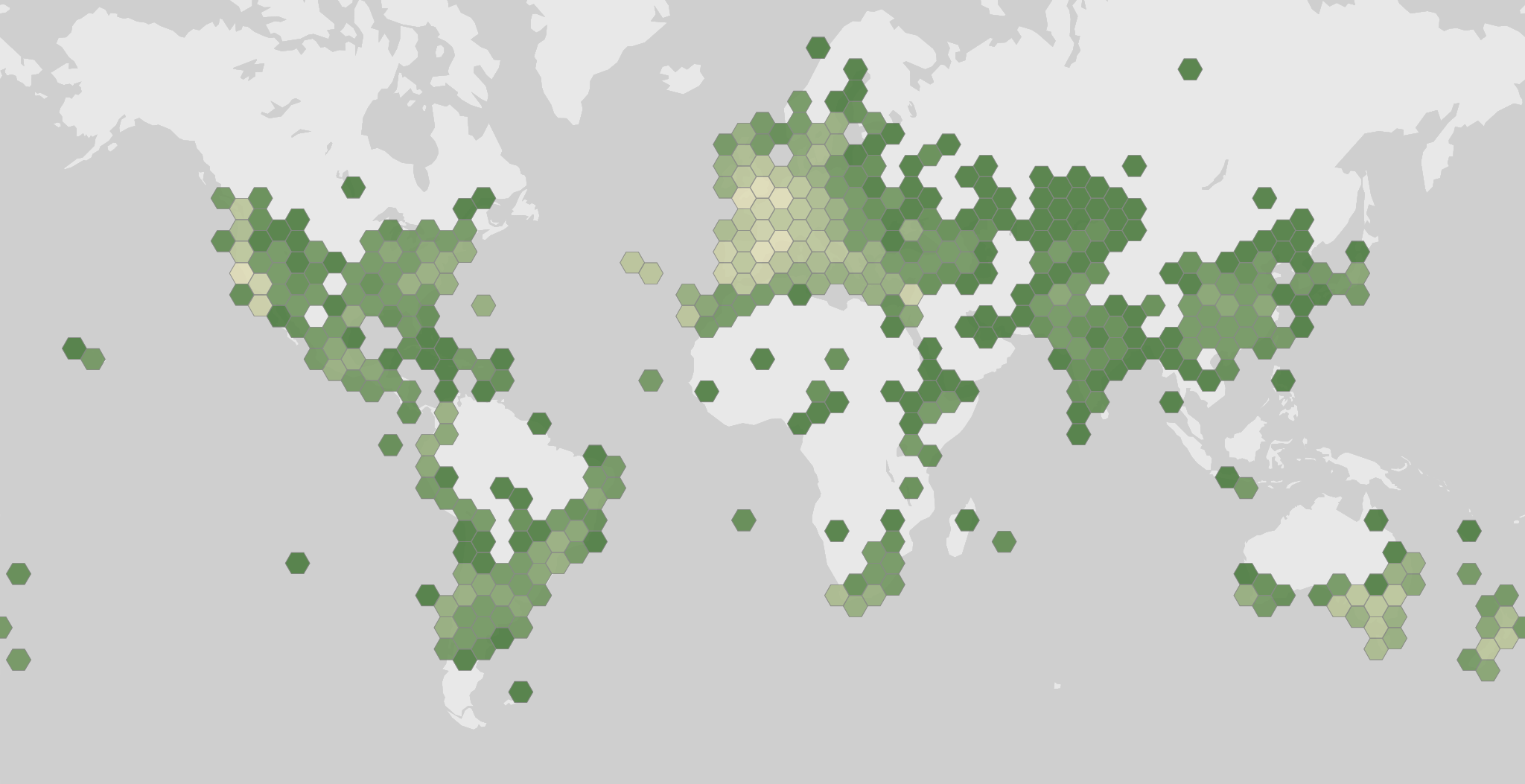
Fennel originates along Mediterranean coastlines but is now recorded as cultivated and naturalized ('adventive') across a wide elevation range, from near sea level up to about 2,600 meters. Occurrence data describe it as growing in cultivated settings as well as escaping into the wild.
Monthly observation counts show a clear seasonal pattern, rising sharply from a low of roughly 4,700 to 6,700 sightings in the winter months to a peak of about 19,200 in May, staying high through June, July, and August before tapering off again by autumn. This pattern likely reflects when the plant is most visible and actively growing or flowering, rather than any change in how many fennel plants exist. As the underlying data are presence observations rather than population counts, they should be read only as a rough sign of seasonal detectability, not as a measure of the species' true abundance or the full extent of its range.
Uses and Human Relationships
Fennel is grown worldwide for its edible bulb, leaves, and aromatic fruits, all carrying an aniseed or licorice flavor derived from the compound anethole, the same compound found in anise and star anise. The cultivar known as Florence fennel produces an enlarged, bulb-like base of inflated leaf stalks that is sautéed, roasted, grilled, or eaten raw, while the dried fruits—called saunf in much of South Asia—are eaten raw or roasted as a digestive and breath freshener, candied as a sweet, or ground into spice blends such as the Bengali/Oriya panch phoron and Chinese five-spice powder. India alone produced about 60% of the world's fennel-type spice output in 2014, with China and Bulgaria as secondary producers.
Beyond the kitchen, fennel has a long history in traditional medicine across Greek, Indian, Arabic, and Iranian systems, where it was ingested to help eliminate poisons from the body and applied topically as a poultice for snake bites. Its cultural weight goes back to Greek mythology, in which Prometheus is said to have used a fennel stalk to carry fire from Mount Olympus to Earth, and warriors reportedly drank fennel tea for courage before battle; centuries later, Emperor Charlemagne required fennel to be grown on all imperial farms.
The same qualities that make fennel useful to people—its vigorous growth from both root crown and seed—have also allowed it to become a naturalized, sometimes invasive plant along roadsides and in open habitats in places like Australia and the United States, where it can crowd out native grassland, coastal scrub, and riparian vegetation.
Fun Facts
- In Greek mythology, Prometheus is said to have used a giant fennel stalk to steal fire from the gods and carry it down to Earth.
- Not every fennel plant forms the familiar bulb; some varieties are grown only for their fruits and stalks, which taste much the same regardless of whether a bulb develops.
- Fennel is sometimes confused with giant fennel (Ferula communis), a much larger wild Mediterranean plant that carries cultural significance but is not eaten as food.
- A tea brewed from fennel was once believed to give warriors courage before heading into battle.
Ecology
Habitat
- Coastal
- Freshwater
- Disturbed Ground
Growth habit
- Herb