All parts of hemlock water-dropwort are extremely toxic, and the plant has caused poisoning in both people and livestock. Oenanthe crocata is a flowering plant in the carrot family, Apiaceae, native to Europe, North Africa and western Asia.
It grows in damp grassland and wet woodland, often along river and stream banks. It is listed as Least Concern in France and Britain, though some French regions classify it as Critically Endangered.
Identification and Appearance
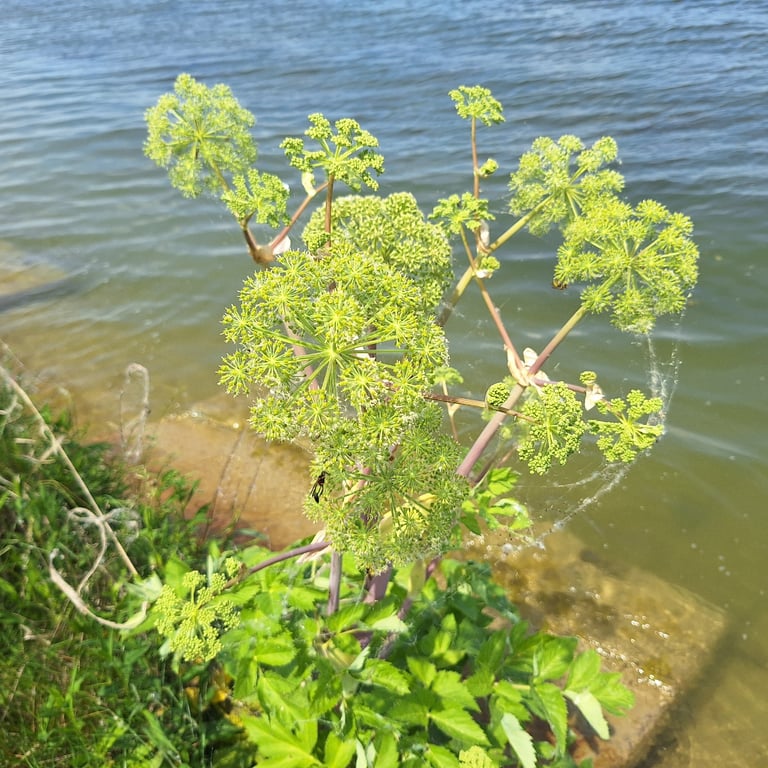
The most useful field marks are the cluster of pale yellow tubers at the base of the roots and the leaves, which smell of parsley or celery. Hemlock water-dropwort is a robust, hairless perennial up to 150 centimeters tall, with hollow, grooved and often branched stems up to 3.5 centimeters across. When cut, its five or more fleshy tubers, up to 6 centimeters long, exude a yellowish oily fluid that stains the skin.
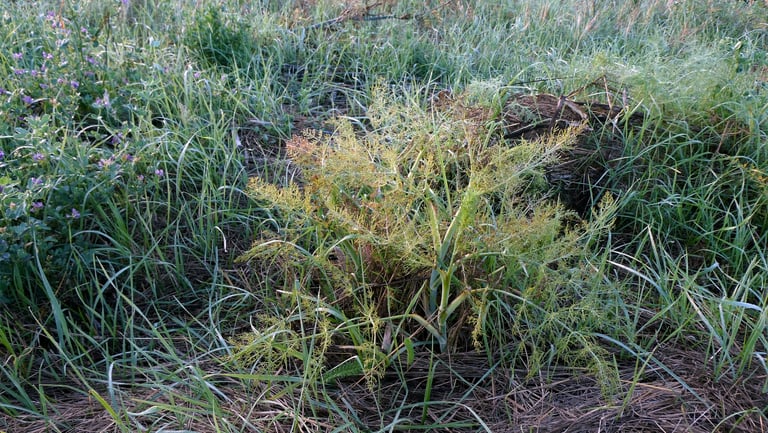
The lower leaves are three or four times pinnate and triangular, with oval, toothed leaflets 10 to 20 millimeters long that taper toward the stalk. The upper leaves are once or twice pinnate, with narrower lobes and shorter stalks. All the leaves are spirally arranged, and their stalks sheath the stem slightly.
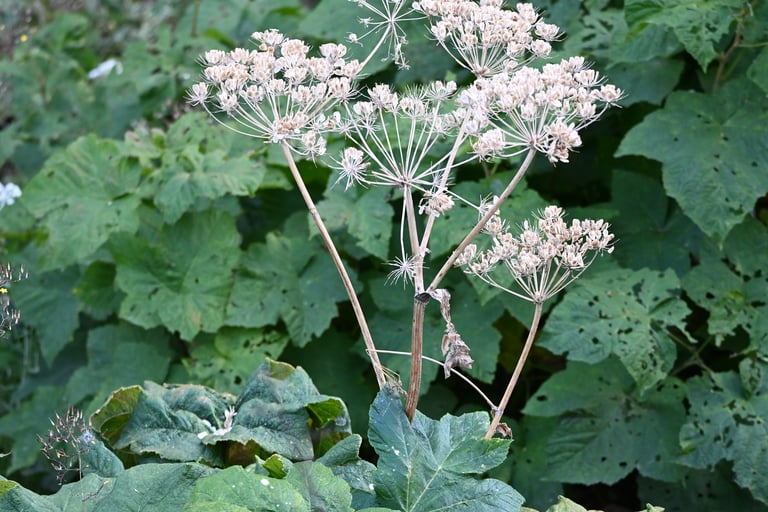
The compound umbels have 12 to 40 smooth rays, 3 to 8 centimeters long, and about five narrow bracts at their base. The white flowers have five petals, five persistent, sharply pointed sepals and five stamens.
In Britain, it is easily separated from other water-dropworts by its size, broad flat leaflets and long, thin bracts. The main confusion is with cowbane or greater water-parsnip. Cowbane has no bracts, and greater water-parsnip has once-pinnate upper leaves, while hemlock water-dropwort always has leaflets divided into at least three parts.
Distribution and Habitat
Hemlock water-dropwort grows in shallow freshwater streams, marshes, lakes, ponds, canals and wet woodland. As a lowland species, it nearly always occurs below 300 meters, although in Britain it reaches 340 meters in the Brecon Beacons. It is usually a calcifuge, a plant that avoids chalky soils.
In Wales, where it is known as cegiden y dŵr, it tolerates salt. It grows on the inland edges of salt marshes and even on harbor walls.
In woodland, it grows in alder carr in bogs and peaty river valleys, and in willow carr on river floodplains. Where flooding has thinned the trees, it can become abundant in open patches. In alder carr, it sometimes grows alongside cowbane, which it closely resembles.
In grassland, its main habitat is rush-pasture, typically with yellow flag, soft rush and cuckooflower. It is common throughout the British lowlands and extends into the upland fringes, sometimes forming dense stands along ditches and around pools that cover hundreds of square meters. Its habitat points to damp, reasonably sunny places with neutral soils of moderate fertility, and it tolerates slightly brackish water.
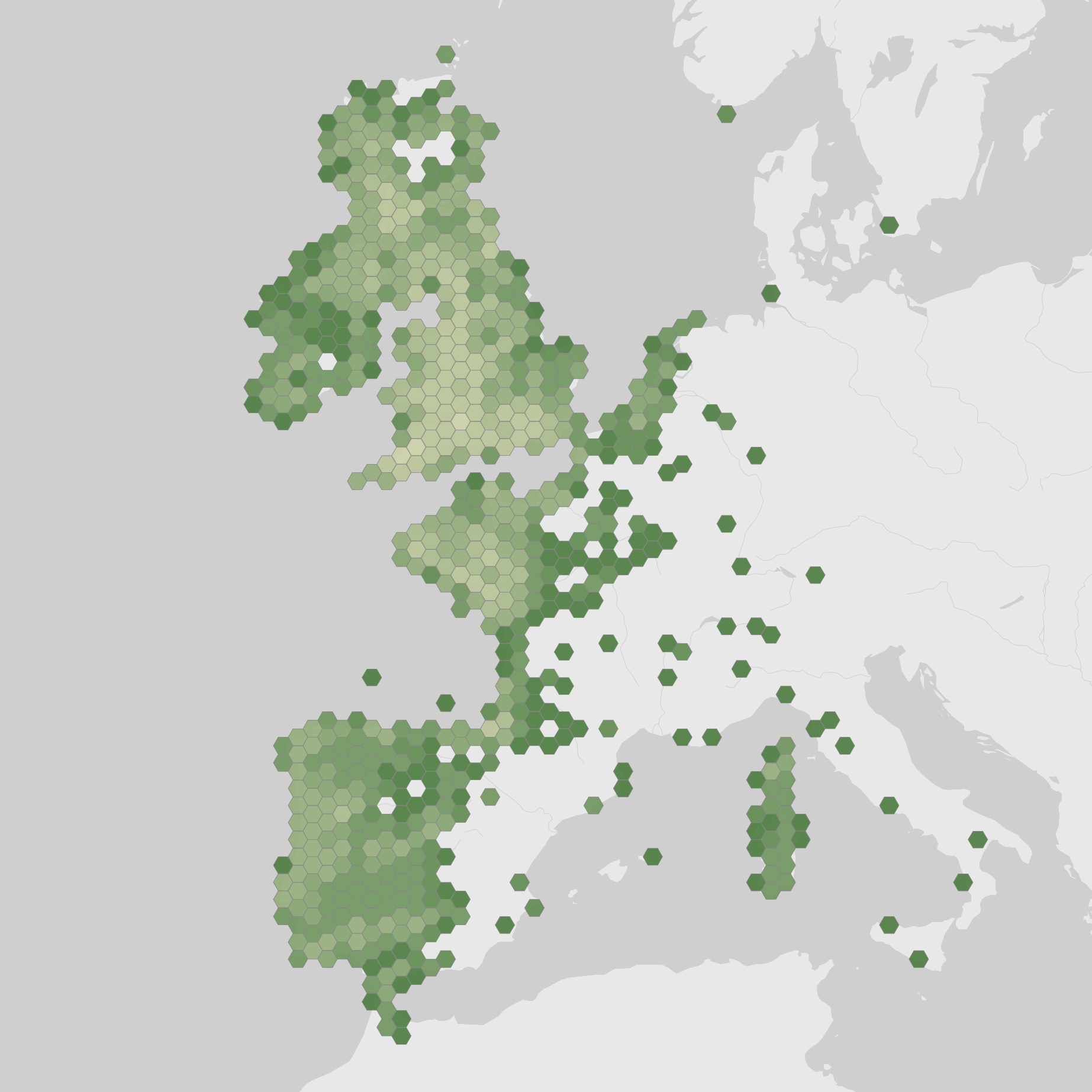
Its native range is concentrated along the Atlantic coast of Europe, from the Netherlands south to Portugal and Spain, and it becomes rare inland. It is common in Corsica and Sardinia and sparse elsewhere around the Mediterranean, east to Syria and south to Morocco. It is most widespread in Britain and Ireland, even inland. Mapped observations cluster from May to June, which reflects when the plant is most visible rather than how abundant it is.
Growth and Form
Hemlock water-dropwort is a perennial helophyte, a plant that keeps its buds at or below the surface of mud or water while its shoots rise above it. Its robust, branching stems can reach 150 centimeters, and its clustered tubers form the main underground structure.
It flowers in June and July in northern Europe, when its umbels open above the surrounding vegetation.
Ecology and Relationships
The flowers are unspecialized, so many kinds of insects can reach the nectar secreted onto the exposed top of the stylopodium. Flies, bees and beetles are the main groups that visit, and bumblebees such as Bombus terrestris are well established among them. Hoverflies, including Myathropa florea and Eristalis pertinax, also visit the flowers regularly. These insects visit for nectar and are not pollinators in the usual sense.
Despite its toxicity, several insects feed on the plant. Beetles, flies, a bug and three micro-moths of the genus Depressaria and related genera eat its tissues, and the larvae of the fly Euleia heraclei mine its leaves.
Uses and Human Relationships
Hemlock water-dropwort is known mainly as a poisonous plant. Its toxin, oenanthotoxin, is a polyunsaturated fatty alcohol that blocks GABA receptors, and it is severe in both people and livestock. Symptoms in livestock include increased salivation, dilated pupils, breathing difficulty and convulsions. Cattle poisonings occur sporadically. During the 1995 drought in England's West Country, cattle were driven to graze by ditches where the plant grew, because grass was scarce in the fields.
Most serious human cases involved roots mistaken for parsnip. Symptoms include nausea, vomiting, seizures, hallucinations, ataxia and bleeding in the brain and lungs. Sap splashed into a laboratory worker's eye caused symptoms that lasted 12 hours.
Researchers at the University of Eastern Piedmont in Italy identified the plant as the cause of the sardonic grin, because the poison constricts the facial muscles. It is also a possible candidate for the ancient 'sardonic herb' of Nuragic Sardinia. In the past, extracts were used in medicine, for example as a treatment for epilepsy. Laboratory tests of essential oils from its seeds showed a moderate antibacterial effect.
Conservation and Threats
Hemlock water-dropwort is listed as Least Concern in France and Britain. In France, where it is called oenanthe jaune safran, it is rarer in some départements, and in Île-de-France and Picardy it is classified as Critically Endangered.
Its status therefore differs from one region to the next, and it is most widespread in Britain and Ireland.
Photos
Photographs from via iNaturalist, licensed under CC0 1.0., by zebedeugalinha via iNaturalist, licensed under CC BY 4.0., by Susan Marley via iNaturalist, licensed under CC BY 4.0., by Garry Lydon via iNaturalist, licensed under CC BY 4.0., by Jose Gutierrez Higa via iNaturalist, licensed under CC BY 4.0., by considerthelilies via iNaturalist, licensed under CC BY 4.0., and by Daniel Cahen via iNaturalist, licensed under CC BY 4.0., credited on each photo.
Ecology and classification
Growth habit
- Herb
Classification
- Phylum
- Tracheophyta
- Class
- Magnoliopsida
- Order
- Apiales
- Family
- Apiaceae
- Genus
- Oenanthe
- Species
- Oenanthe crocata
Sources
- GBIF Species names and classification
- iNaturalist Photos
- Wikidata Common names and conservation status
- Wikipedia Summary extract
- Plants of the World Online Native range, life form and climate (WCVP)
- GloBI What it eats, what eats it, parasites and pollinators
- DoPI