Cow parsnip can tower up to 3 meters tall, making it one of the largest herbaceous plants in many of the North American landscapes it inhabits.
This perennial member of the carrot family (Apiaceae) grows across forests, meadows, shrublands, and riparian corridors throughout most of the continent. It carries the IUCN status of Least Concern. Known by many names, including American cow-parsnip, Indian celery, and pushki, it has drawn attention both for its size and for a sap that can cause painful burns.
Identification and Appearance
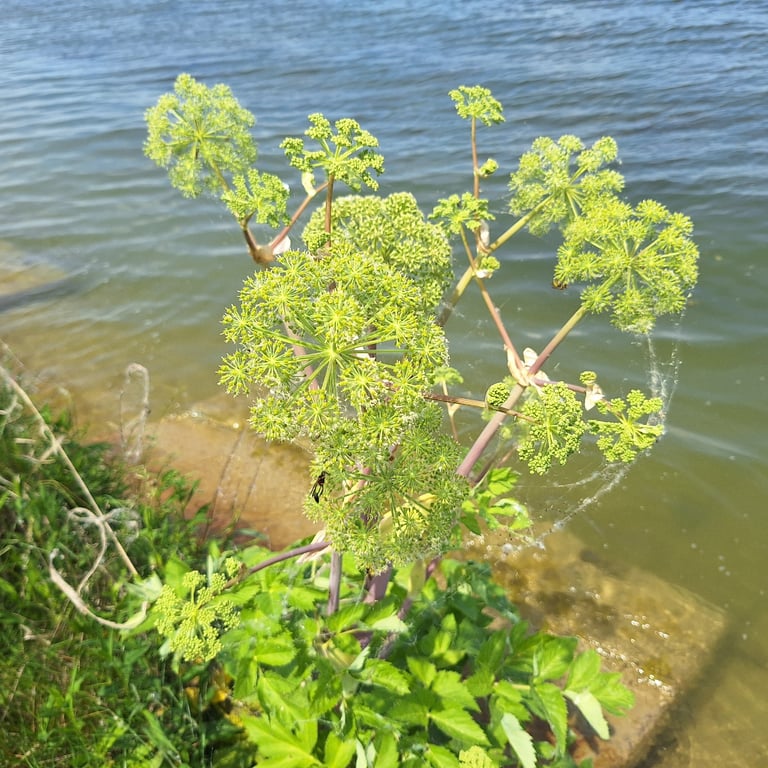
The single best field mark is scale: Heracleum maximum is a coarse, hairy giant that can reach 3 meters in height, with hollow, densely hairy stems supporting leaves up to 40 centimeters across, divided into three broad lobes.
Its flower umbels are equally impressive, spanning up to 30 centimeters across. They are flat-topped or rounded and made up of small white flowers, with the outer flowers of the umbel sometimes noticeably larger than those at the center. Blooming runs from February to September. Seeds measure 8 to 12 millimeters long and 5 to 8 millimeters wide.
Heracleum maximum is frequently confused with the non-native giant hogweed (Heracleum mantegazzianum), a much larger plant distinguished by purplish spots on its stems and more sharply serrated leaves. Other tall invasive relatives include H. sosnowskyi and H. persicum.
It can also be mistaken for wild carrot, cow parsley, poison hemlock, wild parsnip, and species of the genus Angelica, so care in distinguishing these lookalikes matters, especially since some are highly toxic.
Distribution and Habitat
Heracleum maximum is native to nearly all of the continental United States, apart from the Gulf Coast and a few neighboring states, and ranges from the Aleutian Islands and Alaska in the northwest to Newfoundland in the east. Its southern limit reaches California, New Mexico, Kansas, Ohio, and Georgia. In Canada, it occurs in every province and territory except Nunavut. The plant is also found in Siberia, East Asia, and the Kuril Islands.
It grows from sea level up to about 2,700 meters in elevation and is especially prevalent in Alaska, often growing alongside devil's club, a plant of similar size, and monkshood, a highly toxic flower.
The species occupies a remarkably wide range of habitats, including forested habitat types, grasslands, shrublands, meadows, alpine zones, and riparian areas. It appears as an understory species in subalpine fir and Engelmann spruce communities of the Intermountain West, in quaking aspen-dominated stands across Utah, Colorado, and Montana, and in willow-dominated riparian zones throughout the region. Several regional habitat types and plant associations have been named for it, including a subalpine fir/cow parsnip association in Montana and a red-osier dogwood/cow parsnip riparian type in the Idaho-Wyoming-Utah border region.
Observation records peak in the summer months, suggesting the plant is most visible and likely flowering during this period, though these counts reflect presence rather than actual population size.
It is listed as Endangered in Kentucky and of Special Concern in Tennessee, at the edges of its range.
Growth and Form
Heracleum maximum is a perennial herb, returning from its root system each year rather than growing anew from seed alone.
Ecology and Relationships
Cow parsnip serves as an important forage plant, valued as pasture for cows, sheep, and goats, and forms a significant part of the diet of many wild animals, especially grizzly and black bears.
It is a host plant for several butterflies, including the black swallowtail, short-tailed swallowtail, Old World swallowtail, and anise swallowtail, as well as multiple moth species such as Eupithecia tripunctaria and Depressaria pastinacella. Its flowers attract a range of visitors, most notably honeybees (Apis mellifera), along with various hoverflies and native bees such as Andrena and Halictus species.
The plant associates with a wide array of companion species across its many habitat types, from shrubs like serviceberry and chokecherry to herbaceous neighbors such as fireweed and stinging nettle, reflecting its role as a common understory and riparian community member.
Uses and Human Relationships
Indigenous peoples across North America traveled long distances, sometimes 80 kilometers or more, each spring to gather the succulent young shoots of cow parsnip. The peeled young stems and leafstalks were typically eaten raw, valued for a taste and texture resembling celery, which gave rise to the name "Indian celery." Early American settlers instead cooked the plant before eating it.
Beyond food, at least seven native groups used cow parsnip as a dermatological aid, incorporating it into poultices for bruises, sores, and swellings, particularly of the feet. The dried stems served as drinking straws for elders or the infirm and were fashioned into flutes for children. An infusion of the flowers was rubbed on the body to repel flies and mosquitoes, and a yellow dye could be produced from the roots. The Haida used the timing of cow parsnip's bloom as a seasonal signal that gull eggs were no longer safe to eat.
Fun Facts
- The genus name Heracleum was described by Carl Linnaeus in 1753 and derives from the Ancient Greek Ἡράκλειος (Hērákleios), meaning "of Heracles," a reference to the mythological hero.
- The reference to Heracles connects the plant's name to a figure whose myth embodies both heroic ideals and human flaws.
Photos
Photographs from by Liam Steele via iNaturalist, licensed under CC BY 4.0., via iNaturalist, licensed under CC0 1.0., by Aden Sommerville via iNaturalist, licensed under CC BY 4.0., by Matt Berger via iNaturalist, licensed under CC BY 4.0., by Karen (with occasional help from Mike) via iNaturalist, licensed under CC BY 4.0., by Peter L Achuff via iNaturalist, licensed under CC BY 4.0., by Tatyana Petrenko via iNaturalist, licensed under CC BY 4.0., by Caleb Catto via iNaturalist, licensed under CC BY 4.0., by Daughter Dad via iNaturalist, licensed under CC BY 4.0., by snowglobin via iNaturalist, licensed under CC BY 4.0., by Todd Huang via iNaturalist, licensed under CC BY 4.0., by Robyn Perkins via iNaturalist, licensed under CC BY 4.0., and by Rosario Douglas via iNaturalist, licensed under CC BY 4.0., credited on each photo.
Ecology and classification
Classification
- Phylum
- Tracheophyta
- Class
- Magnoliopsida
- Order
- Apiales
- Family
- Apiaceae
- Genus
- Heracleum
- Species
- Heracleum maximum
Sources
- GBIF Species names and classification
- iNaturalist Photos
- Wikidata Common names and conservation status
- Wikipedia Summary extract
- Encyclopedia of Life Habitat, diet and behavior traits
- Plants of the World Online Native range, life form and climate (WCVP)
- GloBI What it eats, what eats it, parasites and pollinators
- Guzman et al. 2022