Few garden plants have been worshipped as a god, yet Hedera helix was sacred to Osiris in ancient Egypt and later became an attribute of Dionysus and Bacchus, the wine gods of Greece and Rome.
This evergreen climbing vine belongs to the ginseng family, Araliaceae, and is native to most of Europe and parts of western Asia. It clings to tree trunks, cliffs, and walls using aerial rootlets, or spreads as groundcover where no vertical surface is available. Beyond its native range it has become a widely naturalized ornamental, valued by gardeners and wildlife alike, which makes it one of the more culturally loaded and ecologically debated vines in temperate landscapes.
Identification and Appearance
The clearest field mark is the vine's aerial rootlets tipped with matted, adhesive pads that let it cling tightly to bark, stone, or masonry without twining or coiling. Where a climbing surface is available, Hedera helix can reach 20 to 30 meters in height; without one, it simply forms a dense, low groundcover instead.
Leaves are alternate and 50 to 100 millimeters long on a petiole of 15 to 20 millimeters. Two distinct leaf forms mark the plant's life stages: juvenile leaves on creeping and climbing stems are palmately five-lobed, dark green and often lighter-veined, while adult leaves on fertile, flowering stems exposed to full sun are unlobed and heart-shaped (cordate), usually appearing high in tree canopies or atop rock faces.
Flowering stems produce small, greenish-yellow flowers clustered into umbels 3 to 5 centimeters across, blooming from late summer into late autumn. These give way to berries 6 to 8 millimeters wide, ranging from purple-black to orange-yellow, which ripen in late winter and contain one to five seeds each.
Because only the sunlit, mature crown produces flowers and unlobed leaves, a shaded climbing vine and a flowering canopy specimen of the same plant can look like two different species.
Distribution and Habitat
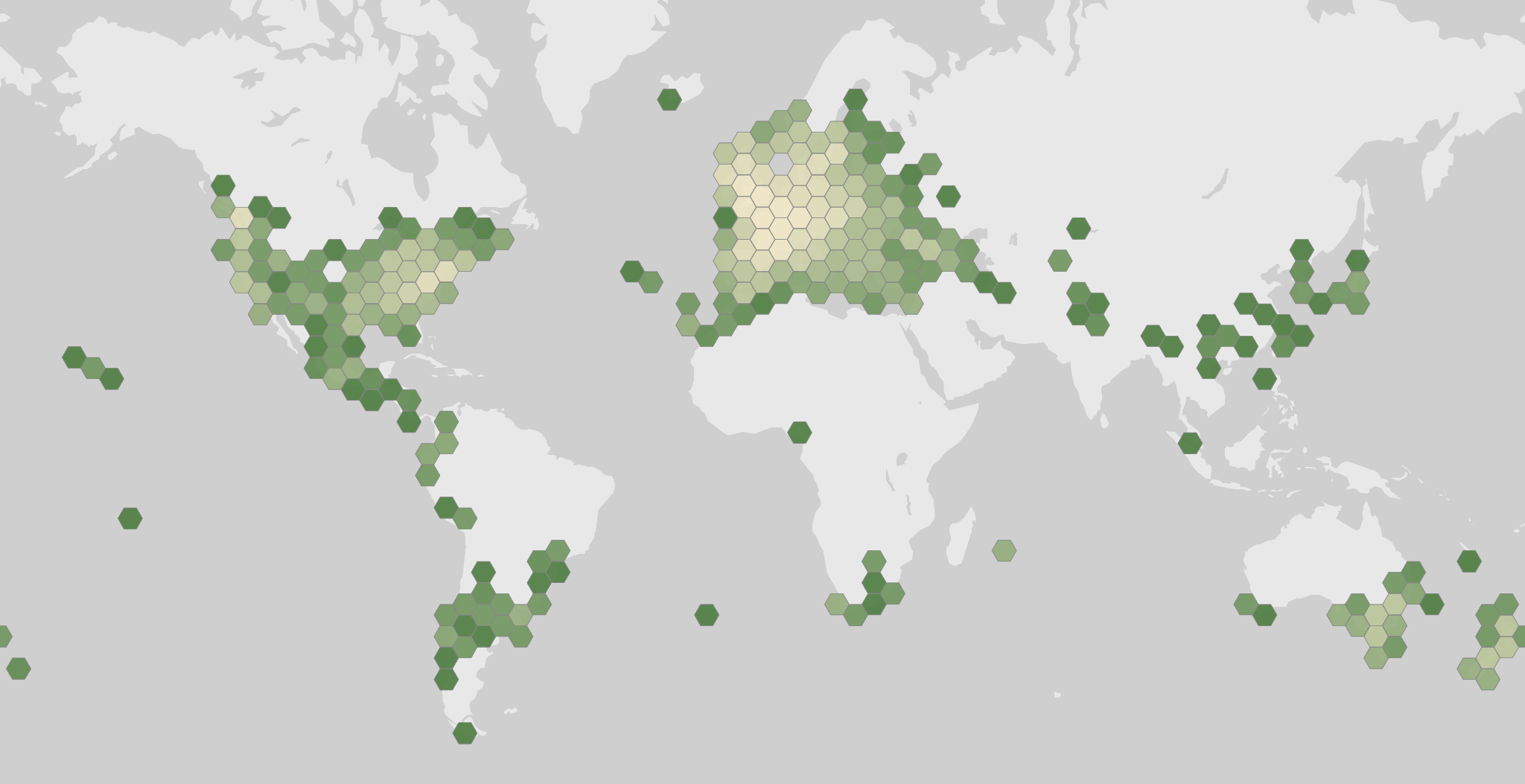
Hedera helix is native from Ireland northeast to southern Scandinavia, south to Portugal, and east through Ukraine, Iran, and northern Turkey. It is very common and widespread in Britain, though notably absent from the Isle of Man and the Channel Islands. Its northern and eastern range limits roughly track the −2°C winter isotherm, and the species is markedly winter-hardy, tolerating temperatures down to −23.3°C.
Outside its native range, English ivy has become widespread in North America, occurring in deciduous and riparian forests, conifer-deciduous mixed forests, thickets, and shrublands, and it is especially abundant in the Pacific Northwest below about 900 meters elevation. It also thrives in disturbed and urban forests, often alongside other nonnative species, and in the mid-Atlantic and southeastern United States it grows in wetlands, salt marsh edges, floodplains, and around old homesites and gardens.
The vine favors moist, shady sites with near-neutral soil pH around 6.5, though it tolerates a wide range of soil textures and moisture levels, from periodically flooded floodplains to fairly dry uplands. It generally avoids high elevations and thins out with increasing elevation and colder winters, and in parts of the Mediterranean Basin its distribution may be shaped by summer drought.
Monthly observation counts show a clear seasonal pattern, rising sharply from a January low near 73,500 to a peak above 142,000 in May before declining through autumn to under 35,000 by December. This likely reflects when the evergreen foliage is most conspicuous and most often recorded, rather than a true change in population size.
Uses and Human Relationships
English ivy has long been grown as an ornamental, valued both for its appearance and for the wildlife it supports: its flowers attract more than 70 species of nectar-feeding insects, its berries feed at least 16 bird species, and its dense evergreen foliage offers shelter and browse for deer. In Europe it is often trained over building walls, and the Bavarian government has recommended it for its ability to cool interiors in summer, insulate in winter, and protect masonry from soil moisture and weather extremes. Growers have also selected more than 30 cultivars for traits such as variegated, yellow, or deeply lobed leaves and purple stems, with 16 cultivars receiving the Royal Horticultural Society's Award of Garden Merit.
Historically, ivy leaves were used to treat skin ailments and to make dyes, and leaves and berries were once taken orally as an expectorant for coughs and bronchitis; in 1597 the herbalist John Gerard recommended an ivy-leaf infusion as an eyewash. Extracts from ivy leaves remain part of some modern cough medicines, and a 2020 evidence review found such preparations may help ease early respiratory symptoms, with the strongest evidence for reducing cough frequency and intensity. Ivy also carries symbolic weight, appearing in bridal bouquets as a sign of fidelity and historically linked to the wine gods Dionysus and Bacchus.
Despite its benefits, ivy can damage brickwork and guttering as it climbs and may conceal structural faults or harbor pests, so its use on buildings calls for careful placement and monitoring.
Fun Facts
- Ivy berries lose much of their toxicity as they ripen in spring, so birds eat far larger quantities then than earlier in winter, when they self-limit their intake.
- In ancient Egypt, ivy was sacred to Osiris, god of fertility and ruler of the underworld, and in Greco-Roman mythology it was an attribute of the wine gods Dionysus and Bacchus.
- Chemical analysis of Hedera helix leaves has identified compounds including hederacoside C (up to 15.7% of leaf content), chlorogenic acid, and rutin, alongside saponins such as α-hederin and β-hederin.
- Extracts from the plant have shown notable activity against fire blight, inhibiting the pathogen Erwinia amylovora for up to seven days, with effectiveness comparable to the chemical acibenzolar-S-methyl.
- Ivy's synonyms include Hedera acuta, Hedera arborea ("tree ivy"), Hedera baccifera, and Hedera grandifolia, and it is also known by the common names bindwood and lovestone.
Ecology
Habitat
- Wetland
- Forest
- Woodland
- Urban
Growth habit
- Vine