Few millipedes look as much like a pill woodlouse as Glomeris marginata. When disturbed, this European species curls into a tight ball, a defense shared by its whole family, Glomeridae.
It is a pill millipede in the class Diplopoda. Its short, stout body is rounded in cross section, and it is often confused with the pill woodlouse Armadillidium, which also rolls into a ball.
Its close resemblance to a woodlouse makes it an easy animal to misidentify, but a closer look at its legs and tail reveals clear differences.
Identification and Appearance
The most useful field mark is the ball. When fully rolled, the head and collum are hidden inside, and the anal shield covers the front edge of the enlarged second segment, forming a slightly flattened oval rather than a true sphere.
Adults are small. Females measure 8 to 20 mm long and 4 to 8 mm wide, while males are a little smaller, at 7 to 15 mm long and 3.5 to 6 mm wide. Behind the head, the body carries 12 arched plates, counting the collum as the first and the anal plate as the last.
The second plate, called the thoracic shield, is nearly twice the size of the plates behind it, and the collum is reduced. Most individuals are black with lighter rims, though some are brown, red or yellow. Females have 17 pairs of legs and males have 19.
Woodlice differ in several ways. Adult woodlice have only 7 pairs of walking legs, and their tail end has several small plates, including a uropod on each side. The millipede's cuticle is darker and shinier, its antennae are club-shaped and shorter, and its rolled ball is less perfectly round than that of a pill woodlouse.
Distribution and Habitat
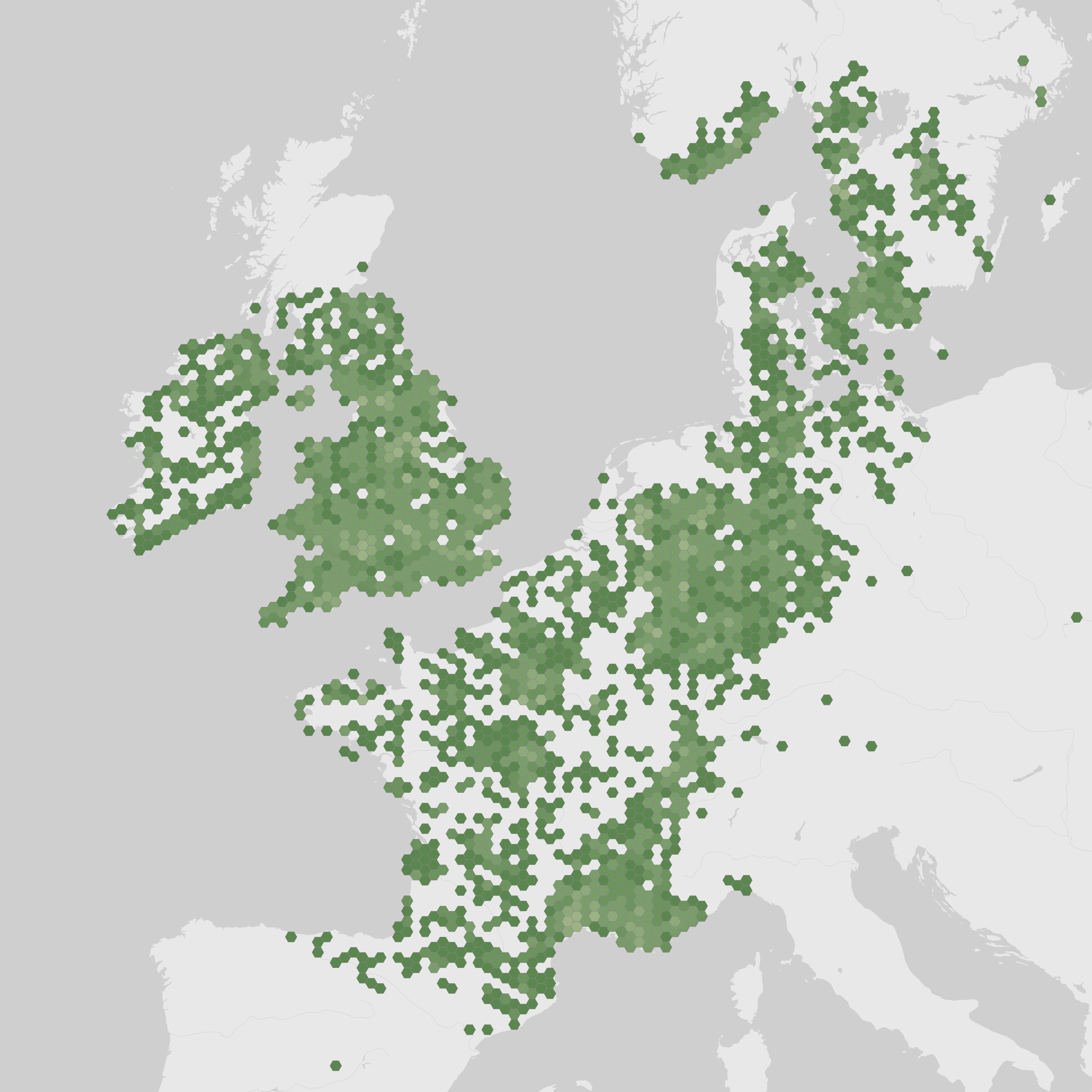
Glomeris marginata is found across western Europe, from the Pyrenees to the British Isles, southern Scandinavia and the coastal plain of Poland. It has been found in Spain, France, Belgium, the Netherlands, Germany, Switzerland, Austria and Denmark, as well as in southern Sweden and along the southern coast of Norway.
In the British Isles it is common in England, Ireland and Wales, but in Scotland it reaches only as far north as the Midland Valley. Its range is centered on western Europe near the Atlantic, and it is rarely found more than 300 meters above sea level. It appears to avoid prolonged cold.
The species favors calcareous soils and lives in leaf litter, grass and under stones. In gardens, it is found along hedgerows and at the base of old walls where the mortar has crumbled and released lime into the soil. It also occurs in woodlands, fields and hedgerows.
Unlike many millipedes, it tolerates dry, hot conditions and can be found on hot sand at midday. It is nonetheless more active at night and prefers humid areas. Its presence peaks in April and May.
Reproduction and Life Cycle
Juveniles take several years to become adults. By their sixth developmental stage they have the adult number of plates and legs, but they keep molting. During these later molts, the last three pairs of legs in males change for mating, and the last pair becomes the largest. Males are ready to breed by their second or third spring, while females wait until their third or fourth spring.
Males produce a pheromone from a gland behind their last pair of legs. They use it to attract females and to prepare a female for mating. During mating, the male grasps the female with his modified legs and transfers a sperm packet, which is placed in the female's genital opening.
After fertilization, the female lays about 50 eggs, each about 0.8 mm across. She makes no nest. Instead, she encloses each egg in a capsule of soil that she passes through her gut.
Females breed again in later years. After first reaching maturity, a female can produce seven or eight more annual broods. Individuals can live as long as ten or eleven years, molting once a year as adults and passing through as many as 15 or 16 stages in their lives.
Population and Ecological Role
Glomeris marginata plays an important part in recycling nutrients in leaf litter. It feeds on old, decaying leaves, even though fresher leaves are more digestible, and its activity helps return nutrients to the soil.
It is an important food source for several predators. Centipedes of the order Geophilomorpha, beetles and turtles of the order Testudines all eat it, and beetles are among its most regular predators.
Photos
Photographs from via iNaturalist, licensed under CC0 1.0., by Hannes Dahm via iNaturalist, licensed under CC BY 4.0., by Alex via iNaturalist, licensed under CC BY 4.0., by Hayley Fulker via iNaturalist, licensed under CC BY 4.0., by D. Rafael S. Fernandes via iNaturalist, licensed under CC BY 4.0., by Joe crutwell via iNaturalist, licensed under CC BY 4.0., by Bastien Le Mort via iNaturalist, licensed under CC BY 4.0., and by Eddie via iNaturalist, licensed under CC BY 4.0., credited on each photo.
Ecology and classification
Classification
- Phylum
- Arthropoda
- Class
- Diplopoda
- Order
- Glomerida
- Family
- Glomeridae
- Genus
- Glomeris
- Species
- Glomeris marginata
Sources
- GBIF Species names and classification
- iNaturalist Photos
- Wikidata Common names and conservation status
- Wikipedia Summary extract
- Encyclopedia of Life Habitat, diet and behavior traits
- GloBI What it eats, what eats it, parasites and pollinators
- trophiCH