The witch flounder carries an unusual name for a fish best known under several aliases, including witch flounder, pole flounder, craig fluke, Torbay sole, and grey sole. It is a flatfish of the family Pleuronectidae, found on both sides of the North Atlantic Ocean, where it lives on muddy seabeds in quite deep water.
The species is currently assessed as Vulnerable. In northern Europe it holds real importance in fisheries as a food fish, making it both a biological curiosity and a commercially relevant catch.
Identification and Appearance
The most useful field mark is the combination of a small, blister-like mucous pit pattern on the blind side of the head and a small mouth that barely reaches the forward edge of the lower eye. This is a right-eyed flatfish, meaning both eyes sit on the right side of its strongly, dorsally compressed, oval body.
The body is elongated, with a standard length 2.5 to 3.5 times its width, and reaches a maximum of 60 centimeters, though most individuals stay under 40 centimeters. The head is small, taking up only about a fifth of the total body length. A single series of small, incisor-like teeth lines the small mouth.
Coloration is brownish gray to grayish brown on the eyed side, with less variation than seen in many other flatfish, and the body and fins are densely covered in muted black spots that darken toward the margins of the median fins. The blind side is white with tiny black dots, though some individuals show a blind side colored similarly to the eyed side. Almost the entire head and body, except the snout tip and lower jaw, is covered in smooth scales that make the fish notably slippery to handle.
A short, sharp forward-pointing spine sits in front of the anal fin, formed by an elongated bone structure, though it can be so small as to be hidden. The pectoral fin on the eyed side is shorter than the head and blackish toward its tip, while the lateral line runs relatively straight along the body, flanked by 110 to 140 scales.
Distribution and Habitat
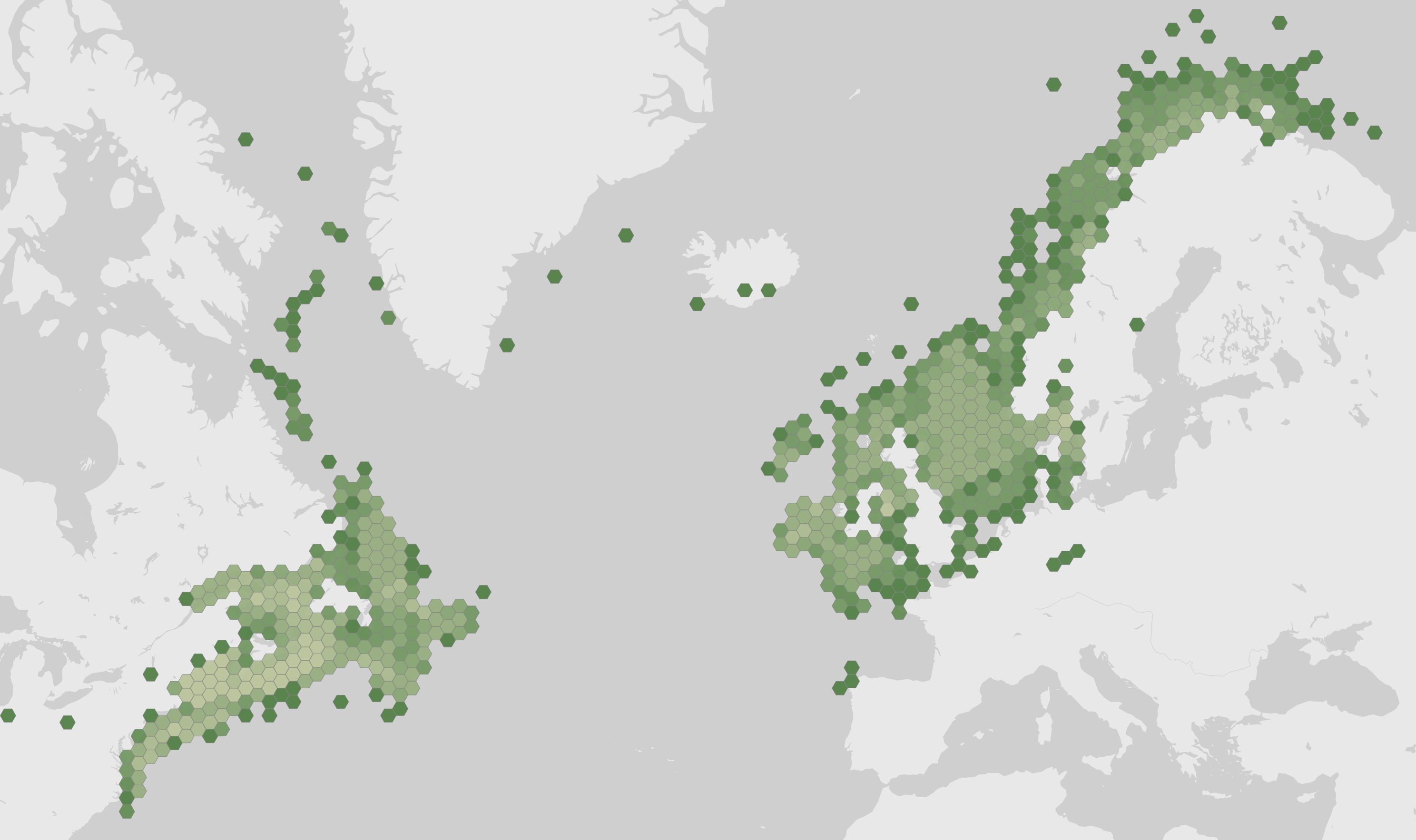
The witch occurs on both sides of the North Atlantic Ocean. In the northeastern Atlantic it ranges from the northernmost Bay of Biscay to the Kattegat and into the westernmost Baltic Sea, north along the entire Norwegian coast and east into Russia's Murmansk region, and west to the southern and western coasts of Iceland. In the western North Atlantic it occurs from Newfoundland and Labrador south to North Carolina, including the Grand Banks, Gulf of Maine, Gulf of St Lawrence, and the Scotian Shelf.
Adults favor the continental shelf and upper continental slope, preferring fine sediments such as clay, muddy sand, and pure mud, as well as deep holes and channels on the shelf. As bottom-dwelling fish, they live mainly at depths between 45 and 1,460 meters, though they are most common between 184 and 366 meters, in water temperatures of 2 to 6°C.
Juveniles behave differently, drifting in open water until they reach 5 to 6 centimeters in length, after which they settle to the bottom at shallower depths than the adults typically occupy.
Observation records through the year show counts rising sharply in one period, hinting at seasonal variation in when the species is encountered, though these figures reflect presence records rather than actual abundance or population size.
Cultural Significance
Interest in Glyptocephalus cynoglossus has sometimes touched on the Cynocephali, a tribe of dog-headed men from ancient Greek and Roman legend, whose name comes from the Greek words for dog and head. That legend is thought to have originated from travelers' accounts of African baboons, later mistaken for a race of dog-headed men, and in Roman mythology the figure of Cynocephalus was linked to Janus, the god of beginnings and endings. Beyond such name associations, the fish itself holds practical value in northern Europe, where it has long been caught and sold as a food fish under names like grey sole and Torbay sole.
Fun Facts
- The witch flounder goes by an unusually large number of common names, including witch flounder, pole flounder, craig fluke, Torbay sole, and grey sole.
- Its blind side carries large, open, blister-like mucous pits, an unusual feature not typical of most flatfish.
- Juveniles live a free-swimming, open-water life until they reach about 5 to 6 centimeters long, after which they settle onto the seafloor like the adults.
Photos
Photographs from by Julien Savoie via iNaturalist, licensed under CC BY 4.0., by Vsevolod Rudyi via iNaturalist, licensed under CC BY 4.0., by Ron Pasieczna via iNaturalist, licensed under CC BY 4.0., by Tvabutzku1234 via Wikimedia Commons, licensed under CC0 1.0., by Daderot via Wikimedia Commons, licensed under CC0 1.0., by cyclonebill via Wikimedia Commons, licensed under CC BY-SA 4.0., by Arnstein Rønning via Wikimedia Commons, licensed under CC BY-SA 4.0., by Benreis via Wikimedia Commons, licensed under CC BY-SA 4.0., and by Cedricguppy - Loury Cédric via Wikimedia Commons, licensed under CC BY-SA 4.0., credited on each photo.
Ecology and classification
Habitat
Classification
- Phylum
- Chordata
- Order
- Pleuronectiformes
- Family
- Pleuronectidae
- Genus
- Glyptocephalus
- Species
- Glyptocephalus cynoglossus
Sources
- GBIF Species names and classification
- iNaturalist Photos
- Wikidata Common names and conservation status
- Wikipedia Summary extract
- AnAge Longevity
- Wikimedia Commons Photos
- GloBI What it eats, what eats it, parasites and pollinators
- Wardeh et al. 2015 (EID2)