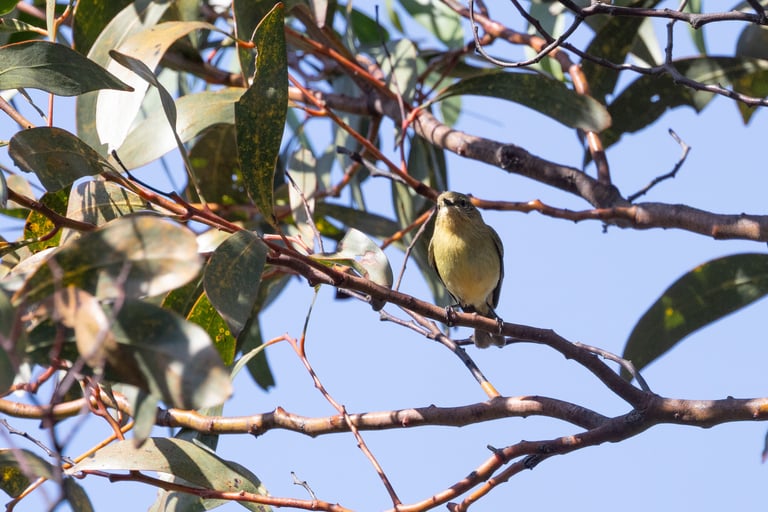
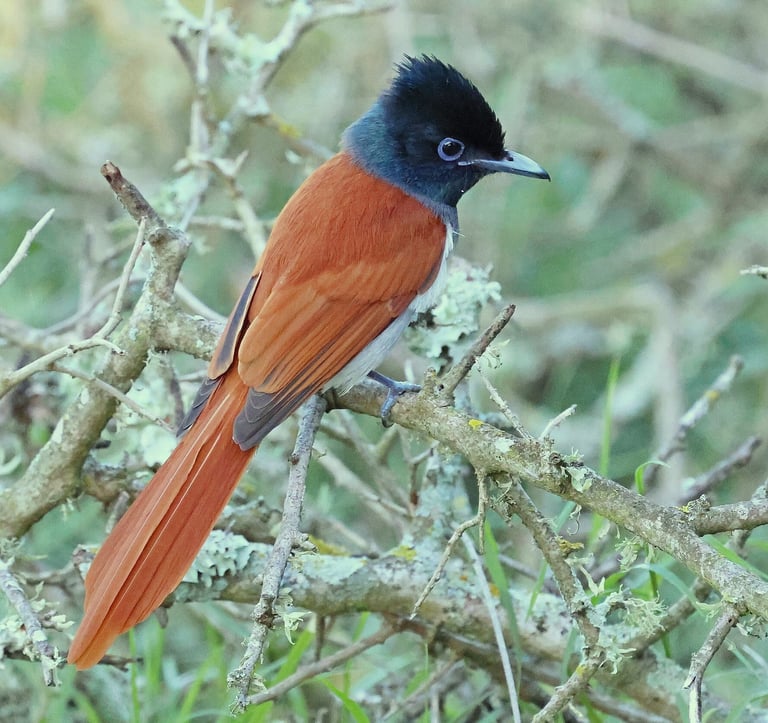
The goldcrest is the smallest bird in Europe, and it belongs to the kinglet family, Regulidae. Its name comes from the golden crest on its head, and in European folklore it was called the king of the birds.
The species lives across a very large range of Eurasia that covers much of the Palearctic, as well as the Macaronesian islands and Iceland. Its range covers about , and several subspecies are recognized within it. Birds from the northern and eastern parts of the breeding range migrate south for the winter.
A goldcrest can live up to , which is long for a bird that weighs only . It is rated as Least Concern by the IUCN, yet its small size and movements through the seasons make it a fascinating subject for anyone curious about how tiny birds survive cold winters.
Identification and Appearance
The most useful field mark is the crest. In males it is yellow with an orange centre, and it is entirely yellow in females. Males raise the crest in display, which makes the orange stripe far more visible.
The goldcrest is the smallest European bird, measuring 8.5–9.5 cm in length with a wingspan of 13.5–15.5 cm. It weighs about . Its upperparts are olive-green, its underparts are buff-white, and it has two white wing bars. The face is plain, with conspicuous black irises, and the crown has black sides and a narrow black front. The small, thin bill is black, and the legs are dark flesh-brown.
The sexes look alike apart from crest colour. In fresh plumage, the female may have slightly paler upperparts and greyer underparts than the adult male. Juveniles are similar to adults but have duller upperparts and lack the coloured crown. By their first winter, young birds are nearly impossible to tell from adults in the field.
The goldcrest is usually easy to separate from other small birds in its range. Poor views can cause confusion with the common firecrest, which has a bright white eyebrow and a black eye-stripe, or with the yellow-browed warbler, which has a yellowish eyebrow and a pale crown stripe. The American ruby-crowned kinglet is larger, has an obvious whitish eyering and yellowish wing bars, and the male has a red crest without yellow.
Distribution and Habitat
Goldcrests breed mainly in mature conifer woods, from lowland forests up to 3,000 m, and occasionally up to 4,800 m. They favour spruce, larch, Scots pine, silver fir and mountain pine. In planted landscapes they also use introduced conifers such as Douglas fir. Broad-leaved woods are used only where some spruce or fir is also present.
The species is common across middle and northern temperate and boreal Europe, where July isotherms are between 13–24 °C (55–75 °F). It is found in cooler climates than the firecrest. Further east, it occurs in patches through southern Siberia, Sakhalin and Japan, the Tian Shan, northern Iran and the Himalayas, reaching central China.
On Tenerife, the local subspecies lives in the mountain zone once covered by laurel forest, now dominated by tree heath. It is common there, but rare in pine forest, where it appears only if tree heath is also present. Goldcrests have bred in Iceland since about 1999 and were widespread there by 2004, although harsh winters reduce their numbers.
Northern populations leave their breeding areas in winter, while southern birds stay. Birds in northern Fennoscandia and Russia vacate their territories between late August and early November, mostly in late September to mid-October. Large numbers have been seen on migration, including 15,000 birds on the Isle of May in October 1982. In one day, goldcrests can fly 250–800 km (160–500 mi), although they fly lower in strong headwinds.

Behavior and Lifestyle
Goldcrests are restless birds that hop, flick their tails and flutter among foliage. They creep along branches and up and down trunks. Most are solitary, although small groups of about eight birds may form, and they migrate in flocks of no more than 12 birds.
Males defend territories during the breeding season, while the species' population density does not depend on the size of a forest patch. Birds may travel several kilometres from their nesting area at a time. Home ranges and territories have not been measured in detail.
To survive freezing winter nights, goldcrests huddle together in dense foliage or snow holes. Two birds roosting together reduce heat loss by a quarter, and three birds cut it by a third. On an 18-hour winter night, with temperatures as low as −25 °C (−13 °F) in the north of the range, huddled birds can burn fat equal to 20% of their body weight to stay warm.
Migrating birds rely mostly on stored fat and use some protein for energy. Birds with large fat reserves may stop for only one or two days. Within the species, larger and more aggressive males may get more food, and males have a lower death rate than females on migration and in resident populations.
Communication
Goldcrests communicate mainly through sound. The contact call is a thin, very high zee given at intervals of 1–4 seconds. Its notes are all at the same pitch, and it may end in a clipped note or be delivered faster. The call is higher and less rough than that of the firecrest.
The male song is a very high, thin double note that is repeated 5–7 times in a sequence ending in a flourish. The whole song lasts 3–4 seconds and is repeated 5–7 times a minute. Males often sing while foraging, and they can be heard in most months of the year. Males also produce a quiet, rambling subsong.
Mainland European goldcrests share nearly identical songs, but island populations vary more. Males on the Azores may have up to three song types, and the Canary Islands have two main dialect groups, one of which is restricted to the mountains of Tenerife. Analysis of these song differences helped trace how goldcrests colonized the Macaronesian islands and revealed a previously unknown subspecies.
Recordings
call, flight call · France · Philippe Grange · Public domain
flight call · France · Philippe Grange · Public domain
Diet and Nutrition
Goldcrests feed mainly on insects, spiders, caterpillars and worms, gleaned from the foliage of trees. They are primarily insectivores. Flies, moths and their caterpillars, and stoneflies make up much of the food, along with other small arthropods.
In winter, goldcrests forage alongside tits in mixed flocks. Hunting for food, they move with frequent dashes, flutters and hovers among the branches. When feeding on the ground, they also take bits of leaves and other plant material.
Goldcrests also eat sap from trees and store seeds for later use, which helps them get through lean periods.
Nesting and Breeding
Courtship usually begins in April or May, when food is most plentiful. Males sing to attract females and to establish a territory, and they show their crest and bow their heads towards other birds. Goldcrests are monogamous for the season.
The nest is a well-insulated, cup-shaped structure built in three layers. The outer layer is moss, small twigs, cobwebs and lichen, and the cobwebs attach the nest to thin branches. The middle layer is moss, and the lining is feathers and hair. The nest is hung from a branch, usually at no great height, with a recorded range of 1.0–22 m (3.3–72.2 ft). Both sexes build it, though the female does most of the work.
Laying begins at the end of April or in early May. The eggs are whitish with faint buff, grey or brown markings at the broad end. A typical clutch in Europe has nine to 11 eggs, though clutches range from six to 13. The female incubates the eggs for 16 to 19 days, sitting tightly and reluctant to leave the nest. Second clutches are common, and the male builds the second nest and feeds the first brood while the female incubates the second.
Both parents feed the chicks, which fledge 17 to 22 days after hatching. The species reaches sexual maturity at about one year old. Annual adult mortality is over 80 per cent, so most goldcrests live only a few months, although one bird survived to 4 years 10 months.
Population and Ecological Role
Goldcrests are widespread and abundant, and the total population is estimated at 80–200 million individuals. The population is generally stable, although it may drop sharply after harsh winters and can recover after a run of mild winters.
Eurasian sparrowhawks are the main predator of small woodland birds, and goldcrests are also hunted by merlins and owls. Crows, ravens and jays are among the birds and mammals that eat them. Goldcrests in turn help disperse seeds by caching them.
Feather mites and lice also live on goldcrests, and a trematode worm, Collyriclum faba, can form cysts in the body and be fatal to the bird.
Conservation and Threats
The IUCN lists the goldcrest as Least Concern, because its range is very large and its population is large. No special protection applies to it under the US Migratory Bird Treaty Act, the US Federal List, CITES or the State of Michigan list.
The main threat is severe winter weather. In a Finnish study, only one-tenth of the wintering population survived until spring. Exceptionally cold winters can cause heavy losses, and breeding populations may take several years to recover. Some reports describe declines, but the population is generally considered stable overall.
Goldcrests have expanded northward in parts of Scotland, Belgium, Norway and Finland during the 20th century, helped by spreading conifer plantations. A series of mild winters can also allow populations to grow rapidly, as happened in lowland Britain, where numbers rose by 48% after the 1970/71 winter.
Cultural Significance
Aristotle and Pliny both recorded a legend in which birds competed to become king by flying highest. The eagle seemed certain to win until a small bird hidden in its tail feathers flew higher and claimed the title. In European folklore, the wren was often called the king of the birds, but the title may first have belonged to the Regulus species, whose fiery crests make them likely originals.
The goldcrest appears in literature mainly through Charles Tennyson Turner's short poem 'The Gold-crested Wren', published in 1868. An old English name for the bird is woodcock pilot, because migrating goldcrests arrived a couple of days before woodcocks.
Suffolk fishermen called it herring spink, after exhausted birds landed on the rigging of herring boats in the North Sea.
Photos
Photographs from via iNaturalist, licensed under CC0 1.0., by Kalvin Chan via iNaturalist, licensed under CC BY 4.0., by nerpanura via iNaturalist, licensed under CC BY 4.0., and by Benny Albro via iNaturalist, licensed under CC BY 4.0., credited on each photo.
Ecology and classification
Classification
- Phylum
- Chordata
- Class
- Aves
- Order
- Passeriformes
- Family
- Regulidae
- Genus
- Regulus
- Species
- Regulus regulus
Sources
- GBIF Species names and classification
- iNaturalist Photos
- Wikidata Common names and conservation status
- Wikipedia Summary extract
- Xeno-canto Audio recordings
- Animal Diversity Web Animal habitat, behavior and diet
- AnAge Longevity
- AVONET Bird mass, habitat, migration, diet and range size
- GloBI What it eats, what eats it, parasites and pollinators
- trophiCH
- Wardeh et al. 2015 (EID2)
- TETRA-EU